


Use a water flosser or soft floss daily to clean around implants and veneers.
Getting a brand-new smile is a huge, life-changing moment. Maybe you’ll have a whole row of implants or custom porcelain veneers. No matter which one you choose, your smile’s beauty depends solely on your daily habits at home.
Unfortunately, beautiful teeth don’t just happen naturally; they need thorough cleaning. The main thing is that cleaning artificial teeth requires a very different approach from cleaning natural teeth. Natural teeth, for example, have a very strong ligament that holds them in the jaw. This ligament is a biological shock absorber, with a great blood supply to fight off any germs. Implants, on the other hand, don’t have nature’s protective shield.
Here are the facts we encounter every day in the clinic. Patients keep thinking the artificial teeth they have cannot possibly get damaged. Well, plaque, on the other hand, doesn’t ever stop forming. Rapidly, bacteria can gather around the metal framework of the implant. This triggers a chain of events that leads to swelling and the so-called peri-implantitis. Visualize your jawbone as the concrete underneath a very expensive building. Your gums are the seal that protects it from the weather. If that seal goes, the foundation is left to the whims of the elements and breaks down.
According to what we have seen at Lema Dental Clinic in Turkey, you will only keep your new smile if you become an expert in daily cleaning between teeth.
Cleaning the Edges: Caring for Veneers
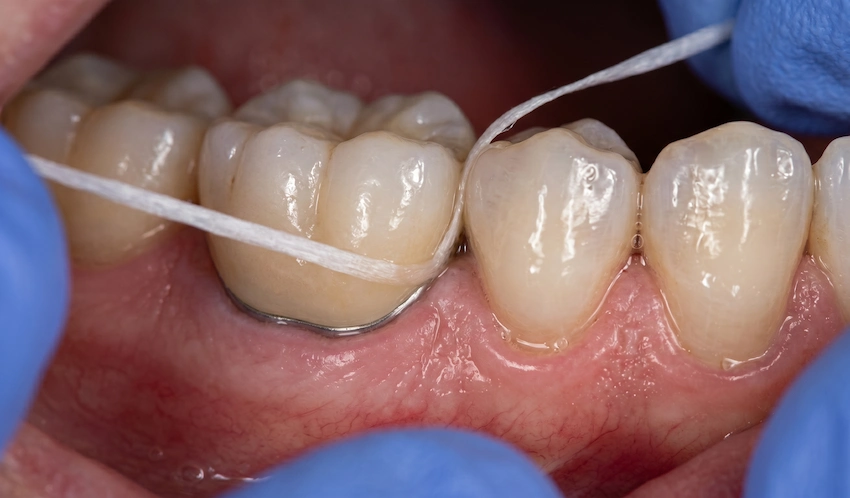
Porcelain veneers are glued only to the front of the natural tooth. The critical point for cleaning is the margin, i.e., the minute line where the ceramic is touching the natural tooth.
But wait, there is more to it than that. Once plaque is on the margin, it continues to be a source of bacteria that can cause the underlying natural tooth to decay. Eventually, the veneer might have to be replaced. It is a fact that Dentist Polen Akkılıç and her staff strongly advise against vigorous flossing. If you use the floss extensively between the teeth, you risk damaging your precious gums, and the fragile edges of the ceramic can even chip.
You need to be very gentle. Just slide floss gently through a gap between the teeth. Bend the floss to make the letter “C”. Wipe the plaque off gently. Never yank the floss upwards against the edge of the veneer.
The Implant Rule: Guarding the Titanium
Cleaning an implant is very different from cleaning a natural tooth. Implant gums are much more fragile and easily hurt. Standard flossing can force harmful bacteria deeply if you push down too hard and the gum seal breaks.
Professor Doctor Coşkun Yıldız makes the point about the necessity of a dental work cleaning routine matching your type of dental work. In terms of single implants, special implant floss must be used. It is thicker, softer, and spongier. If you have full-mouth implants or connected bridges, floss threaders and gentle water flossers have to be an integral part of your oral care.
Comparing Your Daily Cleaning Tools
We created a detailed educational table to help you understand your daily cleansing routine more easily.
| Tool | Good for Veneers? | Good for Implants? | Safety Warning |
| Regular String Floss | Yes | No (Can break the gum seal) | The edges can be damaged by snapping |
| Thick Sponge Floss | Yes | Yes | Very safe |
| Water Flosser | Yes (use low pressure) | Yes | Safe if aimed correctly |
| Little Gum Brushes | Yes (If you have space) | Yes (Must have plastic wire) | Bare metal scratches implants |
| Floss Threaders | Not necessarily | Absolutely required for bridges | Very safe |
Best Practices for Daily Care
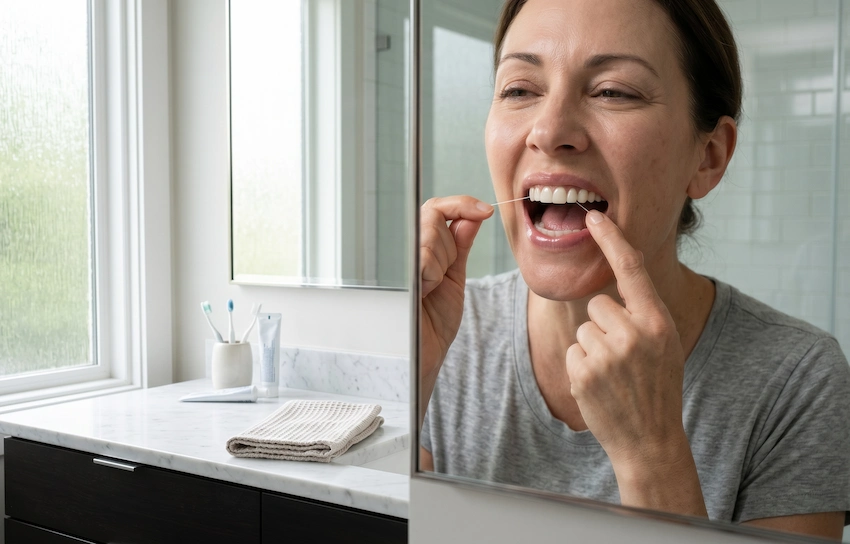
Anyway, how do you do it perfectly every night?
- Perfect Angle: When you use a water flosser, target the water jet directly at the gumline at a 90-degree angle. Never point the water jet down deep into the gum pocket of the implant.
- Always Use Wires with a Covering: If you decide to clean between the teeth with a small interdental brush, check the wire. It must be plastic or nylon-coated. The exposed bare metal will cause permanent scratches on the titanium surface of the implant. These scratches will make it easy for bacteria to hide and develop.
- Pull the Floss Through: Be careful not to use the classic “pop” to pull the floss back up through a gap where the veneers are close together. Instead, you should push the string all the way through the opening and out by the side. This will save the precious ceramic from being damaged.
Patient FAQ: Speaking with the Doctor
If you must, only if you take extreme care. Waxed floss is easier to work with precisely because it slides better. Just make sure that you don’t perform harsh “snapping” in the process. Slide it down, make a C-shape, clean the side, and pull it gently out.
Do not think healthy implant gums can bleed. Bleeding is the sign that your gums are swollen and inflamed at an early stage. We recommend that you keep flossing, but change to a water flosser at the lowest setting. Also,o call us so that we can do a tissue examination.
They help in different areas. But if you have connected teeth from one end to another, then a water flosser is fantastic. It flushes out the tiny particles of food that are stuck underneath the bridge and which string floss simply cannot reach.
Once per day, interdental cleaning is mandatory. Nighttime is a good choice. At night time your saliva production slows down significantly. This benefits bacteria, and eventually their numbers increase to the point where they form tartar, which is hard and stuck to the tooth surface. Cleaning at bedtime effectively prevents this.
The titanium root,t which is implanted in your bone,ne cannot be loosened simply by flossing. But if you floss rigorously, you might end up hurting the soft gums around the crown. You should always do a gentle and wide sweeping motion and never aggressive sawing back and forth.
- Aljateeli, M., & Wang, H. L. (2020). Maintenance interventions for the prevention of peri-implantitis: A systematic review. Journal of Periodontal & Implant Science, 50(4), 211-224.
- Blatz, M. B., & McLaren, E. A. (2019). Ceramic veneers: Clinical management and long-term maintenance protocols. Compendium of Continuing Education in Dentistry, 40(6), 349-356.
- Kotsakis, A. S., & Javed, F. (2018). The role of interdental hygiene in the longevity of dental implants. Clinical Oral Implants Research, 29(10), 1021-1029.
- Magne, P., & Belser, U. (2021). Biomimetic restorative dentistry: Longevity and maintenance of porcelain restorations. Quintessence Publishing.
- Smeets, R., Henningsen, A., Jung, O., Heiland, M., Hammächer, C., & Stein, J. M. (2014). Definition, etiology, prevention, and treatment of peri-implantitis—a review. Head & Face Medicine, 10(1), 34-45.

