


Missing teeth lead to jawbone loss and facial collapse over time.
What Happens to Your Jaw and Face When You Lose Teeth
Most people who visit Lema Dental Clinic are generally tired of hiding their smile or having difficulty eating their favourite meals. However, once we do a 3D scan, the conversation usually shifts to other things. A missing tooth is not just the “space” in your smile; it is the start of a change in your facial structure.
If a gap is left unfilled, your body thinks that the jawbone there is no longer necessary. So it starts to get rid of it. At our dental clinic in Turkey, Professor Doctor Coşkun Yıldız constantly uses the analogy of the jawbone and muscle to get the message across to his patients, i.e. if you don’t work it out, you lose it.
The Use It or Lose It Factor: Bone Resorption Science Explained

Stimulation is what keeps your jawbone in a good state. The moment you bite and chew, the dental root transfers the mechanical load down to the bone, which then gets a cue to produce new cells. When the tooth is lost, so is that cue.
Within a year after a tooth is extracted, there can be a bone loss of as much as 25% in that exact spot. This phenomenon called bone resorption not only remains confined to the location but may also cause the adjacent teeth to move, tilt, and eventually fall out since their support becomes compromised.
Changes in Your Appearance – The “Collapsed” Aspect
A human face will invariably resemble the jawbone that supports it. When the framework diminishes, the skin and muscles covering it will become loose and sag. This explains why individuals with numerous missing teeth usually look significantly older than their actual age.
In the clinic, Dentist Polen Akkılıç and her team regularly witness these aesthetic changes:
- Hollowed Cheeks: When the upper row of teeth and their supporting bone disappear, the cheek area folds inwards.
- “Witch’s Chin”: The chin protrudes forward and up when the lower jawbone resorbs, thus resulting in a shortened facial profile.
- Lips Become Thinner: The lips lose their thickness and become wrinkled as the teeth, which normally push them outward, disappear.
- Nasolabial Folds Get Deeper: The lines that run from the sides of your nose to the corners of your mouth (smile lines) become much more noticeable.
Comparing the Path Forward: Prevention vs. Delay
What happens if you wait? The reality is that the longer you delay treatment, the more complex the restoration becomes.
| Feature | Immediate Dental Implant | Long-Term Missing Tooth |
| Bone Density | Preserved through stimulation | Significant bone loss (resorption) |
| Facial Structure | Maintains youthful contours | “Sunken” facial appearance |
| Procedure Complexity | Standard implant surgery | May require bone grafts or sinus lifts |
| Treatment Time | Faster recovery | Extended (6-9 months if grafting) |
| Adjacent Teeth | Remain stable and straight | Shift, tilt, or become loose |
The Lema Approach: Restoring More Than Just Teeth
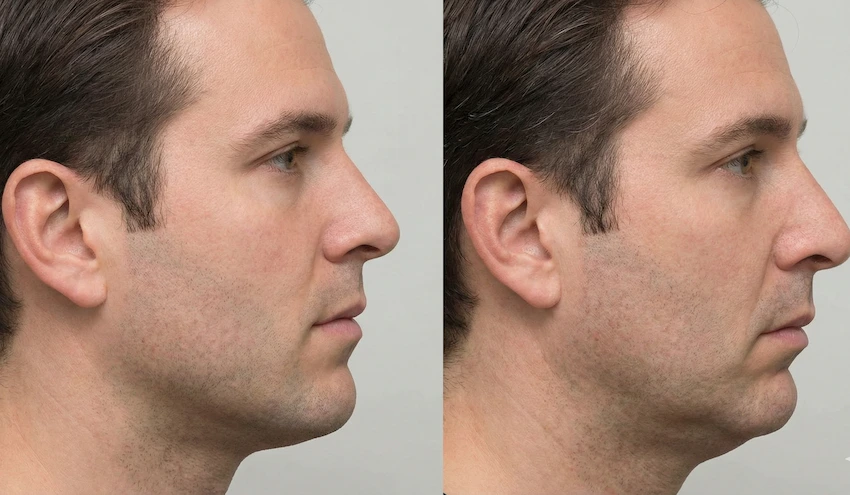
We don’t only focus on the space; instead, we consider overall facial harmony. Upon your visit to us in Turkey, our staff employs state-of-the-art digital dentistry to precisely measure the amount of bone lost.
The most effective way to stop this “aging” process is with the dental implant. Since the implant works as a titanium “root,” it deceives the jawbone into thinking the natural tooth is still there. This subsequently leads to a resumption of the stimulation process, thus stopping bone loss immediately. Even if you have already lost a significant amount of bone, Professor Doctor Coşkun Yıldız is an expert in advanced grafting techniques who can make your foundation ready by rebuilding it before the final crown placement.
“It is not giving you a tooth only; we want to bring back the architectural integrity of your face.”- Dentist Polen Akkılıç.
Frequently Asked Questions
It is hardly ever “too late,” but the treatment might be more complicated in some cases. When the jawbone has been thinned, we can do a bone graft or a sinus lift. This will add new bone material to the area to provide the implant with a firm base. In fact, many patients from abroad go to Turkey to have their complicated cases looked at.
On the contrary, removable dentures can cause even more acceleration of the bone loss process. Because they rest on the gums and keep rubbing the bone without giving it any inner stimulation, it still continues to shrink. Therefore, once the bone has resorbed, the dentures inevitably turn loose because they were originally made for the jaw that is now shrinking.
Simply put? Yes. At first, even the loss of a single molar will give the neighboring teeth the chance to “drift.” When you remove a book from a bookshelf, the rest of the books are inclined to lean, right? The same thing happens here, only that the misaligned bite (occlusion) will cause temporomandibular joint pain along with headaches.
This changes over months and years. No dramatic change will be seen overnight; rather it would be 2-5 years before you could notice the degradation of the structure irreversibly. The idea is to treat patients before the skin becomes slack due to loss of elasticity.
We blend top-notch surgical skills with cutting-edge technology. Selecting us means you are not merely undergoing a procedure but rather the whole care plan with the leading specialists such as Professor Doctor Coşkun Yıldız who exactly know the sensitive touch level between oral health and facial beauty.
- Atieh, M. A., et al. (2014). The effect of alveolar ridge preservation on the bone dimensions after tooth extraction. Journal of Periodontology.
- Carlsson, G. E. (2014). Responses of the jawbone to pressure. Gerodontology.
- Misch, C. E. (2010). Contemporary Implant Dentistry. Elsevier Health Sciences.
- Pagni, G., et al. (2012). Postextraction alveolar ridge resorption: biological title and clinical implications. International Journal of Dentistry.
- Tan, W. L., et al. (2012). A systematic review of post-extractional alveolar hard and soft tissue dimensional changes in humans. Clinical Oral Implants Research.

