


LANAP laser treatment usually takes about 1–2 hours.
Normally, when a patient steps into Lema Dental Clinic in Istanbul they are mostly with a history of bad gums, already. The tales of the old-fashioned “cut and sew” surgeries have really frightened them—sharp instruments, stitches, and the recovery that takes weeks. Then we explain to them what LANAP (Laser-Assisted New Attachment Procedure) is all about.
It is nearly impossible that they do not ask us at least once the question that is on everyone’s lips first: “How long will I have to stay in the dental chair?”
That is quite a sensible question. Your time is indeed valuable. Put simply, despite the fact that the laser works with very high surgical precision, the entire procedure is quite time-saving.
The Clock and the Laser: Breaking Down the Sessions
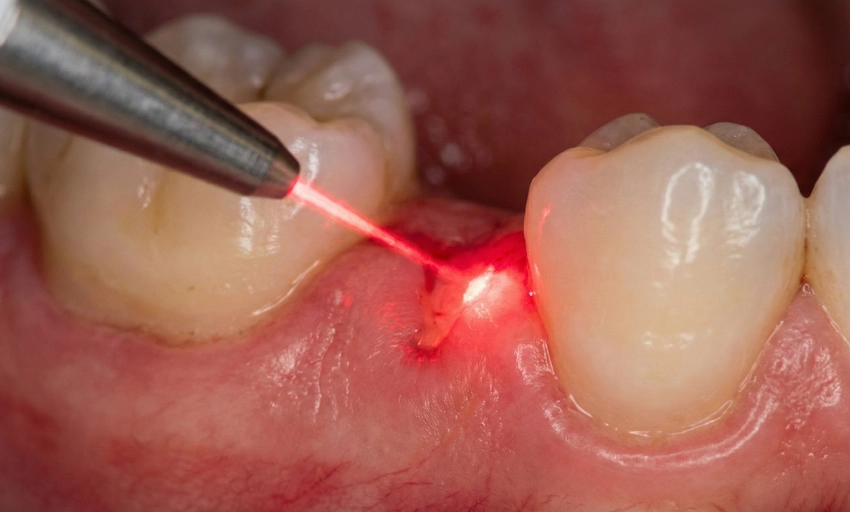
I believe that the body has the power to heal through nature, hence I do not like the idea of forcing a healing process. However, using LANAP technology, we can now, in two hours, accomplish that which required several months of follow-up in the past.
When it is about a full-mouth LANAP it is highly unlikely that more than two visits will be necessary, and each session will last for about two to three hours.
Generally, at the first meeting, we may decide to treat one half of the mouth (right side), and the other half (left side) at the second. We keep the time difference between these two meetings very short, usually up to 24 hours, or they can be on the same day with a break between them depending on the patients’ willingness.
Why Does theTreatment Take This Long?
If you imagine gum disease as a forest fire that is burning under the ground. We aren’t just “cleaning” teeth; we are using the PerioLase® MVP-7 to selectively vaporize bacteria and diseased tissue without harming the healthy “trees”. Professor Doctor Coşkun Yıldız consistently observes that the necessity for the utmost precision in the distinction between healthy and dead tissues dictates the pace of work. We proceed one millimeter at a time since we want to make sure that the source is completely clean and healthy.
Comparing Timelines: LANAP vs. Traditional Surgery
Understanding the figures might be the simplest way to explain why LANAP has disrupted the industry so significantly. Without a doubt, conventional surgery might be considered as a marathon, whereas LANAP is more of a fast sprint at the beginning, and then a slow walk to recovery.
| Feature | LANAP Laser Treatment | Traditional Flap Surgery |
| Time in Chair | 4–6 hours total | 8–10+ hours (multiple visits) |
| Bleeding & Swelling | Minimal to none | Significant |
| Downtime | 24 hours (back to work) | 5–10 days |
| Suture Removal | No stitches required | Required after 7–14 days |
| Long-term Recovery | Fast (Regenerates bone/ligament) | Slow (Repair via scarring) |
The Invisible Healing: What Happens After You Leave the Clinic?
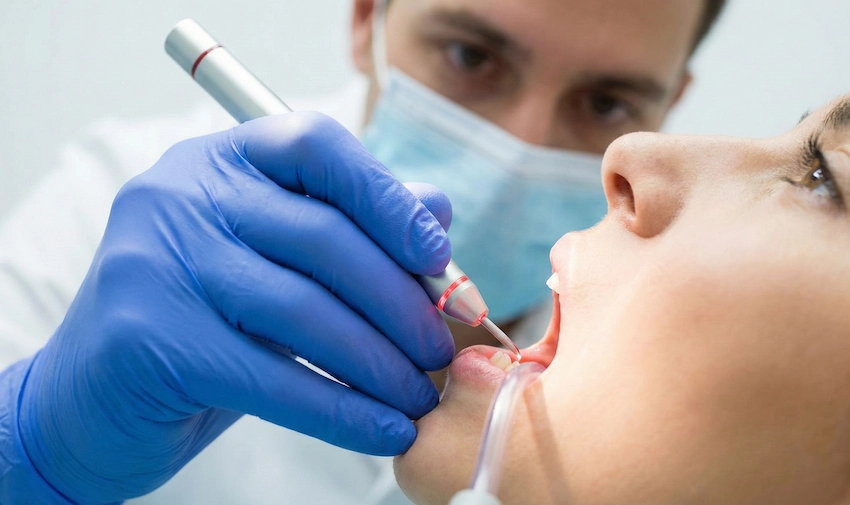
The question of “how long it takes” should not focus only on the chair time. The real enchantment happens post your departure from Dentist Polen Akkılıç and her team.
LANAP is more than just a cleaning; it’s a biological “reboot.” The laser generates a sterile, thermal blood clot. This clot serves as a highly advanced biological seal, like a scab that protects a scraped knee, but far more advanced. It provides a sealed environment where your body can actually produce bone and ligaments that gum disease tries to deplete.
Even though you may be back on a soft diet within a day, your body will be operating under the surface during the next 6 to 12 months to fully lock the teeth.
Can it Ever Be Enough in One Visit?
The truth is that each mouth has a different story to tell. If you have a few teeth with localized gum disease, we may be able to complete it in less than an hour. However, for the chronic, systemic cases that we frequently encounter here in Turkey, the two-session method is what we suggest. It is a way of “cross-contamination” prevention where bacteria from an untreated side could migrate to the newly treated areas.
But let us examine the recovery stage in more detail. Most of the patients who come to us say that they only took over-the-counter ibuprofen for a day or two. If we make a comparison between weeks of discomfort that are usually associated with traditional surgery, the “time cost” of LANAP is really quite low.
FAQ: Common Questions About LANAP Duration
Absolutely not. Most people are able to continue their everyday activities without any disruptions after the treatment. We still suggest not doing very strenuous exercises within 48 hours after the treatment; however, you should not consider your treatment as a reason for complete inactivity.
We would appreciate it if you could stick to a very light diet (like smoothies, yogurt, and mashed potatoes) for the first few days in order not to disturb the very fragile laser-induced blood clots. Generally, you can start eating solid foods again at around day 10 after carefully introducing them.
Generally, it is the same time for LAPIP (implant version of LANAP). The main goal of saving the implant is to disinfect the area thoroughly, which is practically the same pace as the normal treatment.
Here at Lema Dental Clinic, we prefer to check you a day or two after the operation for a short examination. After that, the only thing that will “steal your time” will be quarterly cleaning sessions in the first year when the newly formed bone will be controlled.
Actually, this question is so important to many people that they don’t want to let it go. We ensure your comfort by applying local anesthesia so that you only feel very little pressure. The pain after the surgery doesn’t last long and is quite minimal compared to people’s expectations because there are no incisions.
- Cobb, C. M. (2017). Lasers and the treatment of periodontitis: The role of the Er: YAG and Nd: YAG. Journal of the International Academy of Periodontology.
- Gold, S. I., & Vilardi, M. A. (1994). Pulsed laser beam effects on gingiva: A clinical and histological study. Journal of Periodontology.
- Gregg, R. H., & McCarthy, D. K. (2002). Laser Periodontal Therapy: Case reports. Dentistry Today.
- Harris, D. M. (2010). LANAP protocol for the treatment of periodontitis: A retrospective multi-center cohort study. General Dentistry.
- Yukna, R. A., et al. (2007). Histologic evaluation of an Nd: YAG laser-assisted new attachment procedure (LANAP) in humans. International Journal of Periodontics & Restorative Dentistry.

