


Six months to two years.
In the world of cosmetic dentistry, fashions keep changing, but the craving for a sparkling, unique smile keeps on being relevant. Recently, at Lema Dental Clinic in Turkey, we have noticed a great revival of tooth jewelry in particular, the famous Swarovski crystal. It is a very discreet yet very effective way of making a statement.
So the question is: how many will it be, after being placed on the tooth, bonded with that minute crystal? Is it just a temporary adornment for a holiday in summer or a long-term agreement?
What we have witnessed clinically is that the duration of a Swarovski tooth gem greatly depends not only on the crystal itself but mainly on the “micro-architecture” of the bond.
The Chemistry of the Cling: Why They Stay
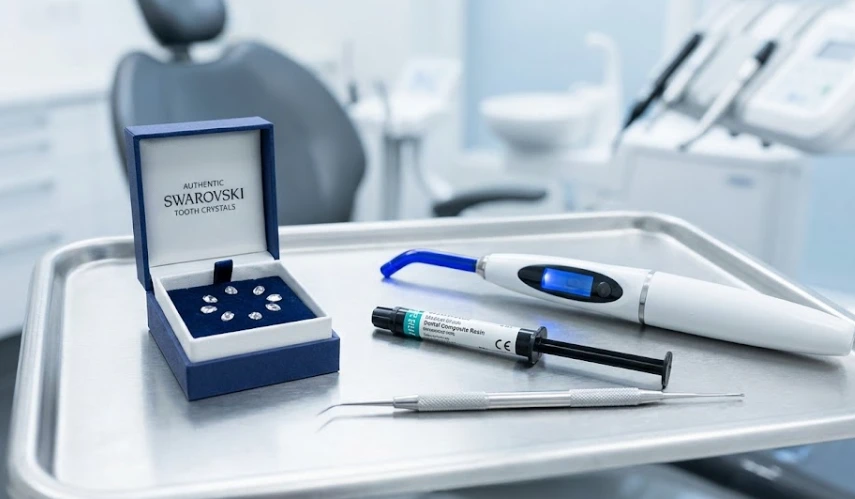
Think of a tooth gem as a tiny passenger on a very high-speed vehicle. Every day, your teeth endure thousands of pounds of pressure, acidic washes from coffee or soda, and the mechanical scrubbing of a toothbrush. To survive this, the gem needs more than just a bit of glue.
Professor Doctor Coşkun Yıldız often notes that bonding a Swarovski crystal is identical to the process of placing an orthodontic bracket for braces. We don’t “drill” the tooth. Instead, we use a medical-grade, light-cured composite resin. The resin acts like a microscopic Velcro, interlocking with the porous surface of your enamel and the flat back of the lead-free crystal.
The reality is, when applied professionally by Dentist Polen Akkılıç and her team, you should expect your Swarovski gem to last anywhere from 6 months to 24 months. We have even seen cases in the clinic where gems have remained perfectly intact for over three years.
Factors That Cut the Sparkle Short
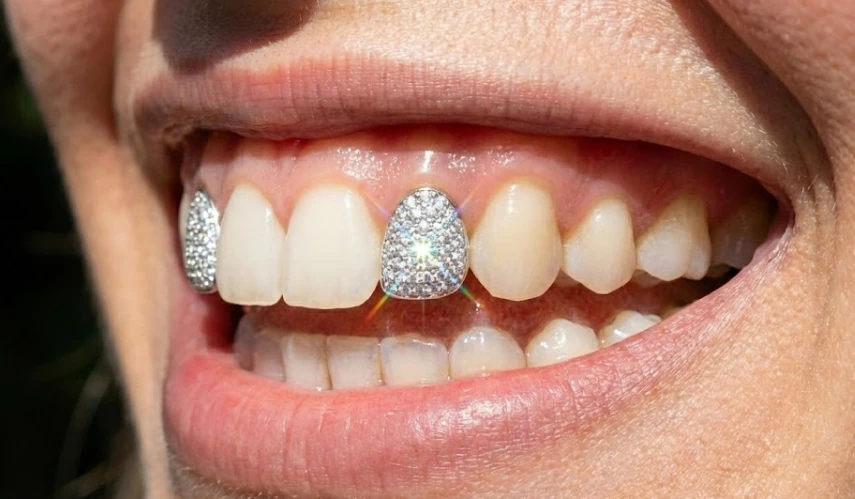
But let’s look closer at why some gems disappear after only a few weeks. Longevity is rarely a matter of luck; it is a matter of environment and habit.
- The “Crunch” Factor: If you are someone who enjoys biting directly into whole apples, hard crusty bread, or ice cubes, you are essentially “leveraging” the gem off the tooth.
- Placement Precision: If the gem is placed too close to the biting edge of the tooth, it absorbs too much mechanical force. Dentist Polen Akkılıç ensures the gem is placed in the “safe zone”—usually the upper third of the tooth—where the lip protects it and the bite doesn’t touch it.
- Oral Chemistry: Patients with high-acidity saliva or those who consume high amounts of carbonated drinks may find the resin bond weakens faster over time.
- The DIY Disaster: The most common reason for a gem falling off in days is the use of “home kits.” These kits use craft-grade glues that cannot withstand the moist, bacterial environment of the mouth.
Longevity Expectations: Professional vs. DIY
| Application Method | Typical Lifespan | Risk of Enamel Damage | Lead-Free Guarantee? |
| Lema Clinic (Professional) | 6 – 24+ Months | Zero (Reversible) | Yes (Swarovski Certified) |
| High-End Salon | 2 – 4 Months | Low to Moderate | Often No |
| DIY Home Kit | 2 Days – 2 Weeks | High (Chemical burns) | No |
| Nail Glue (Never do this!) | Hours / Days | Extreme (Toxic) | No |
Maintaining the Glow: Clinical Advice
This is what is visible at the clinic: the patients who benefit the most from their Swarovski crystals are the ones who consider a gem as an elegant piece of jewelry rather than a tool.
There is no need for a special toothbrush, and you shouldn’t neglect the area either. Actually, if you don’t clean around the gem, plaque will accumulate and a dull bacterial “halo” will form, which will make the crystal appear cloudy. We suggest using a soft-bristle toothbrush and having routine professional cleanings here in Turkey to keep the teeth and gums in top condition.
What Happens When You Want It Gone?
A common worry is that the gem is permanent. Professor Doctor Coşkun Yıldız emphasizes that professional tooth gems are 100% reversible. When you decide the “sparkle era” is over, we simply buff the resin away using a specialized polishing tool. It’s as easy as removing the adhesive left behind after taking off braces—your enamel remains perfectly intact beneath.
FAQ: Your Questions Answered by the Lema Team
Dentist Polen Akkılıç: Genuine Swarovski crystals are made of high-quality glass, not plastic. They do not “fade” or turn yellow. If it looks dull, it’s usually just a film of plaque or food. A quick professional cleaning will restore its original fire.
The Lema Clinical Team: Not at all. There is no drilling, no needles, and no pain. It is a completely non-invasive “surface” procedure that takes about 15 minutes in our clinic in Turkey.
Professor Doctor Coşkun Yıldız: Don’t panic. Swarovski dental crystals are lead-free and very small. If you swallow one, it will pass naturally through your system without causing any harm.
Yes. In fact, we encourage it. Our hygienists are trained to clean around the gem using ultrasonic tools that won’t dislodge the bond but will remove any staining around the base.
This is a bit more complex. Bonding to porcelain requires a different type of etching and adhesive than bonding to natural enamel. While possible, it is generally less “permanent” than bonding to a natural tooth. We can discuss this during your consultation.
- Featherstone, J. D. (2000). The science and practice of caries prevention. Journal of the American Dental Association, 131(7), 887-899.
- Heymann, H. O. (2002). The artistry of conservative esthetic dentistry. Journal of the American Dental Association, 133(9), 1173-1180.
- Knösel, M., et al. (2007). Durability of tooth ornaments bonded with different adhesives. American Journal of Dentistry, 20(2), 113-117.
- Maheshwari, R., & Sharma, A. (2014). Tooth jewelry: A sparkling smile. Journal of Indian Society of Pedodontics and Preventive Dentistry, 32(1), 85.
- Swift, E. J. (2011). Critical appraisal: Bonding to enamel and dentin. Journal of Esthetic and Restorative Dentistry, 23(4), 277-281.

