


Lifetime with proper daily maintenance.
Patients visiting Lema Dental Clinic in Istanbul usually look quite frail and run-down. In fact, most of them have been suffering from the problem of loose dentures or decayed teeth for a number of years without any significant relief. They come prepared to finally get the treatment. There is always that one major question that troubles them before they can go ahead: “If I undergo this treatment, will it stay that way all my life?”
That is a reasonable question to ask. An All-on-8 dental procedure not only requires your money but also your time and emotions. Thus, it is a big decision of the patients. Based on our clinical experience, with a short answer, the answer will be yes. However, you need to hear a warning alongside: “Forever” in medicine mainly depends on how biology and mechanics can work well together.
Professor Doctor Coşkun Yıldız usually uses the metaphor of a house when he is explaining why it is an incorrect question to ask how long an implant lasts. If your house has a sturdy foundation and you keep the roof in good condition, it can be your family home for generations. On the contrary, if you completely neglect the cracks, eventually, the house will be taken over by nature.
The Two-Part Lifespan: Screw vs. Bridge
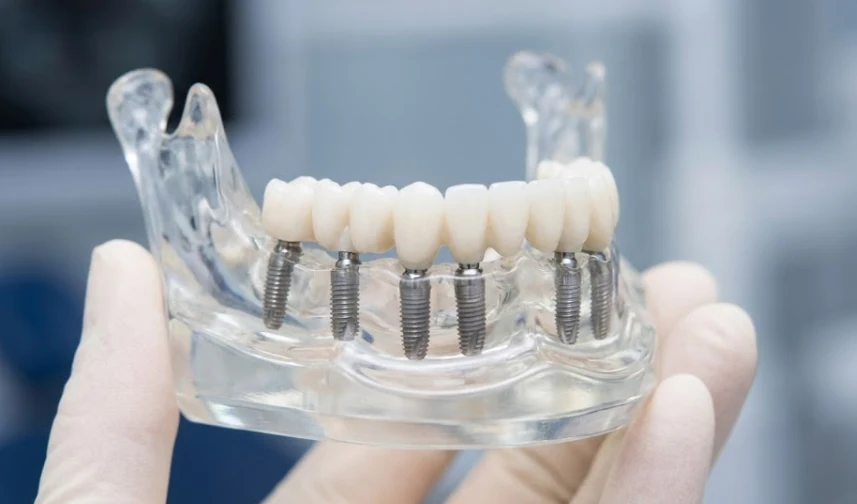
Longevity can be better appreciated when you consider that “All-on-8” is not just one single thing. It is made up of two separate pieces that have different lifespans:
- The Implants (The Foundation): These are the eight titanium posts that your surgeon will implant into your jawbone. Titanium has the property of biomaterial compatibility, so your bone gets attached to it through a process known as osseointegration. Lifespan: 25 years to a lifetime. If the bone completely integrates, these hardly ever fail unless a gum disease (peri-implantitis) that destroys the bone is present.
- The Prosthesis (The Roof): This is the Zirconia or porcelain bridge that serves as the visible teeth. A lifespan: 15 to 20+ years. Even though it is very strong in resisting wear and tears, still, daily mastication is a mechanical load. After several years, the bridge may have to be fixed, at least, slightly or even be replaced, although the implants under it still may be in perfect condition.
Why All-on-8 is the “Gold Standard” for Longevity
The truth is that the laws of physics have a big impact here. You may have heard about All-on-4. Although it works, All-on-4 concentrates the biting force of a jaw in only four posts.
By using All-on-8, we share that force through eight different points. Dentist Polen Akkılıç and her team likes to use this method with patients who have more than enough bone because the load of each implant is considerably decreased. It is similar to the situation of a heavy table being carried by no single person gets exhausted, and the risk of failure drops dramatically.
Factors That Can Shorten the Timeline
Here is what we see in the clinic that threatens the lifespan of these implants:
- Smoking: This is the arch-enemy of dental implants. Nicotine restricts blood flow, choking the bone and gum tissue that holds the implant in place.
- Systemic Diseases: Uncontrolled diabetes can hinder healing and increase infection risk.
- Bruxism (Grinding): If you grind your teeth at night, you can chip the Zirconia bridge. We often prescribe a night guard to protect your investment.

Comparing Full Arch Solutions
Understanding the trade-offs between different full-jaw solutions helps manage expectations regarding durability.
| Feature | All-on-4 | All-on-6 | All-on-8 (Lema Preferred) |
| Stability Level | Moderate | High | Maximum |
| Implant Lifespan | 20+ Years | 20+ Years | Lifetime Potential |
| Bridge Stress | High (Concentrated force) | Moderate | Low (Evenly distributed) |
| Bone Requirement | Minimal | Moderate | High (Needs healthy bone) |
| Failure Risk | Low | Very Low | Extremely Low |
FAQ: Common Questions About All-on-8 Longevity
In the vast majority of cases, no. The titanium implants are permanent fixtures. They fuse with your bone and become part of your body. Unless you develop severe gum disease that destroys the bone around them, or suffer a traumatic injury, the screws are there to stay for the rest of your life.
It is rare, but it can happen, just like a natural tooth can chip. The beauty of the All-on-8 system is that the bridge is retrievable. Dentist Polen Akkılıç can unscrew the bridge, repair the chip in our lab, or replace the bridge entirely without ever touching the surgical implants in your bone.
It doesn’t strictly disqualify you, but it acts as a major warning sign. Smoking doubles the risk of implant failure. We strongly advise our international patients to stop smoking at least 2 weeks before their trip to Turkey and ideally quit forever to protect their investment.
You treat them just like natural teeth, but with more attention to the gumline. You must brush twice a day and use a water flosser (Waterpik) to clean underneath the bridge. If bacteria accumulate around the implants, it can cause bone loss, which is the number one reason for late-stage failure.
Yes. We stand by our work. Because we use world-class Swiss and German implant brands, most carry a lifetime warranty on the mechanical components (the screws). If an implant fails due to a mechanical defect, it is replaced. We discuss all warranty details clearly during your consultation.
- Buser, D., et al. (2012). Long-term stability of contour augmentation with early implant placement following single tooth extraction: 7-year results of a prospective, randomized, controlled clinical trial. Journal of Clinical Periodontology, 39(12), 1097-1103.
- Maló, P., et al. (2011). A longitudinal study of the survival of All-on-4 implants in the mandible with up to 10 years of follow-up. Journal of the American Dental Association, 142(3), 310-320.
- Adell, R., et al. (1990). A 15-year study of osseointegrated implants in the treatment of the edentulous jaw. International Journal of Oral Surgery, 10(6), 387-416.
- Simonis, P., et al. (2010). Long-term implant survival and success: a 10-16-year follow-up of non-submerged dental implants. Clinical Oral Implants Research, 21(7), 772-777.
- Pjetursson, B. E., et al. (2012). A systematic review of the survival and complication rates of all-ceramic and metal-ceramic reconstructions after an observation period of at least 3 years. Clinical Oral Implants Research, 23(s6), 22-38.

