


Color selection is based on skin tone and natural tooth color for a natural smile.
Can you believe it? We all desire that cinematic Hollywood glow. But at Lema Dental Clinic, we are witnesses of a different reality daily: bright white is not always the best choice. A smile that is reminiscent of a piano keyboard or freezer doors happens exactly when the color selection process is given no individual consideration at all.
In fact, authentic aesthetic dentistry is much less like painting a wall and is more about restoring a masterpiece. It is all about achieving harmony. If you come to us in Turkey, besides choosing a color from a chart, you are basically transforming one of the main elements of your appearance – how light interacts with your face.
The “Invisible” Science of Tooth Color
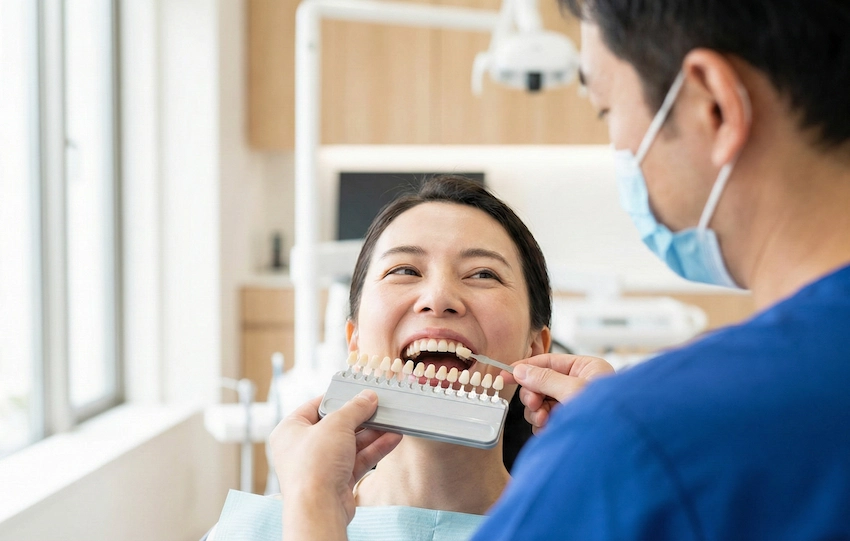
Most people simply take for granted that teeth are white. In fact, a natural tooth under a microscope is like a complex prism. It has features such as translucency, fluorescence, and opalescence.
Imagine your tooth enamel as a frosted glass window. It doesn’t really have its own color; instead, it changes the color of the light that passes through it. The color actually comes from the dentin – the layer underneath – which is what gets seen through that ‘frosted glass.’ If we just put an opaque white veneer on top, you lose the whole idea of depth. What you get is something flat and dead.
The Three Dimensions of Your Smile
At Lema Dental Clinic, Dentist Polen Akkılıç and her team do not only consider whiteness. They assess three essential dimensions, namely:
- Hue: The color category (mostly different shades of yellow or gray).
- Chroma: The intensity or vibrancy of the color.
- Value: The degree of brightness or lightness.
Value is the most significant element. Teeth look unreal if the value is too high. If the value is too low, they appear to be gray and old. Achieving this precise balance is what turns an ordinary dental job into a Lema Dental Clinic masterpiece.
How We Select Your Shade at Lema Dental Clinic
The process is not a guessing game. It is a strict clinical protocol. Environment plays a vital role in the success of color selection just as a color selection tool does, Prof. Dr. Coşkun Yıldız often remarks.
Once you take a seat in our chair, here is what is done:
- Lighting Control: We never select a shade under the normal yellow lights in a room. We make use of color-corrected lighting (5500K) that resembles natural daylight at noon. Eyes can be deceived by standard bulbs where yellow teeth may appear white or vice versa.
- The Clean Slate: We require the patients to remove bright lipstick or colorful clothes (we might put a neutral gray bib on you). For instance, bright red lipstick makes the brain think that teeth are greener due to contrast.
- Digital Verification: Human eyes, although amazing, get tired quickly. The eye loses the ability to distinguish color after about 7 seconds of looking at a tooth. We therefore employ digital spectrophotometers – devices that “read” the color frequencies of your adjacent teeth to produce the perfect match – in addition to the human eye.
Material Matters: Zirconia vs. E-max
Material choice greatly affects how you see color. Check out the screenshot:
| Feature | E-Max (Lithium Disilicate) | Zirconia (Zirconium Dioxide) | Composite Resin |
| Translucency | High (mimics natural enamel best) | Medium to low (more opaque) | Medium |
| Best Used For | Veneers and front teeth | Crowns and bridges (high strength) | Minor repairs and bonding |
| Light Reflection | Dynamic (changes naturally with light) | Bright (strong light reflection) | Flat (absorbs light over time) |
| Stain Resistance | Excellent | Excellent | Moderate (can stain like natural teeth) |
The “Turkey Effect”: Why Expertise Matters
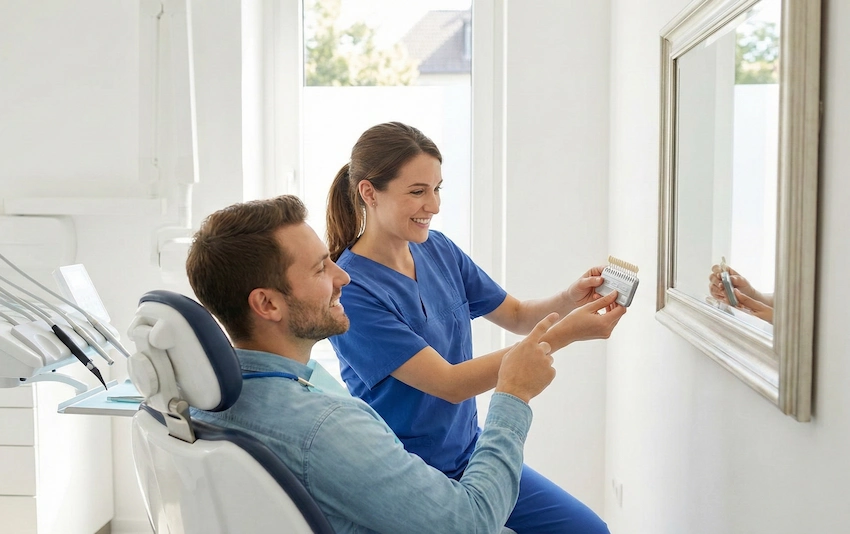
You might ask, what motivates thousands of people to fly to Türkiye? It’s not just cost; volume and variety are also important.
At the same time, our teams can handle thousands of smile makeovers a year. It is like a walk in the park for us after going through every skin tone, every lip line, and every facial structure once.
The shade is always blended with the sclera, the whites of your eyes here at Lema. When your teeth are way too white compared to your eyes, your smile strongly dominates your face. If they are a bit darker, you look worn out. Dentist Polen Akkılıç’s mission is to discover that ‘invisible’ harmony when people notice that you look good, but they are not able to tell the reason for it.
Frequently Asked Questions
For a show, it is technically possible and in fact, I would recommend it only in that case. ‘The whitest white’ often looks fake in natural sunlight. We make a habit of blending the production of shades- slightly brighter tones at the center and slightly warmer tones towards the gums- to imitate nature. It is as if you were born with it rather than buying it.
Top-notch porcelain veneers, like the ones we use at Lema, are completely stain-resistant. They are just like glass tiles. However, the tooth below or beside them can get stained. So, maintaining good dental hygiene after the treatment is incredibly important.
Such an eye phenomenon is called retinal fatigue. For example, if I focus on your toothbrush colored yellow-toned tooth for an extended time, my eyeswill first begin to decline yellow from the image to make up for the fact. On this basis, the tooth will be presented as whiter than it really is in my perception. We do a quick look, a decision, looking away at a grey card to reset our eyes, and looking back.
Definitely. “Pink Aesthetic” is the term. If you havepigmented or inflamed gums that contrast differently, you might need gum treatment first to get a beautiful new smile, in which the health is the natural background, thus the white naturally pops.
It is generally quite short – only about 15 to 20 minutes – but it is very intense. We take pictures, use shade standards, and occasionally perform a ‘mock-up’ meaning we put a temporary material so that you may visualize the color in your mouth before the production of the final ceramics.
- Chu, S. J., Trushkowsky, R. D., & Paravina, R. D. (2010). Dental color-matching instruments and systems. Journal of Dentistry, 38(Supp 2), e2-e16.
- Joiner, A. (2004). Tooth colour: a review of the literature. Journal of Dentistry, 32(Supp 1), 3-12.
- Paravina, R. D., & Powers, J. M. (2004). Esthetic Color Training in Dentistry. Mosby.
- Stephen, S. J. (2002). Fundamentals of color: Shade matching and communication in esthetic dentistry. Quintessence International, 35(1), 12-24.
- Vichi, A., Ferrari, M., & Davidson, C. L. (2004). Color and opacity variations in three different resin-based composite products after water aging. Dental Materials, 20(6), 530-534.

