


Facial anatomy dictates tooth shape.
Deciding on a new smile is almost exactly like finding the right frame for a masterpiece. If a frame is too heavy, it overpowers the artwork. If it is too fragile, the piece loses its effect. When patients initially come to our office, they most of the time have photos of celebrities with them and want to copy a star’s smile. However, a smile that shines on one person may look totally unnatural on another person.
The question still stands: how can we figure out the exact geometric shape that will give you the highest level of confidence? The answer lies in the structure of your natural facial features.
The Rule of Inverse Proportions
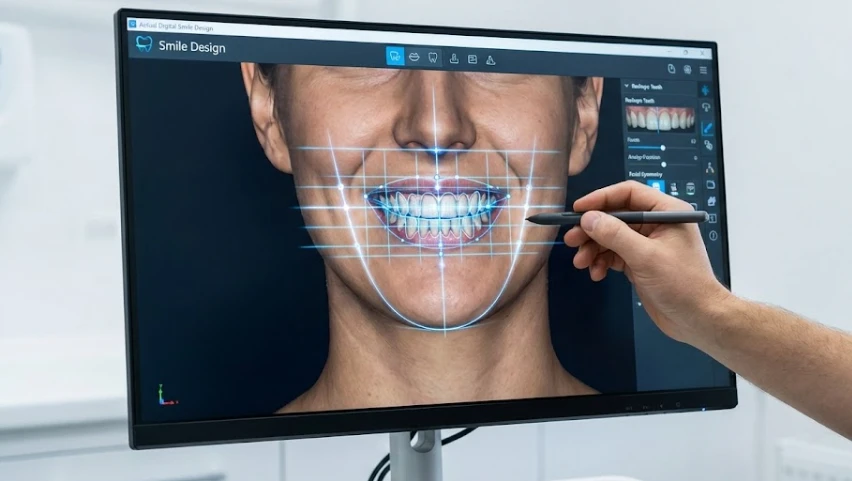
As a principle in aesthetic dentistry, we most of the time consider one fundamental rule: your central incisors or two front teeth should typically have a shape that is the inverse (opposite) of your face shape.
Try to visualize your face as a triangle turned upside down, a circle, or a square. If your face is naturally round, then sharply squared teeth might bring a visually disturbing effect. On the contrary, slightly longer and narrow teeth with rounded edges will have the effect of visually lengthening your face thereby giving it a slim look which is very natural and pleasing.
Professor Doctor Coşkun Yıldız is quite frequent in reminding that the most beautiful smiles are always those that follow the patient’s existing bone structure. We are not simply fixing teeth; we are creating a balance of the entire lower third of the face.
Matching Personality to Porcelain
What we discover at the clinic is that, going beyond the bone structure, the shape of your teeth sends out subconscious signals portraying your personality. Dentistry practitioners in many cases have divided tooth shapes into distinct “styles” which are determined by the line angles and embrasures (small spaces between the tips of teeth).
- Aggressive/Dominant: Flat, sharp, and square. These imply power and authority.
- Softened/Youthful: Rounded edges with a slightly longer central incisor. These show warmth and a willingness to approach.
- Enhanced/Dynamic: A combination of flat central teeth and gently curved canines. This brings a neat, sophisticated appearance.
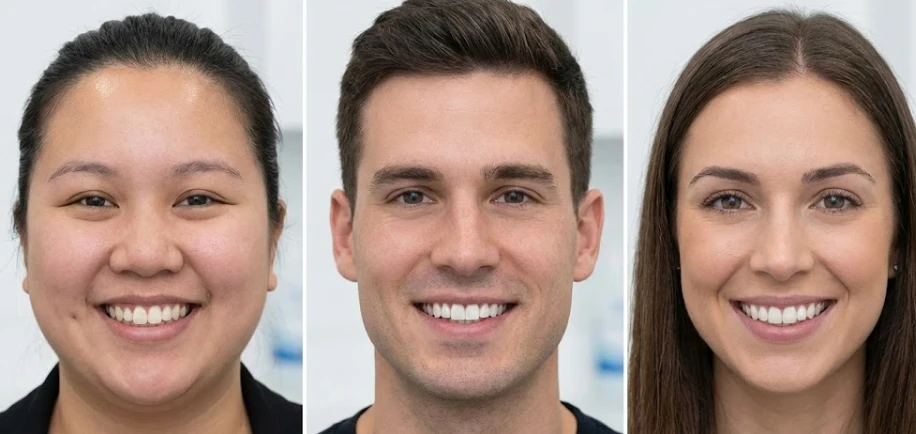
The Face-to-Tooth Blueprint
And to help you picture this therapeutic approach, here is one aesthetic standard guideline:
| Facial Shape | Recommended Tooth Geometry | The Visual Effect |
| Round / Oval | Longer, narrower teeth with rounded edges. | Slims the face, adds vertical length, and softens the jawline. |
| Square / Angular | Rounded, softer canines and incisors. | Reduces harshness and balances a strong, prominent jaw. |
| Heart-Shaped | Shorter, slightly wider teeth. | Adds necessary width to the lower half of the face to match the forehead. |
| Long / Rectangular | Wider, more substantial teeth with flat edges. | Adds lateral volume, preventing the face from looking too drawn. |
Crafting Your Custom Blueprint in Turkey
But let’s look closer at the actual process. You don’t have to guess which category you fall into. When you travel to Turkey for your treatment, the burden of design is on us.
In our clinical experience at Lema Dental Clinic, digital precision removes all the guesswork from cosmetic restorations. Dentist Polen Akkılıç and her team utilize advanced 3D facial scanning and digital smile design software. It’s essentially a complete facial mapping – lips, cheekbones, the whites of your eyes, and even the overall skin tone are carefully examined. We then take your picture and digitally place porcelain veneers or crowns to it. We can work on a very fine level of detail and change the length, width, and even the curve of each tooth until everything is so beautifully balanced that it’s perfect.
Top Inquiries on Selecting Your Perfect Smile Design
Yes, it certainly can. As we age, our natural teeth wear down, becoming flatter and shorter, which can prematurely age the face. By designing slightly longer central incisors with youthful, rounded edges, we can create a highly effective “anti-aging” visual lift for the entire lower face.
Absolutely. We create a “mock-up” using a temporary composite resin. We apply this directly over your teeth so you can look in the mirror, speak, and smile. If you feel the canines are too sharp or the front teeth are too square, we modify the design right there in the chair before the final ceramics are milled.
Minor adjustments to the length or thickness of your teeth can temporarily affect how you pronounce certain syllables (like “s” or “f” sounds). However, because we design the teeth to harmonize with your natural oral anatomy, your tongue and lips typically adapt within just a few days.
Shape and color are intimately connected. A bright, opaque white can make teeth look larger and bulkier, while a translucent, natural shade gives the illusion of delicacy. We select the shade based on the whites of your eyes, your skin’s undertones, and the exact geometric volume of the new teeth to ensure they look luminous, not artificial.
For our international patients, the entire transformation—from the initial 3D scan and shape selection to the final bonding of your custom veneers or crowns—is comfortably completed within 5 to 7 days at our clinic.
- Bhuvaneswaran, M. (2010). Principles of smile design. Journal of Conservative Dentistry: JCD, 13(4), 225–232.
- Dong, J. K., Jin, T. H., Cho, H. W., & Oh, S. C. (1999). The esthetics of the smile: A review of some recent studies. International Journal of Prosthodontics, 12(1), 9-19.
- Frush, J. P., & Fisher, R. D. (1958). The dynesthetic interpretation of the dentogenic concept. The Journal of Prosthetic Dentistry, 8(4), 558-581.
- Lombardi, R. E. (1973). The principles of visual perception and their clinical application to denture esthetics. The Journal of Prosthetic Dentistry, 29(4), 358-382.
- Nold, S. L., Pelzer, C., & Schmage, P. (2014). The relationship between facial shape and the morphology of the central incisor. Journal of Prosthodontics, 23(6), 468-473.

