


Implants protect your jawbone by preventing bone loss after tooth loss.
Having a tooth missing is not just a space in your smile. It is also a biological alarm. Sure, most folks fret about a missing tooth’s appearance. Totally natural, that’s what a lot of people think. But, if you look beneath your gums, an issue is brewing without you even knowing it from the moment a tooth is lost.
The fact is, bone residing in your jaw requires regular stimulation to maintain its robustness. When you eat, drink, or talk, tooth roots communicate mechanical loading to the bone. It can be compared to weightlifting in a gym. When you work out a muscle, it remains strong and healthy. When you cease, it atrophies. Your jawbone, in fact, behaves the same way.
Why Jawbones Shrink
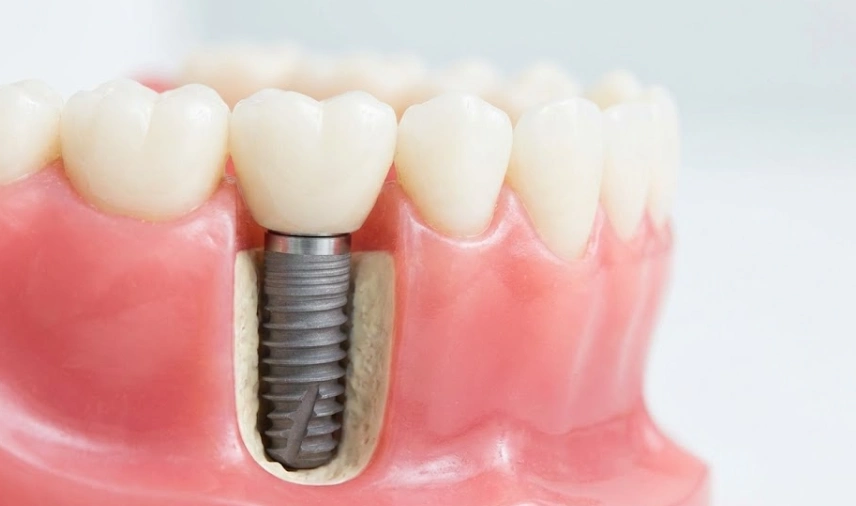
When left without a root that regularly gives it a workout, the body assumes that the jawbone is not needed any longer. It initiates a series of changes called resorption. In layman’s terms, the body is breaking down bone and removing it. Calcium is extracted and redistributed throughout the body.
This is what we experience at the clinic. Patients come to us long after having lost their back teeth. They are annoyed because their facial appearance is older or “sunken.” They see that their chin is lifted and is coming closer to their nose. This is not a sign of normal skin aging. It happens tthat he lower part of the face is closing in due to a lack of bone support. After only losing a tooth for one year, you may lose up to 25% of the width of your jawbone.
Stopping the Clock: The Titanium Root
It is this quick aging that dental implants of today can counteract. Dentures and dental bridges are merely placed over the gums. They can appear quite good, but they do not at all stimulate the bone underneath.
Professor Doctor Coşkun Yıldız frequently points out that implants are the only dental procedure that can preserve and prolong natural bone actively. A controlled surgical procedure is carried out to insert a titanium post into your jawbone. Your nervous system is fooled by this, and the implant is perceived as one natural root.
When you undergo recovery, a splendid chain of events, osseointegration, takes place. The bone that is alive will firmly hold on to the titanium. Your jaw will work out on a daily basis after healing. This is how bone loss is stopped.
What If You Waited Too Long?

Lots of our international patients are left with one question: what if you have been delayed for years before seeking consultation? Classic dental implants require sufficient quantities of healthy bone for firm fastening. This is the same idea as a house being constructed. A concrete foundation that is strong and solid is needed.
In the opinion of our clinicians working at Lema Dental Clinic, located in Turkey, a drastic bone loss does not mean you have no options left. Should the thickness of your upper jaw be minimal, the weak bone can be avoided entirely. The employment of advanced Zygomatic or Pterygoid implants is done when possible. What we actually do is insert those very long titanium posts into your cheekbones. We know for certain that the cheekbone is very hard and does not shrink. Although this operation is complicated, it bypasses the requirement for extensive bone grafts and allows you to chew normally immediately.
Your Treatment Timeline
Taking action at the right time is very important for your well-being. Dentist Polen Akkılıç and her team prioritize the initiation of treatment. This preserves one’s natural bone, and at the same time, the operation is way less complicated. Whenever we receive patients from abroad, our main concern is the earliest placement of the implants.
Bone Preservation Comparison
| Time Since Tooth Loss | Expected Bone Health | Recommended Strategy at Lema Dental Clinic |
| Immediate (0–3 months) | Very healthy, no bone loss | Standard titanium implant with the easiest recovery. |
| 1–3 years | Moderate bone loss, up to 25% | Implant placement with a small bone graft. |
| 5–10+ years | Severe bone loss, thin and short bones | Complex grafting, sinus lift, or cheekbone implants. |
Frequently Asked Questions
Certainly, you will. Your body is highly efficient. It will not continue to maintain bone in an area that is no longer active. The rate of decline varies with each individual, but the absence of an implant root inevitably leads to bone loss.
Yes, you can. Running a long time with dentures facilitates bone loss as they cause the gums to rub. Nevertheless, current dentistry opens the door for us to come up with bone grafts to rebuild your bone and to utilize special implants that grip other facial bones. We do this very regularly here in Turkey.
On the contrary. Bone welding to titanium is an undercover work. You will be clueless about its occurrence. Mild pain is felt only due to the surgery. Surgical pain subsides in a few days.
Jaw protection can be maintained by dental implants for a lifetime. Adequate oral hygiene is necessary. Titanium will never wear down. Hence, as gums remain in good health, bone strength remains.
Your sinus membrane can be likened to the thin skin present inside an eggshell. It is located directly on top of your upper back teeth. After the loss of those upper teeth, unfortunately, the bone starts to shrink. Then, the air-filled sinus comes down. To make sure an implant is placed in a safe way, what we do is gently lift that membrane. Under it, a bone graft is put for the purpose of building a thick, safe foundation.
- Albrektsson, T., Brånemark, P. I., Hansson, H. A., & Lindström, J. (1981). Osseointegrated titanium implants: requirements for ensuring a long-lasting, direct bone-to-implant anchorage in man. Acta Orthopaedica Scandinavica, 52(2), 155-170.
- Carlsson, G. E., & Persson, G. (1967). Morphologic changes of the mandible after extraction and wearing of dentures: a longitudinal, clinical, and x-ray cephalometric study covering 5 years. Odontologisk Revy, 18(1), 27-54.
- Misch, C. E. (2004). Dental Implant Prosthetics. Elsevier Mosby.
- Schropp, L., Wenzel, A., Kostopoulos, L., & Karring, T. (2003). Bone healing and soft tissue contour changes following single-tooth extraction: a clinical and radiographic 12-month prospective study. The International Journal of Periodontics & Restorative Dentistry, 23(4), 313-323.
- Tallgren, A. (1972). The continuing reduction of the residual alveolar ridges in complete denture wearers: a mixed-longitudinal study covering 25 years. The Journal of Prosthetic Dentistry, 27(2), 120-132.

