


Fluoride myths vs. facts for children.
If there is one subject in kids‘ dentistry that really gets heated debates going even before the patients are called in, it is fluoride. Some parents see it as the miracle mineral that has liberated the whole generation from the “drill and fill” cycle, while, on the other hand, there are those who fear it, and their feelings have been fed by the internet rumors about its toxicity and necessity.
There is no doubt that taking care of your child’s oral health should not be like going through a minefield of misinformation. At Lema Dental Clinic, we believe that being open and honest with our patients is better than just following the latest trend. Professor Doctor Coşkun Yıldız, when he talks to the parents in our Istanbul dental office, usually tells them this basic fact: fluoride is not a chemical “additive,” but a biological need for the formation of strong enamel.
How ‘Armor’ Analogy Explains Fluoride Action?
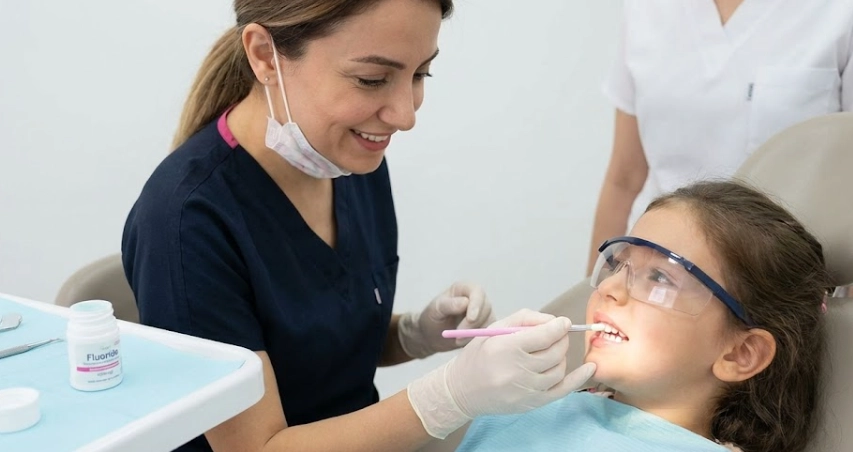
Indeed, a tooth can be seen as a tiny fortress that is regularly attacked. Acid-producing bacteria and sugary foods act as the weapons of attack that gradually leach the minerals from the enamel. This is demineralization, a process constantly occurring in the teeth due to the attack of acid on the enamel.
Fluoride is the ally from within the walls. It chemically associates with the tooth minerals to produce a new, tougher crystal – fluorapatite.
However, the presence of fluorapatite makes a big difference since it is much more resistant to acid attack than the original hydroxyapatite which is the mineral component of tooth enamel. At Lema Dental Clinic, we have observed through our clinical case studies that children undergoing regular and controlled fluoride applications possess an enamel that can be considered as having an “armor,” against a diet high in sugar and acidic food.
Myth 1: “Fluoride is Toxic for Children”
This is the perception that has been hindering the acceptance of fluoride-based therapies for kids since long. The question is, is it dangerous? As with most things in medicine, whether it is Vitamin D or plain water, the risk lies with the quantity and not with the nature of the substance itself.
The truth is that the fluoride varnish applied by Dentist Polen Akkılıç and her team is very concentrated but because it is used in such tiny amounts, there is no risk of the substance circulating in the body. It is a local application that is “fixed” on the tooth surface very quickly by the saliva. In a way, they are completely different from the old-style fluoride rinses which were quite intensive and, therefore, did not stay on the tooth surface for very long.
Myth 2: “If My Child Brushes with Fluoride Toothpaste, They Don’t Need Treatments”
Brush washing, so to speak, is the base of oral health, but it is rarely enough to give deep protection, a good analogy would be home’s brushing is a car wash daily, whereas in-office fluoride treatment in Turkey is like a high-grade ceramic coating.
Still, what we notice during our practice is that the majority of kids do not brush their teeth for a sufficient duration or properly to the extent that the small amount of fluoride in the toothpaste can actually get into the tooth enamel sufficiently. The treatments administered by professionals give a “storage” of fluoride that keeps the teeth protected for a couple of weeks following the treatment session.
Professional Varnish vs. Over-the-Counter Care
| Feature | Professional Fluoride Varnish | Fluoride Toothpaste (Home) |
| Concentration | High (22,600 ppm) | Low (1,000 – 1,450 ppm) |
| Application Frequency | Every 3–6 months | Twice daily |
| Method | Painted on by a clinician | Brushed on and spit out |
| Safety | High (controlled by professional) | High (if not swallowed in bulk) |
| Primary Benefit | Deep remineralization & cavity reversal | Daily maintenance |
Myth 3: “Fluoride Causes White Spots (Fluorosis)”
Dental fluorosis – the whitening of teeth – is real but it happens mostly when a lot of fluoride is swallowed during those years when teeth are still developing.
Treatment which is professionally supervised and applied at the surface of the tooth, is safe regarding fluorosis because only a small amount of fluoride is taken in and the fluoride is not intended to be ingested. Dentist Polen Akkılıç and her staff are very skilled and experienced in assessing your child’s needs so that they can make the correct decision as to how often fluoride should be applied, thereby giving your child the benefits without the risk to their appearance.
FAQ: Direct Answers from the Lema Dental Team
The reality is that sugar isn’t the only culprit,” says Professor Doctor Coşkun Yıldız. “Natural acids in fruit juices, starches in bread, and even the simple act of snacking throughout the day create an acidic environment. Fluoride provides a safety net for those ‘hidden’ acids.
The amount of varnish used is so small that even if a child swallowed the entire dose, it wouldn’t reach a level of toxicity,” notes Dentist Polen Akkılıç. “Furthermore, the varnish hardens immediately, making it nearly impossible to swallow in a significant quantity.
The question remains a popular one. While substances like hydroxyapatite toothpaste are showing promise, they lack the fifty years of rigorous, global clinical data that supports fluoride’s ability to prevent and even reverse early-stage cavities. At Lema Dental Clinic, we stick to what is scientifically proven to work.
As soon as the first tooth erupts,” the team suggests. “Early intervention is the key. Protecting those primary (baby) teeth is essential because they hold the space for the permanent teeth that follow.
Yes, but we usually recommend sticking to soft foods and avoiding hot liquids for the rest of the day,” explains the clinical staff. “This gives the varnish the best chance to bond deeply with the enamel without being scraped off prematurely.
- American Academy of Pediatric Dentistry. (2023). Guideline on Fluoride Therapy. Reference Manual of Pediatric Dentistry.
- Centers for Disease Control and Prevention (CDC). (2021). Other Ways to Get Fluoride. Oral Health Basics.
- Marinho, V. C., et al. (2013). Fluoride varnishes for preventing dental caries in children and adolescents. Cochrane Database of Systematic Reviews.
- Walsh, T., et al. (2019). Fluoride toothpastes of different concentrations for preventing dental caries. Cochrane Database of Systematic Reviews.
- Weyant, R. J., et al. (2013). Topical fluoride for caries prevention: Executive summary of the updated clinical recommendations and supporting systematic review. Journal of the American Dental Association (JADA).

