


Restore Function with Fixed Implants.
For a patient, the switch from natural teeth to full-arch prostheses is not only a big change in their body but also a change in their mind. Nowadays, the field of dental restoration is evolving, and the question that is being discussed is no longer only “tooth replacement” but how to restore the complex biomechanical relationship between the jawbone, soft tissues, and the nervous system.
The decision-making for totally toothless patients at Lema Dental Clinic in Istanbul is limited to two main treatment modalities: conventional removable dentures and implant-supported fixed prosthetics. Although both methods focus on restoring the aesthetic aspect, their effects on the patient’s quality of life and the long-term health of the oral cavity differ significantly.
The Biomechanics of Comfort: Proprioception and Stability
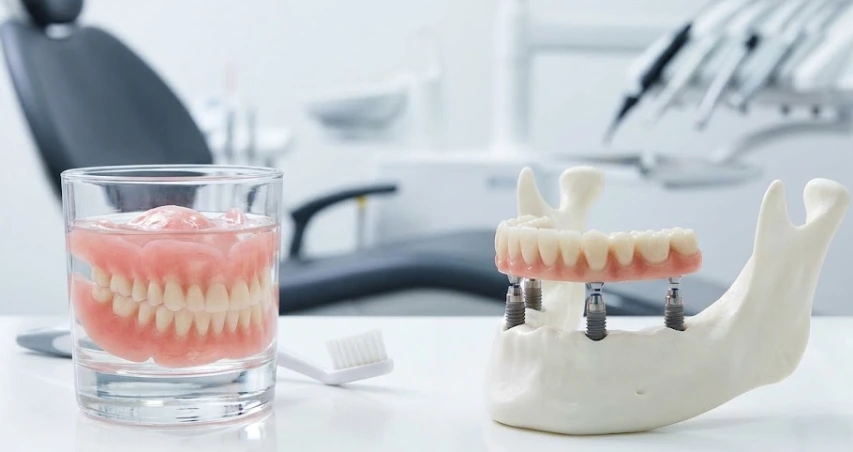
In simple terms, “comfort” can be understood as a prosthetic stabilizing solution and proprioception, which is the patient’s sweet spot in the body’s perception of oral structures.
Removable Dentures (Traditional)
Traditional removable dentures depend on atmospheric pressure, surface tension, and the control muscles for their retention. In the case of the maxillary (upper) arch, the suction is obtained by covering the palate, which therefore changes the sense of taste and temperature.
- Comfort Issue: Even a properly fitting removable denture will have a little micro-movement during speaking and chewing. This, in turn, can cause mucosal inflammation (the formation of sore spots) and a permanent psychological “awareness” of the prosthesis.
Fixed Implant-Supported Prosthetics
Permanent prosthetics, such as the “All-on-4” or “All-on-6” at Lema Dental Clinic, involve implantation and are fixed directly into the alveolar bone with titanium or zirconia implants.
- Comfort Benefit: The fact that these prostheses are fixed bricks one side off the friction against the gingiva. As Professor Doctor Coşkun Yıldız explains, fixed bridges are fabricated with a “palate-less” design, thus, the tongue can assume its normal position which results in a quicker acquisition of normal speech.
Functional Efficiency: Masticatory Force and Nutrition
When it comes to functional efficiency, it is the means to the end of the functionality, the meal processing that gives the value to the item used.
- Force Distribution: Nature provides with teeth a wide range of functions including biting with great force. Traditional removable dentures, on the other hand, which simply rest on the gum, diminish the biting force down to only around 20-25%. This inevitably leads to dietary limitations, keeping away from hard and fibrous foods.
- The Fixed Solution: Just like natural tooth roots, implant-supported fixed dentures deliver the load directly to the jawbone. It is the restoration of the capacity to chew at 80-90%. Dentist Polen Akkılıç and her colleagues point out that the change is not only about physical comfort; it is also an intervention at the level of nutrition through which the patients regain their freedom to a varied and healthy diet.
The Physiological Factor: Bone Preservation
Most probably, the most significant disparity between the two clinically is the one regarding the strength of the bone.
- Resorption with Removable Dentures: After losing the teeth, the jawbone loses the mechanical stimulus that helps it to keep its density. Sort of paradox, the very wearing of normal dentures will speed up the “bone resorption” through the pressure they put on the ridge continuously.
- Fixed Implants and Stimulation: Implants are acting as roots substitutes. During osseointegration, implants are mechanically connected with the bone thus when chewing, the implants transmit the forces to the bone which helps to maintain the facial structure and avoid the typical sagging of the facial tissues frequently seen in long-term denture wearers.
Comparative Matrix: Prosthetic Modalities
| Feature | Conventional Removable Dentures | Fixed Implant-Supported Bridges |
| Stability | Relies on suction/adhesives; prone to movement. | Stationary; fused to the jawbone. |
| Masticatory Power | Low (approx. 20-30% of natural force). | High (approx. 80-90% of natural force). |
| Palatal Coverage | Required for upper dentures (affects taste). | None; mimics natural tooth layout. |
| Bone Health | Does not prevent bone loss (resorption). | Prevents bone loss via stimulation. |
| Maintenance | Must be removed and cleaned daily. | Brushed and flossed like natural teeth. |
FAQ: Clinical Perspectives from Lema Dental Clinic
The primary constraint is bone volume,” says Professor Doctor Coşkun Yıldız. “However, with advanced techniques like sinus lifting or bone grafting available at Lema Dental Clinic, we can now provide fixed solutions to many patients who were previously told they could only wear removable dentures.
It involves a surgical component and high-precision engineering. You are paying for the implants (the hardware), the surgery, and the highly durable materials like Zirconia or E-max used for the bridge. In Turkey, we provide these premium global brands at a more accessible cost due to lower overheads, but the quality of materials remains international standard.
Yes,” states Dentist Polen Akkılıç. “Because fixed bridges do not need the ‘flange’ (the pink plastic gum part) to be as thick for suction, they can be contoured much more precisely to the patient’s facial profile, resulting in a more ‘organic’ smile.
Removable dentures often require weeks or months of practice for speech and eating. Fixed dentures usually feel “natural” within days, as the brain quickly accepts the stationary prosthetic as part of the body.
- Feine, J. S., et al. (2002). The McGill consensus statement on overdentures. International Journal of Oral & Maxillofacial Implants.
- Branemark, P. I. (1983). Osseointegration and its clinical outcomes. Journal of Prosthetic Dentistry.
- Zarb, G. A., & Albrektsson, T. (1991). Nature of implant-tissue interface. Journal of Prosthetic Dentistry.
- Misch, C. E. (2007). Contemporary Implant Dentistry. Elsevier Health Sciences.

