


No, professional scaling preserves enamel.
It’s one of the myths about dentistry I hear most of the patients telling me. You may even be one of them. You sit down, open your mouth, and when the ultrasonic scaler starts its high-pitched humming, suddenly a really scary idea comes to your mind: Isn’t this scraping away my tooth?
In truth, there’s absolutely no harm done. That said, one can see where the misunderstanding stems from. The vibration and scraping sounds coming from the scaler might, to you, be just like a “strike” on your teeth. However, at Lema Dental Clinic in Turkey, our experience has always been that the single biggest cause of damage to teeth is patients who stay away from the dentist, not damage from dental cleaning.
Let us take an analogy to explain tartar (calculus) further. If you imagine the ship’s hull having barnacles on the underside, this is analogous to the teeth having tartar. If you’re trying to dislodge barnacles from the ship by scraping with a spoon, it only results in the paint being scraped too. But dental scaling is very different these days. We apply ultrasonic vibrations that break the “barnacles” while leaving the hull intact. Enamel is, in fact, the most rigid material found in the human body – even harder than bone. So, a conventional dental cleaning does not have sufficient force to cause damage to it.
The Mechanism: Why Your Enamel Is Safe
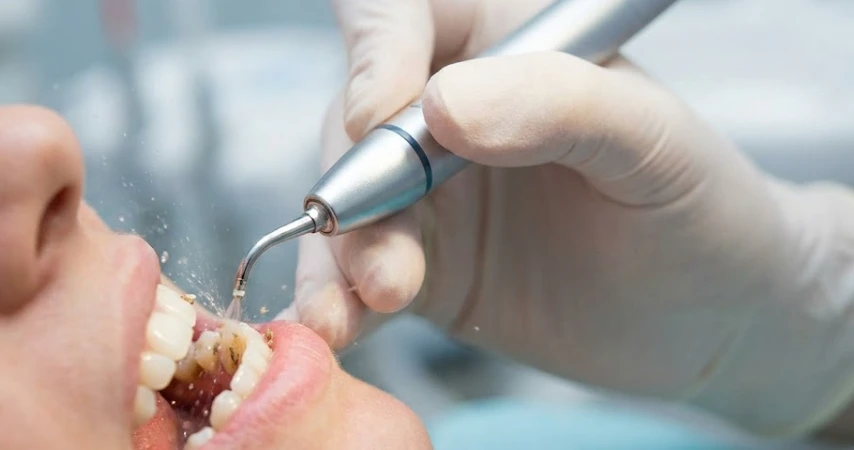
When Dentist Polen Akkılıç and her team are doing a scaling, they are not literally sanding your tooth surface. They are taking advantage of ultrasonic technology. These devices oscillate at a frequency that is specifically designed to dislodge hard deposits.
The scaler tip sprays a jet of water to get rid of the debris and keep the tooth cool. What a scaler tip is designed for is to be less hard than enamel. It’s a skilled and trained professional who knows how to control the tip, so that it only targets the hardened tartar that is the rough outer layer.
Why Do My Teeth Feel “Thinner” or Sensitive Afterward?
That’s where the confusion comes in, generally speaking. After having a deep clean, your teeth often will seem different. You might even be able to notice the spaces between your teeth more than before. In fact, what’s happening is that:
- You can compare tartar to a filthy blanket that is wrapped around your teeth. Therefore, cold air and hot beverages cannot reach the enamel at the gumline. If we remove that layer, your teeth will be essentially exposed to the elements again. So, it’s quite understandable why you would experience some sensitivity which should not, however, be regarded as damage but a tooth that has been properly cleaned and is now “breathing“.
- As soon as bacteria (gingivitis) make the gum inflamed and swollen, the tissues will fill in between your teeth. When the irritant (tartar) has been removed, the inflammation is gone and the gums return to their healthy, tight state. The “gaps” which you feel, therefore, are naturally occurring spaces that have been hidden by the swollen tissues and tartar.
The Real Risk: Leaving Tartar Alone
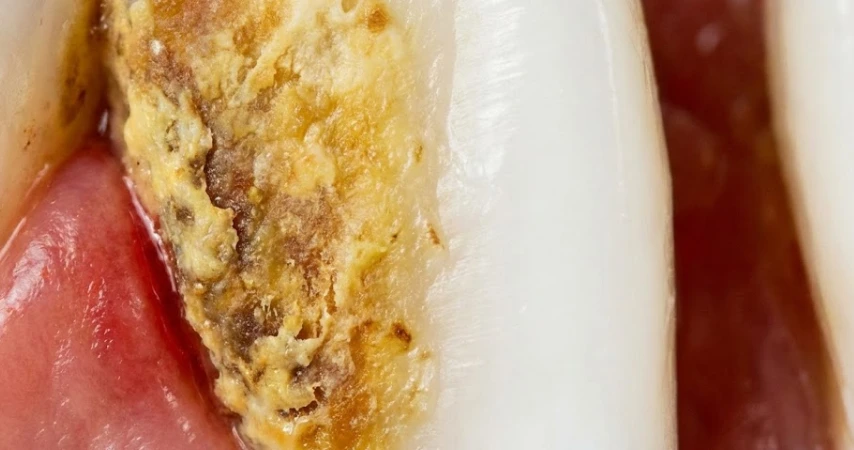
Your worry about the safety of your teeth may lead you to the most bad decision: the scaler is not your biggest enemy—the tartar is. Professor Doctor Coşkun Yıldız lays out that tartar is fundamentally “a coral reef” for bacteria. Being a rough and porous surface, it offers a perfect hiding and breeding place for bacteria, which is the main cause of gum disease.
If left unattended, these bacteria produce acids and toxins that destroy the gum and bone that hold the teeth progressively. So, if you give up going toget the cleaning done as you want to “protect your enamel“, it is the quickest way to lose the tooth entirely.
Comparing the Outcomes: Scaling vs. Neglect
In order to have a better understanding of long-term effects, we listed below some differences between regular maintenance and neglect.
| Feature | Professional Scaling (Regular) | Neglecting Tartar Buildup |
| Impact on Enamel | Safe; removes surface stains and biofilm. | Enamel remains intact but is covered by acidic bacteria that cause decay. |
| Gum Health | Reduces inflammation; promotes pink, firm gums. | Leads to Gingivitis (bleeding) and eventually Periodontitis. |
| Bone Structure | Preserves jawbone density. | Causes bone resorption (loss) due to chronic infection. |
| Tooth Stability | Teeth remain firmly anchored. | Teeth become loose as bone and gum support recedes. |
| Breath Smell | Neutral/Fresh. | Chronic Halitosis (bad breath) due to sulfur-producing bacteria. |
Top Queries on Cleaning and Enamel Integrity
Yes, but not because the dentist cut you. Bleeding during a cleaning is almost always a sign of active inflammation (gingivitis). Healthy gums do not bleed when touched. If you see blood, it means your body was already fighting an infection caused by plaque buildup. The bleeding usually stops shortly after the irritant is removed.
The polishing step uses a rubber cup and a gritty paste (prophy paste) to smooth the surface of the tooth. While this is technically abrasive, it is extremely mild. The goal is to make the tooth surface glass-smooth so that new plaque has a harder time sticking to it. It removes microscopic roughness without compromising the structural integrity of the enamel.
We strongly advise against this. Consumer “scaling tools” sold online are dangerous in untrained hands. Without the proper angle and leverage, you can slip and gouge your gums or scratch the enamel. At Lema Dental Clinic, our specialists spend years training to use these instruments safely.
For most patients, every six months is the sweet spot. However, if you have a history of periodontal disease or rapid tartar buildup, we might suggest a 3-4 month interval. It is not a “one size fits all” schedule; it depends on your saliva composition and oral hygiene habits.
Scaling is not a bleaching treatment, but it often results in a brighter smile. By removing the yellow or brown tartar deposits and scrubbing away surface stains from coffee or tea, your natural tooth color is revealed. It’s like power-washing a driveway—you aren’t painting it, just cleaning off the grime that was hiding the true color.
- Graves, D. T., & Cochran, D. (2003). The contribution of interleukin-1 and tumor necrosis factor to periodontal tissue destruction. Journal of Periodontology, 74(3), 391-401.
- Needleman, I., et al. (2015). Improving the quality of reporting of randomized controlled trials in periodontology. Journal of Clinical Periodontology, 42(3), 201-207.
- Axelsson, P., & Lindhe, J. (1981). Effect of controlled oral hygiene procedures on caries and periodontal disease in adults. Journal of Clinical Periodontology, 8(3), 239-248.
- Drisko, C. L. (2001). Nonsurgical periodontal therapy. Periodontology 2000, 25(1), 77-88.
- Van der Weijden, G. A., & Campbell, S. L. (2015). Ultrasonic versus hand instrumentation for periodontal maintenance. International Journal of Dental Hygiene, 13(2), 113-122.

