


Yes, Parkinson’s disease can affect teeth by causing dry mouth, grinding, swallowing issues, and harder oral hygiene.
Patients often come to us with a heavy heart and many concerns. For the families coping with disorders such as Parkinson’s disease, dental care is easily overlooked. They usually get more concerned about other health matters. However, the question persists: what exactly is the influence of Parkinson’s on the mouth?
Truth be told, the disease has a major impact on dental health, although indirectly. The disease does not immediately destroy tooth enamel; rather than through other means. Still, let’s take a closer look. It is the physical symptoms plus daily medications that make up a perfect storm for problems in the mouth.
We witness this firsthand at the Lema Dental Clinic in Turkey. Loss of motor skills alters the balance of your mouth. Prof. Dr. Coşkun Yıldız often says that the human mouth is a delicately calibrated machine. Once tremors and stiff muscles set in, this machine is no longer functional. At the sudden turning point, brushing teeth, something as trivial as it is, becomes quite a challenge.
Common Oral Health Complications in Parkinson’s Disease Patients
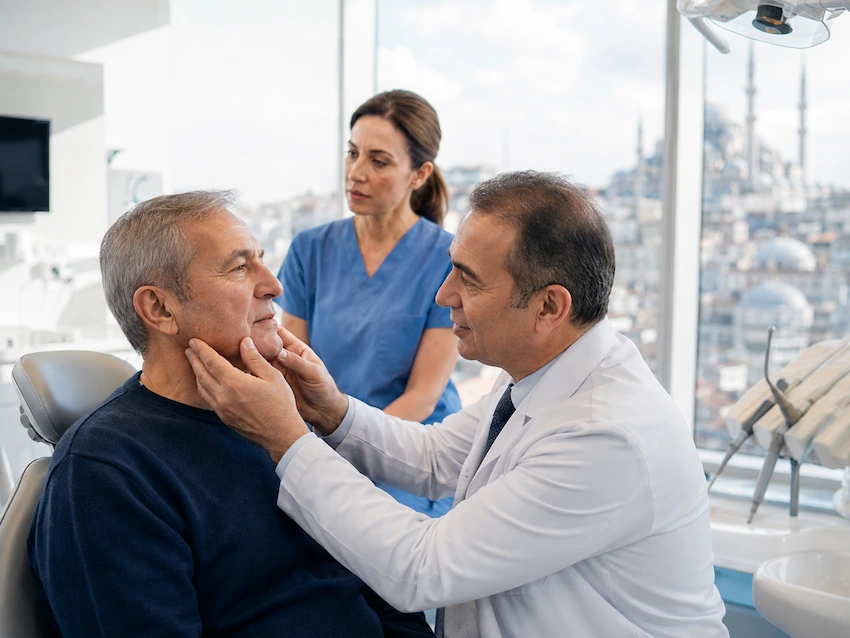
Suffering from a lack of saliva is the leading factor against us in a clinical setting. Think about the mouth getting a constant wash from the natural river of your mouth. That is what saliva is – a river running through your mouth without ever stopping, which clears food particles and prevents damage to your teeth by neutralizing the acids.
Some of your Parkinson’s drugs are life-saving, but these have been blamed for severe dry mouth by doctors. Another name for this is xerostomia. The effect of these drugs is to dry up your protective river of saliva. The result without this flow is a fast speed up of tooth decay. Moreover, your gums become weak and very susceptible to disease.
Swallowing problems and jaw movements that come out of nowhere can be a reason for tooth damage and enamel loss. The food could get wedged between your cheeks very frequently, and the result is an intense attack of acid right on the gum line.
Early Signs of Dental Issues
To have a healthy smile, we have to know the symptoms, that is, the signs to detect problems at home. Just like the foundation of a house is the base and if that part cracks or collapses, one would find it impossible to construct anything above it. The jawbone is exactly that part for the teeth.
Dentist Polen Akkılıç, together with her team take up whole body approach. First of course we examine your teeth. We also watch how you hold the toothbrush, and whether there is anything in general about your swallowing behavior that draws our attention.
You might recognize the signs of teeth trouble such as:
- Bleeding gums and unpleasant breath that won’t go away despite attempts
- Sudden discolored spots or changes in color on your tooth surfaces
- Aches in the jaw joint or inability to chew
- Cheeks may reveal skin cracking and drying that may be quite disturbing
Tips to Take Care of Your Teeth & Gums When Living With Parkinson’s
If getting around becomes difficult, then keeping the habits and routine simple is crucial if you still wish to retain all of them promptly. Choosing the tools should be according to how your body functions, not challenging it.
| The Challenge of Movement | Effect on Oral Health | Our Dentists’ Approach |
| Slight Hand Tremors | Inaccurate brushing, a lot of plaque buildup | Heavy-handled toothbrushes that help reduce hand shaking |
| Side Effects of Drugs | Very dry mouth | Saliva substitutes and xylitol mouth rinse |
| Very sudden Jaw Movement and/or Opening of Mouth | Teeth grinding and tooth fractures | Customized dental mouth guards for sleeping to safeguard your bite |
Treatment Options & Risk Management
Modern dentistry has excellent and permanent methods of replacing missing teeth after an individual has lost them. Prof. Dr. Coşkun Yıldız regularly places dental implants for Parkinson’s patients without any problem. At the clinic, there are some special adjustments to the surgery room. We also know how to handle your sudden jerky movements in a safe way during the session.
Besides implant placement, the secret in treating such problems is a simple design which enables us to fabricate very cleanable new tooth crowns. This way, the risk of food particles lodging within the crown area reduces almost to zero.
If you choose dentures, then it is extremely important for us that they fit precisely. You also should know to use a good quality dental adhesive that can keep them in your mouth during the day. This would be a way of preventing any friction or soreness at your gums caused by the teeth rubbing.
FAQ
I find it difficult to retain the toothbrush because of my shaking hands. What can I do?
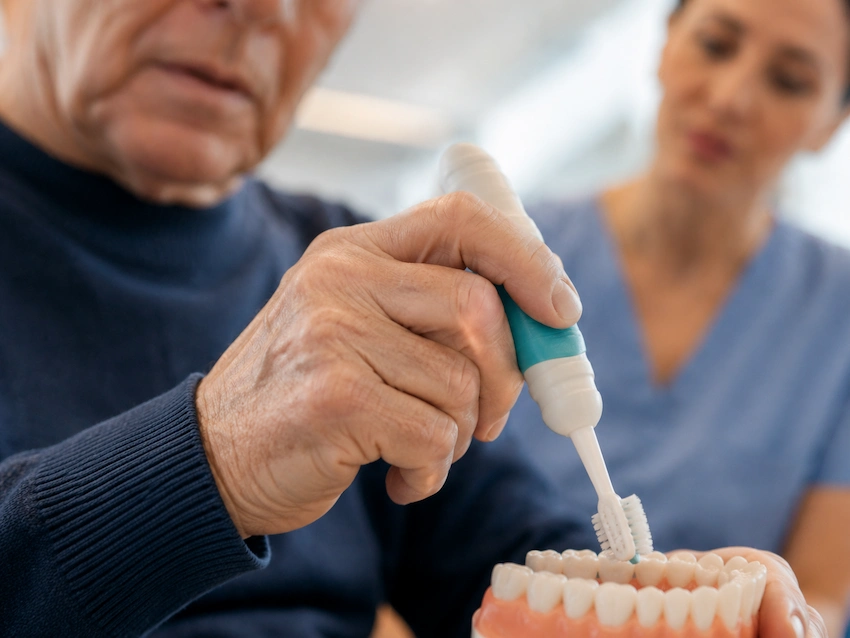
Your toothbrushes are all gone, and now you have found another one that your shaking hand can still do some of the work for you. We usually recommend that you switch to using a heavy-handled electric toothbrush. The increased weight can indeed help stabilize your hand. In addition, the brush head rotate , and that takes away the need for manual brushing. Try to do the best you can at home, and if you are having problems at your house, we can definitely assist you with deep cleaning at our clinic.
I have been wondering why my mouth has become so dry all the time recently.
It is very possible that your drug regimen is to blame. They are medicines you take all the time to maintain your mobility,y but they dry up your salivary glands. You would want to use a xylitol mouthwash. Moreover, I recommend bringing with you a water bottle to keep on rehydrating yourself throughout the day to keep your mouth moist.
Is dental implantation still possible for me after the diagnosis of Parkinson’s?
Yes, of course. We are the clinic where many patients with Parkinson’s disease can trust their dentist. Before we implant, we only need to check if your jaw is strong enough to support the implants. Once we confirm that, a professional team will take care to make sure you’re feeling both relaxed and protected from possible unexpected movements at the surgery site throughout the whole procedure.
Will going for dental procedures be too difficult for me with this disorder?
Yes, it is a real fact that tension or anxiety tends to worsen your shakings, a very unpleasant sensation. That is why Dentist Polen Akkılıç has designed all your visits to last just for an instant and be as peaceful as possible. Between each task, we allow small breaks, provide a soft neck pillow as comfort and support, and we are never impatient or rush your departure; that’s our promise.
How many times does a Parkinson’ patient need to see a dentist?
Prof. Dr. Coşkun Yıldız’s recommendation is not to wait for the six-monthly standard but to come every three and a half or four months only if you can manage the frequent trips. The main reason is that with a dry mouth, hs tooth degradation is just so fast if one is careless. Therefore, by seeing you frequently, it is more than just catching up on your dental care;, we can stop the tooth decay at the earliest stage.
References
- Barbe, A. G. (2018). Dentistry for patients with Parkinson’s disease. Journal of Dental Research, 97(11), 1279-1280.
- Friedlander, A. H., Mahler, M., Norman, K. M., & Ettinger, R. L. (2009). Parkinson disease: systemic and dental implications. The Journal of the American Dental Association, 140(6), 658-669.
- Müller, T., & Palluch, R. (2007). Pharmacological treatment of Parkinson’s disease and oral health. Journal of Neurology, 254(7), 967-968.
- Nakayama, Y., Washio, M., & Mori, M. (2004). Oral health conditions in patients with Parkinson’s disease. Journal of Epidemiology, 14(5), 143-150.
- van Stiphout, M. A. E., Marinus, J., van Dijk, K. D., & van Hilten, J. J. (2018). Oral health of Parkinson’s disease patients: a case-control study. Parkinsonism & Related Disorders, 55, 93-98.

