


No, professional bonding is painless.
That is a trend that we recognize more and more in our chair at Lema Dental Clinic in Turkey. Someone comes into our clinic, having been inspired by the smile of a star or a post on Instagram, and wants that little twinkle of light on their eye tooth or their lateral incisor. However, right away, the enthusiasm changes to doubt. The query goes: “Are you really going to drill a hole in my tooth?”
The brief, comforting response is no.
In our hands-on clinical experience, we have found that the fear stems from a misconception regarding the mechanism of the modern dental jewels. In the past, a gemstone required the dentist to prepare a cavity, almost like a filling. Today, however, this act has been revolutionized so that the whole process is quite different. It is non-invasive. We don’t take away any tooth structure; we are simply making an addition.
Professor Doctor Coşkun Yıldız frequently likes to say that it is just like putting on a luxury, semi-permanent contact lens. It just rests there on the surface doing its job and yet the biology of the eye beneath it is left unchanged. Similarly, a diamond tooth gem rests on the enamel and does not impair its strength.
How It Works: Adhesion, Not Tooth Tissue Removal
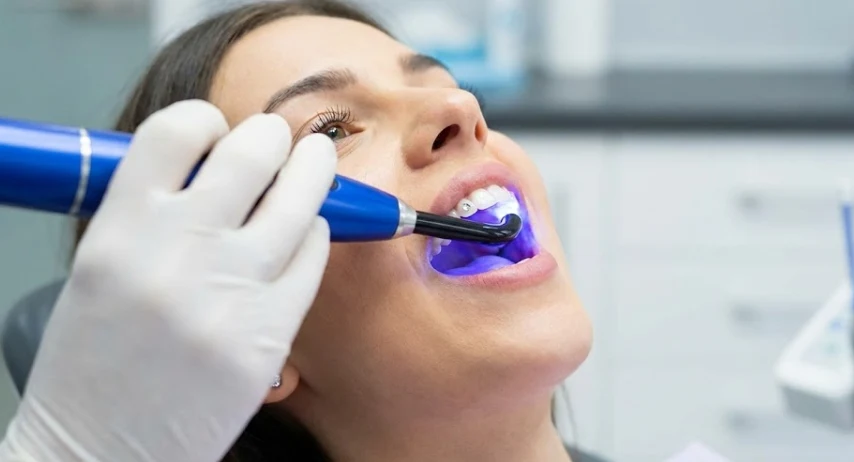
When Dentist Polen Akkılıç, along with her aesthetic team install a tooth gem, they make use of exactly the same technology that is utilized to attach orthodontic braces.
Those who have braces have witnessed the brackets being glued to their teeth and not screwed in. A special dental adhesive is what we use, a fluid composite resin that bonds microscopically to your enamel’s pores.
This is the step-by-step reality of how the sensation:
- The Clean: After polishing the tooth surface, you can hear the vibrating brush.
- The Prep: A mild etching gel is introduced. This tastes a bit sour (like lemon juice) and on a microscopic level gelatinizes the enamel surface to help the glue stick. You don’t get hurt, but it feels cold.
- The Bond: The liquid resin and the gem are placed.
- The Cure: One just needs to point the blue UV light at the bonding for a few seconds to get the glue hardened.
Not for a single moment is the drill passing through your nerve; there is no heat or friction either. It, therefore, is quite literally a “paint and cure” procedure.
The “False Nail” Analogy
Imagine your tooth enamel as being like a fingernail. Applying a gel manicure or a false nail tip is just attaching it to the surface of the nail. You don’t get to the place where the nerves are by cutting the nail bed.
The same principle is used when bonding a diamond. Deep inside the pulp chamber is where the nerves of your tooth are located and this chamber is surrounded by layers of dentin and enamel. Since the outer shell, which does not have nerve endings, is what we are working with exclusively, your brain will not even be able to detect pain signals during the procedure.
Real Diamonds VS. Crystals:
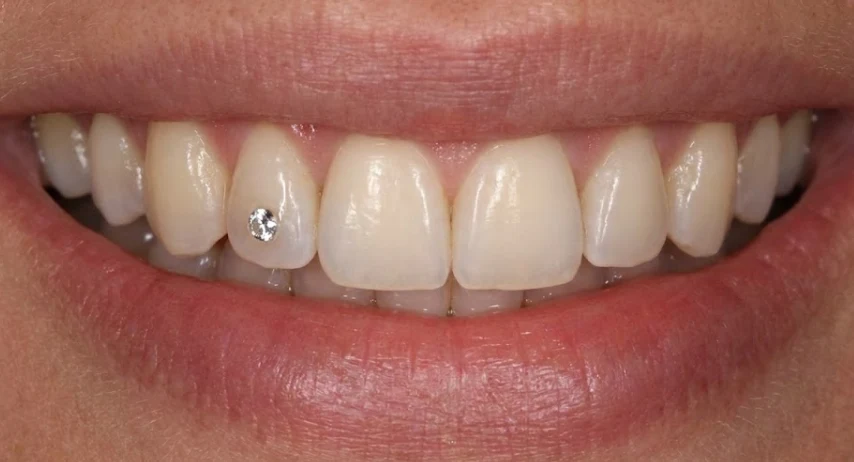
It is a technical detail that we have to clarify. A vast majority of the so-called “tooth gems” are high-quality crystals (such as Swarovski) or gold designs that have a flat back only. They are attached directly to the surface.
But if you bring in a real cut diamond (like one of your rings), then it may most probably have a sharp pavilion (pointy bottom). Therefore, in order to place the stone with the point, the dentist would theoretically have to make a small hollow in the tooth that fits exactly that point.
Usually, at Lema Dental Clinic, we would not allow that the healthy enamel be drilled just for the sake of cosmetic diamond jewelry. We suggest that you get flat-backed high-quality gems or dental jewelry that has been specifically designed so that you can get the look of the diamond without harming the structure. Keeping your original tooth structure intact has always been our primary ethical concern.
Which is Safer? A Comparative Review
In order for you to be able to grasp why the dental jewel’s professional application is at any cost we have brought together the clinical versus the at-home or improper methodology for comparison purposes.
| Feature | Professional Dental Bonding (Lema Clinic) | DIY Kits / Nail Salon Application | Invasive Embedding (Drilling) |
| Pain Level | Zero (Painless) | Low to Moderate (Gum irritation) | Low (Requires Drilling) |
| Enamel Damage | None (Reversible) | High (Superglue damages enamel) | permanent (Hole drilled) |
| Longevity | 6 Months – 2 Years | Days to Weeks | Permanent |
| Removal | Polished off by Dentist | often chipped off (Risk of fracture) | Requires filling the hole |
| Hygiene | Sealed edges (No bacteria trap) | Rough edges (Traps plaque) | High risk of decay around inset |
Top Queries on Tooth Gem Safety
Absolutely. In fact, you must. The gem creates a tiny ledge where plaque can accumulate, so Dentist Polen Akkılıç recommends being extra diligent with your electric toothbrush around the jewelry. You can brush right over it—it won’t fall off. The bond is strong enough to withstand eating, brushing, and professional cleanings.
No, provided it is removed by a professional. When you decide you are done with the sparkle, we pop the gem off and use a polishing disc to remove the remaining microscopic bits of adhesive. Your tooth underneath will look exactly as it did before the procedure—smooth and intact.
This is a common worry, but it is generally harmless. Dental gems are tiny and made of non-toxic materials (glass, gold, or safe crystals). If one detaches while you are eating and you swallow it, it will pass through your digestive system without causing injury.
Not if it is sealed correctly. This is why DIY kits are dangerous. If there is an air pocket between the glue and the tooth, bacteria can sneak in and breed, causing a cavity spot (white lesion). In our clinic, we ensure a hermetic seal so that nothing—not sugar, not acid, not bacteria—can get under the diamond.
It depends. Bonding agents are designed to stick to natural enamel. Sticking them to porcelain veneers or crowns is more difficult and can sometimes damage the glaze of the expensive veneer work. We usually suggest placing gems on natural teeth, but we can assess your specific veneers during a consultation in Istanbul.
- Gordan, V. V. (2000). Clinical evaluation of the durability of dental adhesives. Journal of the American Dental Association, 131(8), 1091-1093.
- Van Meerbeek, B., et al. (2003). Adhesion to enamel and dentin: current status and future challenges. Operative Dentistry, 28(3), 215-235.
- Milosevic, A. (2010). Tooth jewelry: A review of the literature and clinical management. Dental Update, 37(1), 50-54.
- Joiner, A. (2007). The bleaching of teeth: A review of the literature. Journal of Dentistry, 35(6), 475-497. (Context on enamel safety in cosmetic procedures).
- Schiestel, C., & Tirlet, G. (2012). Dental jewelry: A review. Clinical Dentistry and Research, 36(2), 22-28.

