


Yes, improper at-home whitening can damage enamel.
We see this scene regularly. A patient visits our clinic in Turkey, with a smile a bit less bright than they would have liked, showing a phone with an advertisement for a “miracle” at-home whitening kit. The promise is always the same: dazzling white teeth in no time, and at a fraction of the price.
But the question they give to us is the one that really matters: “Doctor, is this going to ruin my teeth?“
Honestly, that fear is quite reasonable. It is enamel that is the hardest substance in your entire body, even harder than bone. But imagine it like a top of the range marble slab: quite strong, however, acid erosion and scratching are always the two most likely things to happen if you use the wrong chemicals on it. Once that marble gets etched, there is no way for you to “grow” it back.
At Lema Dental Clinic, honesty is what we stand for. We can peel off the hype of advertising and look at the effect of these kits on your enamel and the reasons why Professor Doctor Coşkun Yıldız and Dentist Polen Akkılıç recommend that you be very cautious when handling your smile yourself.
The Chemistry of the “Hollywood Smile”
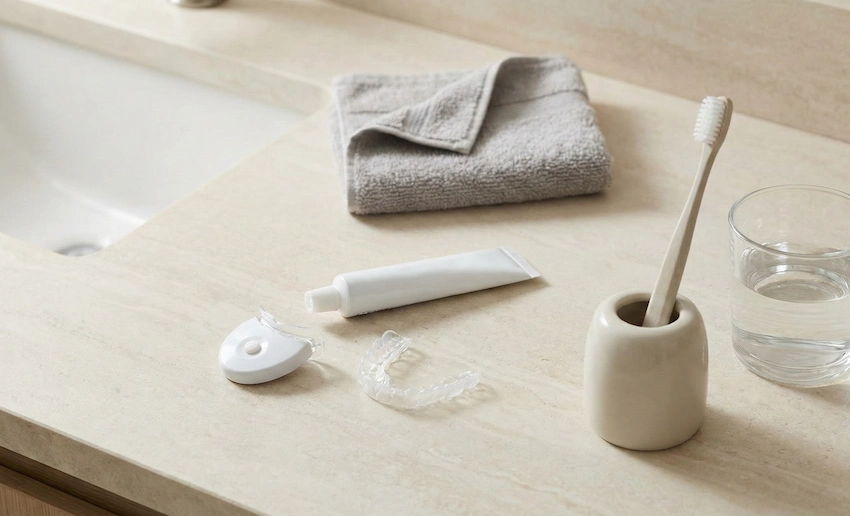
To comprehend the danger, you ought to know the mechanism. The bulk of whitening products employ bleaching agents based on peroxide (hydrogen peroxide or carbamide peroxide). These agents penetrate the porous enamel and break down the stain molecules inside the tooth.
In a well-controlled clinical environment, your gums are carefully protected, and only after a thorough sensitivity assessment do we use concentrations specific to your sensitivity levels. It’s a different story at home, though.
The “One-Size-Fits-All” Tray Problem
Let’s say you want to wear shoes that are supposed to fit “everyone”. Most probably they would cause you to get blisters. The same thing happens with teeth whitening trays that are not made to be worn. Since they are not custom-molded to your unique bite, the bleaching gel can spill out onto your gums, thus causing chemical burns or it may be washed away with saliva before it gets to work.
On top of that, it is really risky when the users keep filling those trays time after time assuming “more is better,” thus the tooth surface is getting acid flooded and this is leading to enamel erosion. When the enamel is eroded, the yellow dentin beneath it also becomes visible. It’s a pretty odd situation that whitening too much can make your teeth look yellow and translucent: the very reason you wanted them to be white.
Clinical Note: When your teeth start to appear “glassy” or you get sharp pains while breathing cold air, you should immediately cease using the product. These are the initial enamel demineralization symptoms.
Abrasives vs. Bleaching: The Hidden Danger in Toothpaste
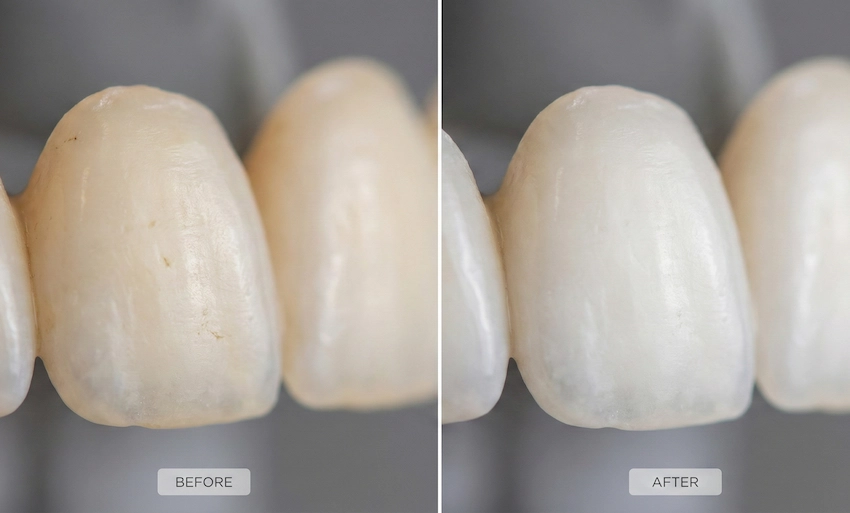
Not necessarily do all at-home methods involve bleaching. A lot of “whitening” toothpastes work on abrasives principle – they have tiny gritty particles which are designed to scratch the stains on the surface away.
Imagine this as if you were using sandpaper to clean a painted wall from a scuff mark. If you do it gently once, the wall will look clean. But if you do it every day with coarse grit, it is going to be like stripping paint off the wall and exposing the drywall.
Dentist Polen Akkılıç along with her team regularly encounter patients who have brushed away their enamel so hard with charcoal powders or baking soda mixes that they have actually come to see the dentist as a result of their aggressive brushing. These substances may be effective in removing surface coffee stains, but they degrade the enamel over time thus causing increased sensitivity as well as the dulling of the tooth surface which happens when the surface loses its reflective property.
Professional vs. At-Home Whitening: The Safety Breakdown
Truth be told, whitening products vary considerably in terms of quality and safety. We have put together a table reflecting a range of applicant features observed by our patients in Turkey.
| Feature | Professional Whitening (In-Clinic) | At-Home Kits (DIY) | Whitening Toothpaste |
| Active Ingredient | High-concentration peroxide (with protection) | Low-concentration peroxide | Abrasives (silica, charcoal) |
| Gum Protection | A protective barrier is applied to isolate the gums | None or poorly fitting trays | None |
| Enamel Risk | Negligible under dental supervision | Moderate to high due to user error | High with long-term abrasion |
| Time to Results | Immediate (about 1 hour) | Weeks to months | Months (surface stains only) |
| Sensitivity | Controlled with desensitizing agents | Often uncontrolled | Can increase significantly |
The Lema Way: We Put Health First.What to Nothing
For us at Lema Dental Clinic, our motto is self-evident: Health comes first, then aesthetics. A white smile is meaningless if it is painful to drink water.
When you book an appointment with us in Turkey, Professor Doctor Coşkun Yıldız personally makes sure that a thorough examination is performed first, before any whitening procedure is done. The reason is quite straightforward: Bleaching a tooth that has a cavity or a cracked filling will lead to severe pain and possibly nerve damage. There is no X-ray factored in for the usage of a home kit and therefore, the state of your mouth is unknown to the product.
Bleaching is not always the way to go if your enamel is naturally thin or if you have severe intrinsic staining (like tetracycline stains). At the same time, in these situations, zirconium crowns or laminate veneers might be the better and safer option as they are also more durable and do not chemically alter the tooth, but rather protect the existing tooth structure.
Frequently Asked Questions: The Clinic Gives Straight Answers
It is very dangerous. Though baking soda is natural, it is also abrasive. Using it a few times probably won’t do damage right away, but if you use it regularly, you will eventually scratch your enamel. Once those micro-scratches appear, they actually trap stains more readily, thus creating a vicious stain and scrub cycle that ruins the teeth.
You must be very cautious. Tooth sensitivity is frequently your body’s way of telling you that the enamel on your teeth may be compromised, or that your gums are receding. At-home kits will probably inflict such pain that you won’t be able to bear it. At a dental clinic, however, we can use certain buffers and desensitizing agents that will help the process and make it safe and painless.
Charcoal toothpaste works by abrasion rather than bleaching. It can effectively remove surface stains so at first, it may look like your teeth have become whiter. However, several people ended up with their teeth in a more vulnerable state to decay after having abused charcoal that way. We generally advise against using it.
Whitening done professionally stays effective much longer as the bleaching of dentin can be done deeper and more safely. The effects may last up to a year or even more if good oral hygiene is maintained. Home strip treatments usually only impact the enamel of the teeth so the brightness diminishes quite fast – generally, in just a matter of weeks.
It definitely can be if you select the right clinic. Turkey has been known as one of the top countries in the dental treatment field. At Lema Dental Clinic, we adhere to all global standards regarding hygiene and safety. The equipment you are provided with here is equal to that in the UK or US, and you are even given the advantage of being treated by a committed team such as ours.
- Epple, M., Meyer, F., & Enax, J. (2019). A critical review of modern concepts for teeth whitening. Dentistry Journal, 7(3), 79.
- Carey, C. M. (2014). Tooth whitening: what we now know. Journal of Evidence-Based Dental Practice, 14, 70-76.
- Joiner, A. (2006). The bleaching of teeth: a review of the literature. Journal of Dentistry, 34(7), 412-419.
- Kwon, S. R., & Wertz, P. W. (2015). Review of the mechanism of tooth whitening. Journal of Esthetic and Restorative Dentistry, 27(5), 240-257.
- Pintado-Palomino, K., Peitl-Filho, O., Zanotto, E. D., & Tirapelli, C. (2015). A clinical, chromatic, and histologic assessment of tooth bleaching. Brazilian Dental Journal, 26(4), 364-368.

