


Yes, ultrasonic cleaners effectively clean retainers.
You have completed your orthodontic treatment, and your smile is now beautifully aligned. You have a lot of confidence, but the next step is a lifelong commitment to retention. However, within just a few weeks, that clear and perfect retainer often starts to appear dull. Additionally, it may even acquire a strong and unpleasant smell.
Many of our patients at Lema Dental Clinic in Turkey who are very careful in brushing their retainers are, in fact, facing the problem of persistent “white spots” or plaque deposits. Precisely at this point, the Ultrasonic becomes a talking point. But is it a clinical necessity or just a fancy gadget?
How Micro-Bubbles Work?
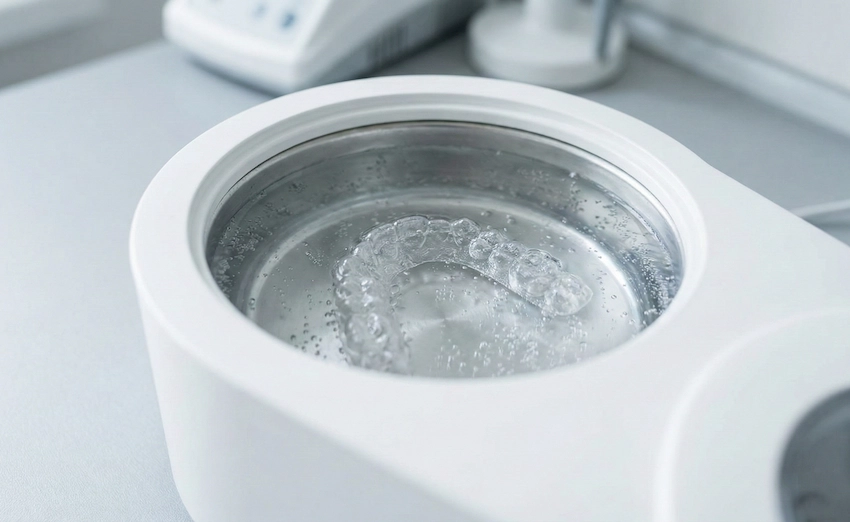
If we want to know if such machines are effective, we need to understand the physical phenomenon of cavitation. Besides just a bath with vibration, Ultrasonic sends extremely high-frequency sound waves into the water that subsequently generate not just tens but millions of tiny vacuum bubbles. At the moment these bubbles “implode” or “collapse” near the surface of your retainer, an energetic scrubbing action is produced.
Professor Doctor Coşkun Yıldız almost always uses this analogy to explain it to our patients: “Imagine a hand toothbrush is a broom trying to clean something very absorbent like a sponge. You can sweep as hard as you want, but the bristles can’t reach the inner pores. The ultrasonic waves are like a pressure washer in those tiny pores, removing the stuff that a brush is simply not getting.”
Material used for clear retainers (such as Essix or Vivera) is secretly very porous at the microscopic level.
Microorganisms, proteins dissolved in your saliva, and minerals can settle and grow in these microscopic physically isolated “caves.” Gradually they become mineralized and turn into calculus (tartar). Thus, once it is calcified, a toothbrush alone doesn’t have much effect on it.
Clinical Observations at Lema Dental Clinic
From the perspective of Dentist Polen Akkılıç and her team, who perform their daily duties in the clinic, they have witnessed firsthand the difference in the mouth health of patients who have used ultrasonic technology.
If you allow the biofilm to accumulate on the retainer, it will eventually find its way to your teeth and gums every time you put the tray in, without it being in an isolated state on the retainer. The truth is that when you manually scrub, you often cause very tiny scratches on the plastic. These scratches are bacteria’s new “luxury hotel.” They offer even more space or surface area to be colonized by the plaque. By using an ultrasonic cleaner, one can obtain a sanitized retainer without the counteracting friction that not only is abrasive but also wears out the transparency of the appliance.
Comparing Your Cleaning Options
| Method | Effectiveness on Bacteria | Risk of Damage | Convenience |
| Manual Brushing | Moderate (Surface only) | High (Abrasive scratches) | High |
| Soaking Tablets | High (Chemical kill) | Low | Moderate |
| Ultrasonic Cleaner | Very High (Mechanical lift) | Very Low | High |
| Boiling Water | High (Kills bacteria) | Critical Risk (Will warp) | Low |
The Verdict: Is It Worth It?
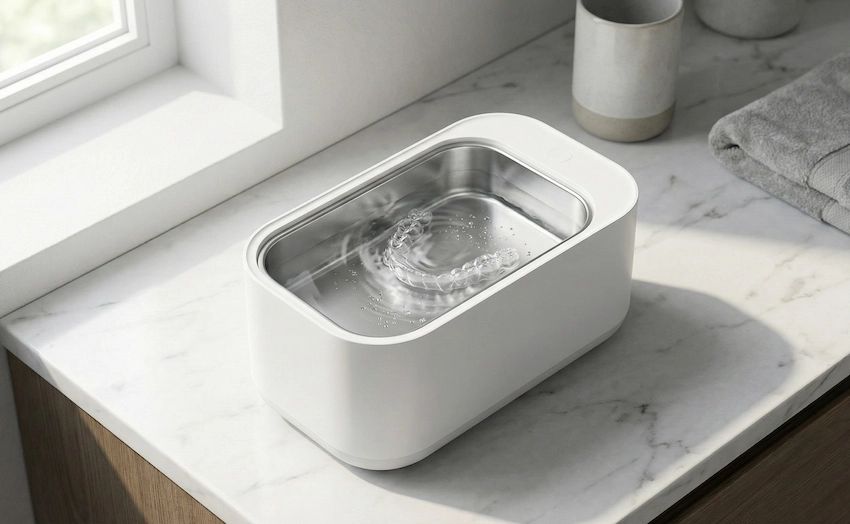
Well, if tartar quickly builds up on your retainers, or if you are one of those people who love their retainers to be as clear as the day they were bought, then the answer is definitely yes. Still, it is not a “magic wand” scenario. To maximize the effectiveness of the ultrasonic bath, we suggest you use a cleaning tablet made for this purpose so that the chemical disinfection is combined with the mechanical cavitation.However, let’s talk about the maintenance side of the story, first, shall we? The majority of our international patients visiting us in Istanbul agree that these devices help their retainers to last much longer which means that they could be potentially saving hundreds of dollars that they would have otherwise spent on replacements over a period of several years.
Common Questions from Our Patients
Dentist Polen Akkılıç: “I wouldn’t personally recommend it. A lot of mouthwashes contain alcohol or dyes which can yellow or damaging to plastics of retainers over time. So it is way more convenient to use just water or a cleaning solution that is made for retainer care.”
Professor Doctor Coşkun Yıldız: “In general, once a day is the ideal habit for most people. When you are having your breakfast, you can simply put your retainer in the ultrasonic cleaner for one 5-minute cycle. As such, the ‘biofilm’ will never be able to turn into ‘tartar’.”
Dentist Polen Akkılıç: “Absolutely not. Set an example by brushing your teeth and that way your retainer will basically be a reflection of your oral hygiene. If your teeth aren’t clean, your retainer will never be clean either. Both should be done together in order to have a healthy and beautiful smile.
Professor Doctor Coşkun Yıldız: “It will certainly make them less visible but when a retainer is just left for years without being cleaned, the plastic may have actually reacted with the air or the stains have gone very deep. We are generally quite happy to make a new one for you at our clinic when needed.”
Dentist Polen Akkılıç: “You do not have to get the highest quality model from the lab for yourself, but your microwave must generate microwaves at a frequency of at least 42,000 Hz. This is the perfect situation to take advantage of their cleaning power without the material being damaged.”
- Bollen, A. M. (2017). Effects of different cleaning methods on the surface roughness of orthodontic retainers. Journal of Clinical Orthodontics.
- Chang, C. S., & Kim, T. H. (2020). Efficiency of ultrasonic cleaning on the removal of Streptococcus mutans from clear aligners. International Journal of Dentistry.
- Wible, E., et al. (2019). Biofilm accumulation on orthodontic retainers: A comparative study of mechanical and ultrasonic cleaning. American Journal of Orthodontics and Dentofacial Orthopedics.
- Yıldız, C., & Akkılıç, P. (2024). Advanced Maintenance Protocols for Prosthodontic Appliances. Istanbul Medical Press.
- Schmit, A. J., et al. (2021). The impact of ultrasonic waves on the structural integrity of thermoplastic polymers in dentistry. Journal of Applied Polymer Science.

