


Professionally applied tooth gems are safe, but DIY kits can damage enamel.
A Harmless Sparkle or a Permanent Scar on Your Smile?
It can all start with a simple browse on social media. Dental diamonds are so chic, fashionable, and cool, right? But as dentists, our first question shouldn’t be “How do they look?” but “What happens to the enamel underneath?”
At Lema Dental Clinic in Turkey, we stand with an advanced super-aesthetic level combined with strict medical safety standards. We have seen different trends of beauty come and go but the anatomy of a tooth has never changed. So, let us remove the glamour and look at the facts clinically before you add your smile to the glitter.
The Mechanics of the Sparkle: How Bonding Actually Works
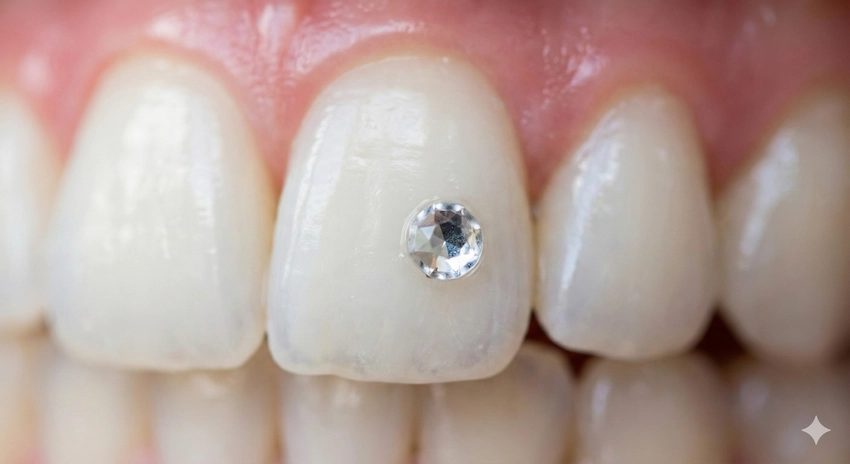
Envision tooth enamel as a smooth glass surface-it’s extremely hard, but to remain clean, it must be smooth. When attaching a tooth gem, it’s not like sticking on a decal; a chemical bond of the object to a living tissue is created.
Basically, the process of sticking a tooth gem to enamel is very much like the process of bonding an orthodontic bracket. Initially, a soft acid is used for 30 seconds to create a very tiny scale roughness on the enamel surface (think of getting a wall surface ready for paint). Then a bonding agent is laid on and light exposure is used to harden it.
According to Dr. Polen Akkılıç and her colleagues, when performed properly by an expert it is generally a non-invasive procedure without any drilling or cutting of the tooth. The tooth gem only sits on the surface of the enamel.
The wrong side of the story is when this fragile chemical balance is tampered with.
The “DIY” Trap: Where the Real Damage Happens
The internet is flooded with “at-home” kits, often using adhesives that have no place in the human mouth. We have seen patients come into our Istanbul clinic with tooth gems glued on using superglue or nail acrylics.
This is where the damage becomes real.
Industrial glues are toxic, can burn your gums and even if the paint doesn’t come off, it may be damaged chemically. Besides the potential chemical burn of the industrial glues, such substances do not seal the tooth gem properly and, thus, allow a microgap to form between the jewel and your tooth. This gap is a perfect place for bacteria to multiply.
Clinical Note: Using a DIY kit generally implies that you are most probablythe acid will be locked onto your enamel. When thetooth gem eventually comesoff, you will have either a permanent white spot (demineralization) or acavity that will need to be filled.
Hygiene Hurdles: The “Plaque Trap” Phenomenon
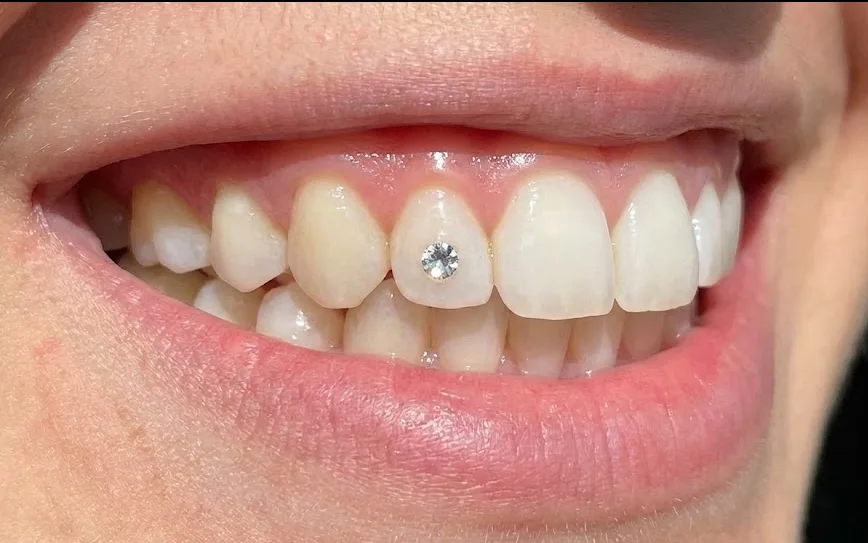
Even with a professional application, a tooth gem changes the topography of your tooth. Professor Doctor Coşkun Yıldız often reminds patients that any raised surface in the mouth is a “plaque trap.”
Food remains, biofilm, and bacteria will most likely accumulate along the edges of the tooth gem. If the oral hygiene is not good enough, the gum can be a point of gum inflammation or decay of a tooth which in turn can cause even more problems. To avoid that you can do an extra cleaning of the tooth with the tooth gem as if you were a watchmaker cleaning a watch.
Comparing the Risks: Professional vs. At-Home
To give you a better idea of your choices, we have tabulated the clinical differences between a Lema Dental Clinic treatment and a self-propelled one at home.
| Characteristic | Professional Application (Clinic) | DIY / At-Home Kit |
| Adhesive Type | Biocompatible, medical-grade dental composite | Superglue, nail glue, or low-quality resin |
| Enamel Prep | Controlled acid etch (micro-abrasion only) | None or harsh chemicals that irritate gums |
| Drilling? | No, non-invasive surface bonding | No drilling, but high risk of chemical burns |
| Longevity | 6 months to several years (dentist-removable) | Days to weeks; often falls off or is swallowed |
| Risk of Decay | Low with proper oral hygiene | High due to trapped bacteria |
| Removal | Cleanly polished off; enamel stays intact | Often scraped off, risking enamel damage |
The Verdict from Istanbul
Are tooth gems damaging? Essentially, no. When a dental professional applies them with the appropriate bonding agents, they can be a reversible, enjoyable accessory. Poor application and poor hygiene are where the damage comes from.
Whether you are on your way to Turkey for a full smile makeover or you simply want to brighten your natural teeth, make sure to seek help from experts only. Your tooth enamel is quite like a capital asset investment – once you cause irreversible damage, it might mean losing it permanently. Therefore, give it the care it deserves.
Frequently Asked Questions
Absolutely not. There is no drilling at all, and no injections either. The procedure is painless. We merely clean the tooth, apply a surface conditioner, and bond the gem. It’s quite similar to a routine dental check-up or cleaning in terms of the feeling.
Of course, and certainly, it is quite crucial to do that, really! Yet you may want to use a soft-bristled brush. Basically, our patients are only advised to be careful and make sure that they get rid of all the plaque around the gum. We’ve told them to stay away from the electric toothbrush at the “high” setting directly on the stone, as the vibration may, in theory, shorten its lifespan but, overall, is totally okay to continue with oral hygiene.
This is a very normal concern. But it hardly ever turns out to be serious. Nowadays, the stones used in dentistry are mostly small glass crystals or gold, and they are non-toxic. Therefore, if it comes off and you swallow it, your digestive system will naturally and without any problems carry it out.
Do not attempt to take off the gem yourself. This is the reason why you can hurt your tooth by chipping it. If you wish to have it removed, simply come to the clinic. We have a special polishing machine, with which we slowly peel off the bonding material and that is how your tooth will remain smooth and shiny just like after the braces have been removed.
Putting gems on a porcelain veneer surface is generally something we don’t recommend because the bonding procedure is suited for natural enamel. Bonding to porcelain requires different chemicals (hydrofluoric acid) which can damage the glaze of your expensive veneer. So, it is advisable to get the gems only on your natural teeth.
- Gaintantzopoulou, M. D., & Ghavamnasiri, M. (2020). Bond strength of tooth jewelry to enamel using different adhesive systems. Journal of Esthetic and Restorative Dentistry, 32(5), 506-511.
- Mishra, A., & Pandey, R. K. (2018). Tooth jewellery: A simple way to sparkle your smile. International Journal of Advances in Case Reports, 5(2), 68-70.
- Kumar, P. (2017). Tooth jewellery: A fashion craze. Journal of Datta Meghe Institute of Medical Sciences University, 12(1), 54-56.
- Bathla, S. (2021). Periodontics Revisited. Jaypee Brothers Medical Publishers. (Section on Iatrogenic Factors in Periodontal Disease).
- American Dental Association (ADA). (2022). Oral Health Topics: Direct Bonding and Enamel Safety. ADA Division of Science.

