


Yes, they feel completely natural.
At Lema Dental Clinic, we often sit across from tired patients. Tired of hiding their smiles, tired of avoiding their favorite foods, and tired of the “clacking” sensation of traditional dentures. When they ask if an implant feels natural, they aren’t just asking about aesthetics. They are asking if they will ever feel “whole” again.
The question remains: can a piece of medical-grade titanium truly mimic a gift of nature? In our clinical experience in Turkey, the answer is a resounding yes—but the path to that “natural” feeling is a fascinating journey of biological integration.
The Foundation: Why the Brain Accepts the Change
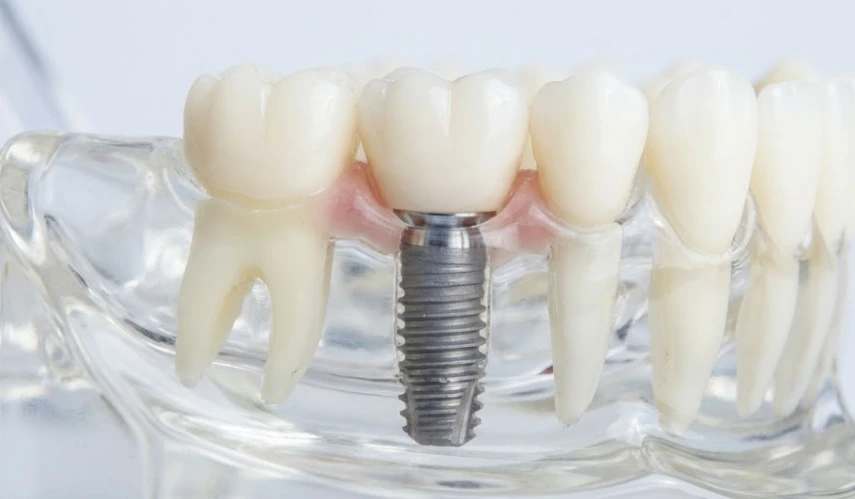
Imagine the foundation of a historic building. If you simply rest a pillar on top of the soil, it will lean and shift with every storm. Traditional dentures are that pillar. A dental implant, however, is a deep-rooted anchor.
Professor Doctor Coşkun Yıldız often notes that the magic happens through osseointegration. This isn’t just “healing”; it’s a biological handshake. The jawbone doesn’t just grow around the implant; it fuses with it.
The fact is, after this fusion is finished, your nervous system will start re-mapping your mouth. Since the implant is firmly fixed within the bone, the brain ceases to identify it as a “foreign object” and starts to consider it as a part of your own skeleton.
What Makes an Implant Feel Integrated?
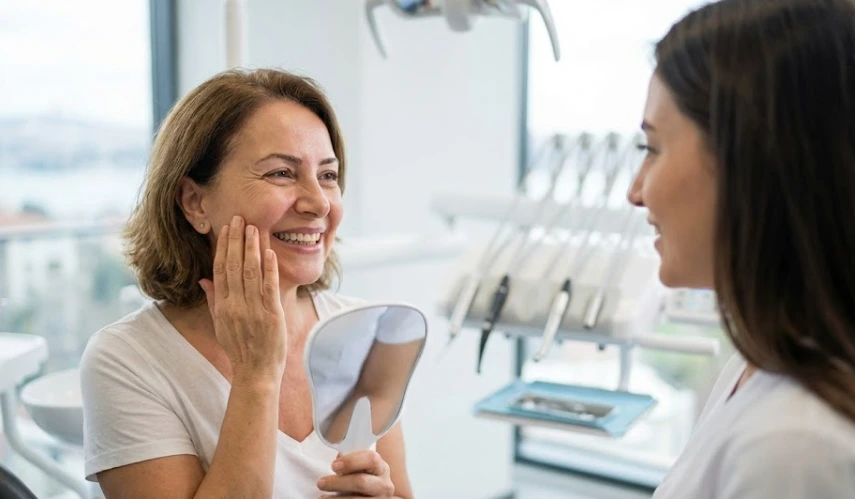
However, let’s delve deeper into the daily experience. How is it that after several months, our patients at Lema Dental Clinic hardly remember which tooth had been replaced? It is basically about how we handle the border between technology and tissue.
The 4 Pillars of a Natural Feel
- Fixed Stability: There is no “micro-movement.” The implant does not move when you bite. Not moving at all is the main reason why the prosthetic feels like a natural part of your body.
- Proprioception via Bone: The tooth itself is devoid of nerve, but the jawbone is not. You still feel the pressure of chewing through the bone itself—a sensation called osseoperception.
- Thermal Comfort: Unlike metal-based dentures that can feel cold, the high-quality Zirconia we use acts as an insulator. It doesn’t “shiver” when you eat ice cream.
- Anatomical Contouring: Dentist Polen Akkılıç and her team spend hours perfecting the “emergence profile.” This is the way the tooth emerges from the gum. If this transition is smooth, your tongue won’t detect a “ledge,” which is crucial for a natural feel.
The Sensory “Shock Absorber” Gap
Here is what we see in the clinic: a natural tooth is suspended by the periodontal ligament (PDL), a tiny, elastic shock absorber. Implants don’t have this. They are “direct-to-bone.”
This means the “feedback” is slightly more solid. If you bite down on a hard seed, a natural tooth gives a “soft” warning. An implant gives a more “immediate” signal. But here is the kicker: the human brain is incredibly adaptable. Within weeks, your “bite software” updates. You subconsciously learn the new pressure limits of your implant, and the difference fades into the background of your daily life.
Comparison: Sensation and Longevity
| Feature | Natural Tooth | Dental Implant | Removable Denture |
| Stability | High | Maximum (Fused) | Low (Slippage) |
| Bite Strength | 100% | ~98% | 20-30% |
| Bone Preservation | Yes | Yes (Stimulates Bone) | No (Causes Atrophy) |
| Sensory Feedback | Ligament-based | Bone-based | Surface-based |
| Maintenance | Brush / Floss | Brush / Floss | Soak / Adhesive |
The Artistry of the Final Bite
The question remains: why do some implants feel “off” while others feel perfect? At Lema Dental Clinic, we believe it is a matter of precision. Professor Doctor Coşkun Yıldız emphasizes that if a crown is even 0.1mm too high, the entire “natural” feeling is ruined.
By utilizing advanced digital occlusal mapping in Turkey, we ensure that your new tooth hits the opposite tooth at the same microsecond as your natural teeth. When the bite is perfectly balanced, the implant effectively “disappears” from your conscious mind.
FAQ: Direct Insights from the Surgeons
Dentist Polen Akkılıç: If the crown is made of high-quality Zirconia or E.max and the bite is balanced, no. It will sound and feel just like tooth-on-tooth contact.
Not at all. The implant is buried deep within your warm bone and gum tissue. It stays at your body temperature.
You will feel it with your tongue, just like a natural tooth. Because we contour the crown to fit your gum gap perfectly, it shouldn’t trap food any more than a healthy natural tooth would.
Most patients report that by the 3-week mark, they’ve stopped “testing” the tooth with their tongue and it has become part of their normal sensory map.
It’s about the volume of expertise. At Lema, we don’t just “place screws.” We reconstruct smiles. Our focus on the “sensory” side of dentistry ensures that you leave with a smile that doesn’t just look like a photo—it feels like home.
- Albrektsson, T., & Wennerberg, A. (2004). Oral implant surfaces: review focusing on topographic and chemical properties. The International Journal of Prosthodontics, 17(5).
- Brånemark, P. I. (1983). Osseointegration and its experimental background. The Journal of Prosthetic Dentistry, 50(3), 399-410.
- Misch, C. E. (2007). Contemporary Implant Dentistry. Elsevier Health Sciences.
- Pjetursson, B. E., et al. (2007). A systematic review of the survival and complication rates of fixed partial dentures. Clinical Oral Implants Research, 18(s3).
- Weiner, S., et al. (1995). The perception of bite force and thickness by patients with implants and natural teeth. Journal of Oral Rehabilitation, 22(3).

