


Subtle facial enhancements are possible.
You look in the mirror and imagine a straighter smile. But then a thought creeps in: If my teeth move, will my face change too?
It is indeed a reasonable question. Actually, it’s among the most frequent concerns we hear during consultations in Istanbul. Patients often express concern over losing their facial features, while others secretly think that a bite correction via a dental surgeon might reveal a more chiseled jawline or increase the prominence of cheekbones.
The short story is that yes, they can to some extent. However, it is considered to be a feature. Aligners are no less than plastic surgery, but they significantly alter the foundation on which your soft tissues are laid.
How It Works: Skeletal Vs. Dental Changes
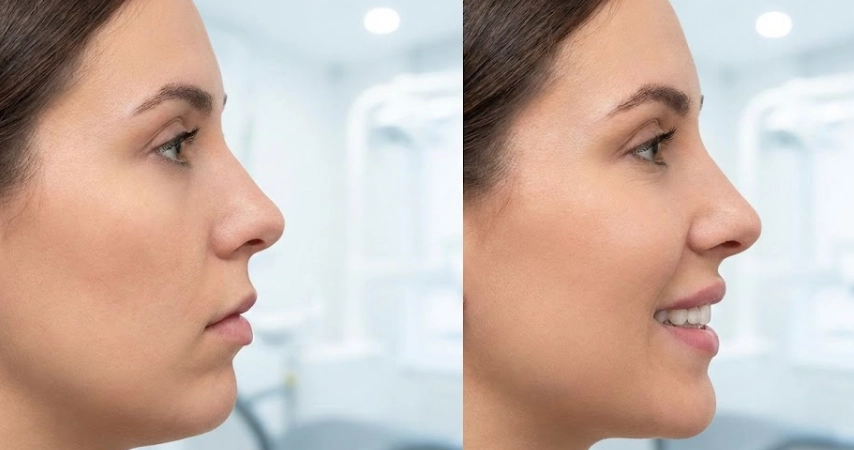
Imagine a scenario where your face is a tent. Teeth and jawbone are the poles while lips and cheeks are the fabric covering them. If the poles are moved, the reshaped fabric is the inevitable consequence. At Lema Dental Clinic, clear aligners are considered primarily for dental movements. Although certain orthodontic cases such as overbite or underbite corrections, can result in a change in the appearance of the lower face.
Both Dentist Polen Akkılıç and her team believe that during the retraction of the protruding teeth, the lips lose their volume slightly and therefore, a person can appear to have a more balanced profile. This is basically a subtle adjustment rather than a dramatic change.
The “Lema Effect”: Strategic Alignment
We not only shift teeth positions but also design smiles that fit your facial features. This is where the surgical expertise counts. Professor Doctor Coşkun Yıldız often tells our patients that successful orthodontics in Turkey is not simply a matter of straight teeth but identifying and focusing on the specific beauty points that will make the result look natural and harmonious.
These are the main facial changes we deliberately look to achieve with aligners:
- Lip Support: Influencing the appearance of lips by pushing or pulling the front teeth in such a way that it gives the lips a fuller or smaller look.
- Facial Height: Raising the facial dimension by the correction of a deep bite, which can make a short, compressed face look longer and more graceful.
- Buccal Corridors: Enhancing the dental arch for the purpose of eliminating the shadowed areas in the corners of the mouth and getting a wider and more confident smile.
- Jaw Definition: Getting the teeth to close together properly so that the jaw muscles can relax, thus the lower face might become slimmer and the tooth grinding “bulky” appearance might be reduced.
Having a deep bite causes your face to appear shorter than it actually is. Aligners that open your bite go a long way in restoring your proper facial proportions.
Comparative Look: Orthodontic Tools & Facial Impact
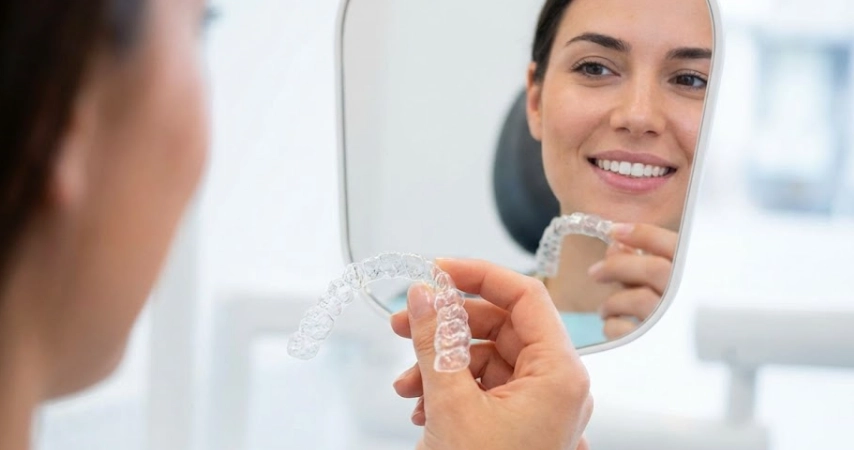
We have listed below the different degrees of impact that various treatments we provide bring about so as to facilitate you in grasping the size of such changes.
| Treatment Type | Primary Focus | Potential for Facial Change | Recovery/Adjustment Period |
| Clear Aligners | Dental alignment & mild bite correction | Low to Moderate (Subtle lip/profile changes) | Instant (No downtime) |
| Traditional Braces | Complex dental & root movement | Moderate (Can affect lip protrusion) | Days for comfort |
| Orthognathic Surgery | Skeletal jaw repositioning | High (Structural face shape change) | Weeks to Months |
| Hollywood Smile | Surface aesthetics (Veneers/Crowns) | Low (Improves smile width, not bone) | 5-7 Days in Turkey |
Top Queries on How Aligners Reshape Your Jaw
This largely depends on your starting point. If you have significant protrusion (buck teeth) and we retract them, your lips will naturally follow the teeth back. This often results in a flatter, more aesthetic profile. However, if your lips are already thin, our team carefully plans the movement to ensure we maintain enough support so you don’t lose lip volume visually.
Aligners cannot grow bone. If you have a skeletal chin deficiency, aligners alone won’t create a strong jawline. However, by correcting a deep overbite, we can often rotate the lower jaw slightly forward. This doesn’t grow the chin, but it reveals it, making a “weak” chin appear significantly more defined without invasive surgery.
You may have read forums about “aligner face.” The reality is often simpler: patients sometimes lose a little weight during treatment because they stop snacking (since they have to remove the trays to eat). This weight loss can lead to more defined cheekbones or slightly hollow cheeks. It is rarely a result of the aligners shifting bone structure in the mid-face.
Soft tissue changes usually lag behind tooth movement. While you might see your teeth straightening in the first 3 months, changes to your lip support or jaw profile typically become noticeable toward the latter half of your treatment plan. Patience is key.
Orthodontic relapse is real. If you stop wearing your retainers after treatment, your teeth will drift back to their original positions. Consequently, any aesthetic gain in your lip profile or jaw balance could be lost. This is why we insist on retention protocols immediately after you finish your treatment here in Turkey.
- Bishara, S. E., & Jakobsen, J. R. (2024). Longitudinal changes in the face and soft tissues: A study of adult orthodontic patients. American Journal of Orthodontics and Dentofacial Orthopedics.
- Proffit, W. R., Fields, H. W., & Sarver, D. M. (2023). Contemporary Orthodontics (7th ed.). Elsevier Health Sciences.
- Talic, N. F. (2022). Adverse effects of orthodontic treatment: A clinical perspective. The Saudi Dental Journal, 23(2), 55-59.
- Ackerman, J. L., & Proffit, W. R. (2021). Soft tissue limitations in orthodontics: Treatment planning guidelines. The Angle Orthodontist.
- Kamak, H., & Celikoglu, M. (2022). Facial soft tissue changes following clear aligner therapy. Journal of Orofacial Orthopedics.

