


Safe surgery through sugar control.
For many people living with diabetes, the dental chair can feel like a place of “no.” No to certain procedures, no to quick healing, and often, a fearful “no” to dental implants. There is a persistent myth that a diagnosis of Type 1 or Type 2 diabetes automatically closes the door on a permanent, beautiful smile.
In our clinical experience at Lema Dental Clinic in Istanbul, we have seen the opposite. The reality is that diabetes is not a barrier to dental implants; it is simply a clinical factor that requires a more sophisticated level of management.
The question remains: how do we ensure that your body accepts a titanium post when your blood sugar is a constant variable? It comes down to preparation, precision, and a deep understanding of how your body heals.
The Construction Site: Why Blood Sugar Matters
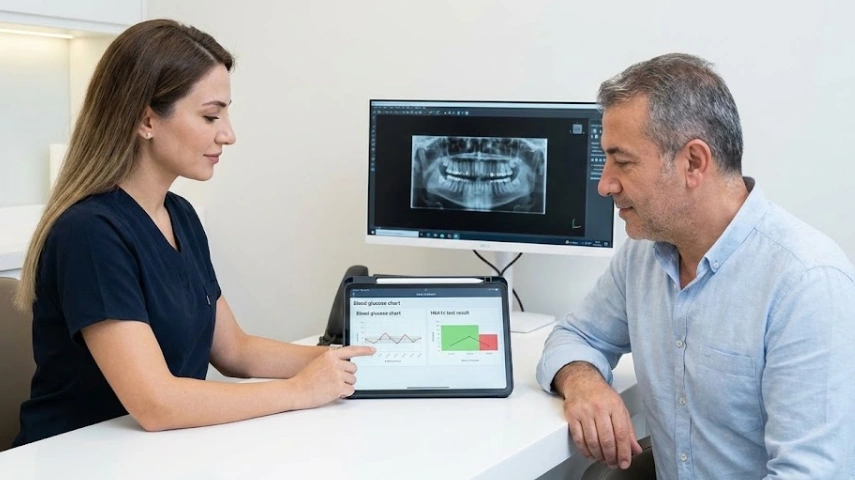
To understand the relationship between diabetes and implants, imagine a construction site. To build a sturdy house (the implant), you need a reliable crew of workers (your white blood cells and nutrients) and a clear road for them to deliver materials.
Professor Doctor Coşkun Yıldız often notes that high blood sugar acts like a massive traffic jam on those roads. When glucose levels are uncontrolled, the “construction crew” moves more slowly, the materials arrive late, and the foundation takes much longer to set. This process—where the bone fuses to the implant—is called osseointegration.
But let’s look closer at the science. Diabetes doesn’t stop the bone from growing; it just changes the pace. If we manage the “traffic” (your sugar levels) before and after the surgery here in Turkey, the body builds that foundation just as strongly as it would for anyone else.
The HbA1c Threshold: Our Safety Blueprint

At Lema Dental Clinic, we don’t guess. We measure. Before Dentist Polen Akkılıç and her team begin any surgical work, we look closely at your HbA1c levels. This number tells us the story of your blood sugar over the last three months, not just the last three hours.
If your diabetes is well-controlled, your success rate is virtually identical to a non-diabetic patient. The risk only rises when the sugar is unmonitored.
| Factor | Controlled Diabetes (HbA1c < 7%) | Uncontrolled Diabetes (HbA1c > 8.5%) |
| Infection Risk | Low (similar to non-diabetics) | Moderate to High |
| Healing Timeline | Standard (3-4 months) | Delayed (5-7 months) |
| Success Rate | 95% – 98% | 80% – 85% |
| Primary Concern | Routine post-op care | Delayed osseointegration |
| Clinical Approach | Standard surgical protocol | Antibiotic prophylaxis & sugar monitoring |
Why Turkey is a Preferred Choice for Diabetic Patients
You might wonder why so many diabetic patients choose to travel to Turkey specifically for this procedure. Here is what we see in the clinic: it is the combination of high-tech surgical tools and a holistic medical approach.
Because diabetic patients have a slightly higher risk of infection, we utilize advanced sterilization and minimally invasive techniques that cause less trauma to the gum tissue. Professor Doctor Coşkun Yıldız often employs specialized implant surfaces that are designed to “speed up” the bone-to-implant connection, giving your body a head start in the healing race.
The reality is that you aren’t just a dental patient; you are a medical patient. We treat the whole person, ensuring your primary care physician and our surgical team are on the same page.
FAQ: From the Doctor’s Desk
The stress of any surgery can cause a temporary rise in glucose. However, because we use localized, painless anesthesia and maintain a very calm, professional environment at Lema Dental Clinic, we minimize that stress response. We also schedule diabetic patients for morning appointments when insulin levels are typically most stable.
Usually, yes. In our clinical experience, a pre-operative and post-operative antibiotic course acts as an extra safety net for our diabetic guests. It protects the ‘construction site’ while your body focuses on healing.
We don’t say ‘no’; we say ‘not yet.’ If your levels are too high, we will work with you to create a plan to bring them down. We would rather wait two months and ensure a 98% success rate than rush into surgery today and risk failure. Your safety is our priority.
The pain levels are generally the same as for anyone else. However, because healing is a bit slower, you might feel minor tenderness for a few days longer. We provide a tailored pain management and nutritional plan to help you through this window.
The reality is that the surface of the implant matters most. We use premium, Swiss or German-engineered implants with ‘hydrophilic’ surfaces that attract blood and bone cells faster, which is a massive advantage for the diabetic healing process.
- Chrcanovic, B. R., et al. (2014). Diabetes and Tilted Implants: A Systematic Review. Journal of Oral Rehabilitation.
- Mellado-Valero, A., et al. (2007). Effects of diabetes on the osseointegration of dental implants. Medical Oral, Patología Oral y Cirugía Bucal.
- Naujokat, H., et al. (2016). Dental implants and diabetes mellitus—a systematic review. International Journal of Implant Dentistry.
- Oates, T. W., et al. (2013). Glycemic control and implant-stabilization in Type 2 Diabetes. Journal of Dental Research.
- Peled, M., et al. (2003). The use of dental implants in patients with diabetes mellitus. Journal of Periodontology.

