


Severe, throbbing, radiating jaw pain.
Imagine a pressure cooker was left on the stove for a really long time without anyone noticing. That is basically what happens to your jaw when a dental abscess develops inside it. A dental abscess is not just a “bad cavity” – it is a pocket of pus caused by a bacterial infection that is trapped deep in the bone or soft tissue and has no way of reaching the surface. Likewise, a pressure cooker, if you continue to ignore the steam that is leaking out, eventually, the lid will blow up.
We at Lema Dental Clinic in Turkey often encounter patients who come from overseas after weeks of “toughing it out” with the help of drugs bought over the counter. An abscess can really get the better of you and stop you from carrying on with your routine.
It does not really matter whether you have a toothache that is aggravating and irritating the whole time or your whole cheek has become so swollen that it has altered your facial features; identifying these symptoms is the first step in saving your tooth as well as your general health.
The Red Flags: How Your Body Screams “Infection”
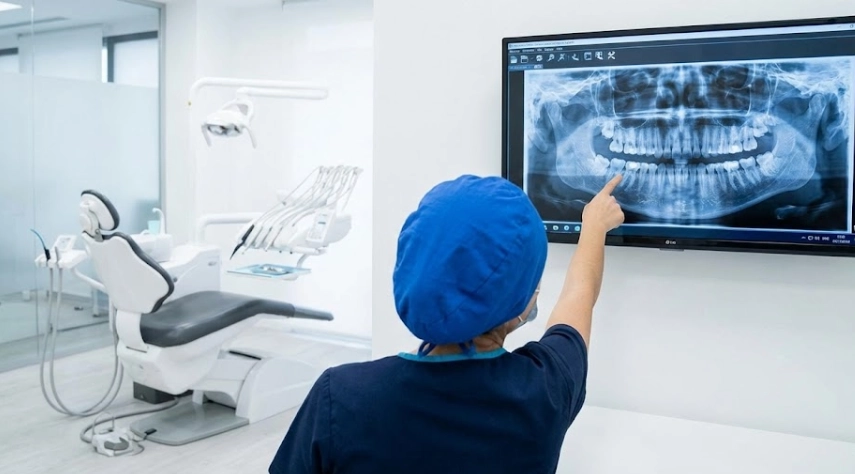
Pain is often the first sign that your body sends out, but what really gives the story away is the character of the pain. From the clinic perspective, we have found that very rarely do patients report pain from an abscess as a “sting” or a “twitch.” It is generally deep, insistent, and feels almost like a continuous torture.
The Unmistakable Throbbing Pain
You might get a quick sensation from biting an ice cream, for instance, but the one we are describing here is persistent, relentless pain that sometimes spreads up the jawbone, neck, or even the ear. Dentist Polen Akkılıç and her staff remark that patients generally assume pain gets worse when they lie down. The logic certainly explains why this happens: when the body is horizontal, the blood rushes to the head, hence what is essentially an increased pressure of the sensitive tooth pulp, making your rest practically impossible.
Temperature Sensitivity That Lingers
Take a mouthful of hot coffee or cold water and the pain “gets you” but then continues for a relatively long time after the liquid left, that is basically your nerve dying or more likely already infected. Such a long-lasting reaction signifies an irreversible pulpitis, which is probably the beginning of an abscess.
Swelling and Facial Asymmetry
You may be able to see your gums looking irritated-character-opening-the-mouth-red, shiny, and swollen. There is, however, a condition in which this swelling travels as it becomes more pronounced. You may be able to confirm by yourself by looking at the facial asymmetry, or, besides the swelling, if it is underneath your jaw, the infection is progressing in the tissues around it.
The “Pimple” on Your Gums
In the dental setting, a fistula or a sinus tract is the term used by clinicians. For you, it is basically a tiny pimple on the gum tissue near the tooth that is causing the pain. Upon pressing the area, you may notice that a salty or foul-tasting fluid is coming out, and interestingly, the pressure (pain) may cease temporarily. This does not imply that you have been healed; on the contrary, it means that the “pressure cooker” has found a release valve. The infection is still active, and hence, it is hazardous to your health.
The Systemic Shift: When the Infection Moves Beyond the Tooth
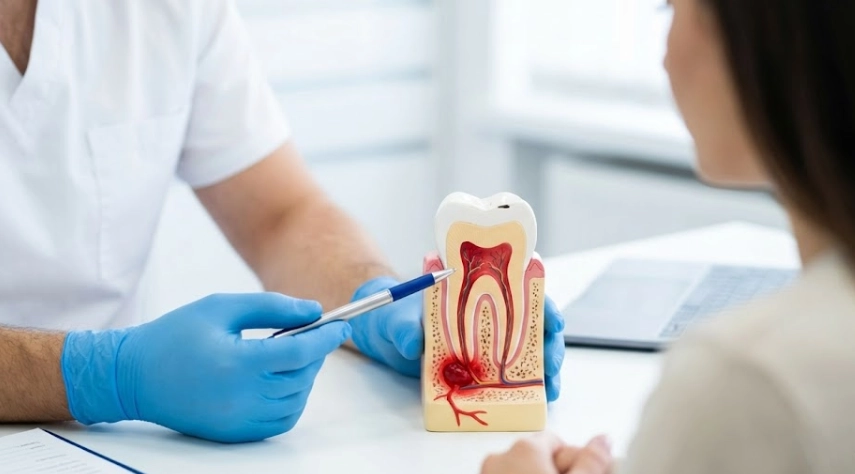
It should be emphasized that your mouth is in fact connected to your entire body. When bacteria get past the tooth’s defense mechanisms, they circulate in your blood.
- Fever and Chills: If toothache has come along with a temperature, it means your body is at war on a systemic level.
- Swollen Lymph Nodes: Sensitive bumps in the jaw or neck just show your immune system responding to the infection drainage.
- Difficulty Swallowing or Breathing: Immediate medical attention is needed for this. If the swelling has severely compromised the airway (this is what is called Ludwig’s Angina), you will need an ER visit and not just a call to the dentist.
Comparing the Types: Periapical vs. Periodontal
A dental abscess is not always the same kind of thing. Professor Doctor Coşkun Yıldız quite frequently tells our surgical candidates that it is the origin of the abscess that decides the treatment plan. Here’s how we clinically simplify it.
| Feature | Periapical Abscess | Periodontal Abscess |
| Location | At the tip of the tooth’s root. | In the gum pocket next to the tooth root. |
| Primary Cause | Untreated cavity or injury reaching the pulp (nerve). | Gum disease (periodontitis) or trapped food. |
| Pain Characteristics | Severe; hurts to bite down or tap on the tooth. | Dull, consistent ache; tooth may feel “loose.” |
| Visual Signs | Often invisible until facial swelling starts. | Localized swelling/boil on the gum line. |
| Treatment Urgency | Critical: Root canal or extraction needed. | High: Drainage and deep cleaning needed. |
The Lema Approach: Why Treat It in Turkey?
You might wonder why someone would travel to Turkey for a tooth infection. The answer lies in the complexity of saving the tooth. in many general practices, the quick fix for a severe abscess is extraction. At Lema Dental Clinic, our priority is preservation whenever biologically possible.
Under the guidance of Professor Doctor Coşkun Yıldız, we utilize advanced 3D tomography to determine exactly how far the infection has spread into the jawbone. We don’t just drain the abscess; we treat the biological root cause. Whether it requires a precision root canal or a surgical apical resection (removing the infected tip of the root), the goal is to clear the infection while keeping your natural smile intact.
Critical Queries on Managing Dental Infections
Absolutely not. We cannot stress this enough. Attempting to drain an abscess at home is incredibly dangerous. You risk pushing the bacteria deeper into the tissue (causing cellulitis) or introducing new, more aggressive bacteria into the wound. Allow a professional to establish drainage in a sterile environment.
This is a common hope, but unfortunately, the answer is no. Antibiotics travel through the blood, but the inside of a necrotic (dead) tooth has no blood supply. The drugs can stop the infection from spreading to your cheek or neck, but they cannot sterilize the dead nerve inside the tooth. The physical source of the infection must be removed or treated mechanically.
You shouldn’t wait at all. An abscess is a ticking clock. What starts as a toothache can evolve into a life-threatening condition if the infection spreads to the brain, heart, or lungs (sepsis). If you have symptoms, time is your enemy.
Ironically, the treatment is what stops the pain. The abscess itself is painful because of the pressure. Once Dentist Polen Akkılıç or our surgeons numb the area and release that pressure, the relief is almost instantaneous. Modern anesthesia ensures the procedure itself is comfortable.
No. The pain might stop if the nerve dies completely, but the infection is still there, eating away at your jawbone. Silence in a tooth that was previously throbbing is actually a bad sign—it means the damage is deepening, even if you can’t feel it anymore.
- Abbott, P. V. (2004). Classification, diagnosis and clinical manifestations of apical periodontitis. Endodontic Topics, 8(1), 36-54.
- Matthews, D. C., & Sutherland, S. (2018). Emergency management of acute apical abscesses in the permanent dentition: a systematic review of the literature. Journal of the Canadian Dental Association, 69(10), 660.
- Robertson, D., & Smith, A. J. (2009). The microbiology of the acute dental abscess. Journal of Medical Microbiology, 58(2), 155-162.
- Sanders, J. L., & Houck, R. C. (2022). Dental Abscess. StatPearls Publishing.
- Siqueira Jr, J. F., & Rôças, I. N. (2013). Microbiology and treatment of acute apical abscesses. Clinical Microbiology Reviews, 26(2), 255-273.

