


Discrete adult orthodontic choices.
One of the main dilemmas in adult orthodontics is usually the trade-off between clinical effectiveness and social discretion. Most adults, as opposed to teenagers, who come for orthodontic treatment, will almost always require that the appliance be as little noticeable as possible during their professional and social interactions.
Choosing the right solution between polycrystalline ceramic braces and traditional stainless steel at Lema Dental Clinic in Istanbul is not only a matter of evaluating the patient’s lifestyle but also a combination of a detailed study in material science and light physics. Although the two systems follow the same biomechanical principles to make the teeth move, the way they look and their performance differ a lot.
The Physics of Invisibility: Polycrystalline Alumina
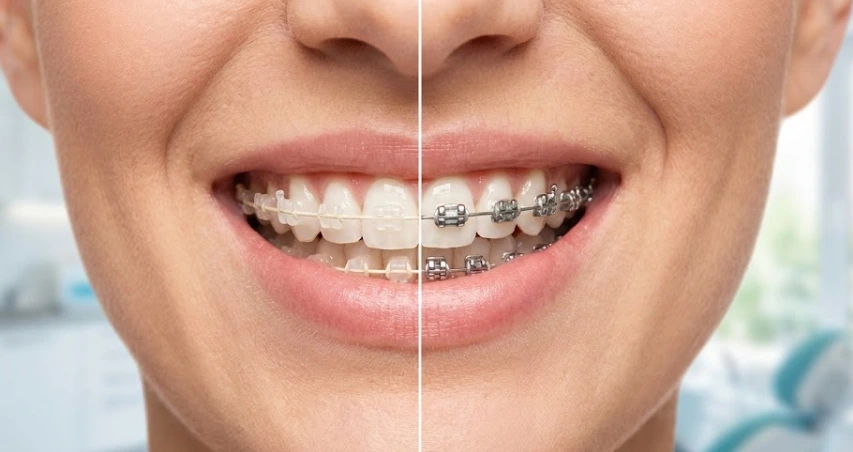
The “invisible” appeal of ceramic braces lies in their optical properties. Most modern ceramic brackets are composed of polycrystalline alumina.
- Light Refraction: While metal is a kind of material that reflects the light (thus a high-contrast visual is created), ceramic brackets are more of a light-transmitting type. Being translucent, the bracket can take the natural color of the tooth beneath it, thus greatly lowering the “chromatic contrast” which makes the metal braces so conspicuous.
- The “Clear” Wire Illusion: To further minimize visibility, Dentist Polen Akkılıç and her team often utilize tooth-colored or frosted archwires. However, it is a clinical reality that these coatings can wear over time, revealing the metal core beneath.
Clinical Note: While the ceramic bracket itself is immune to staining, the clear elastic ligatures (the “o-rings” that hold the wire) are highly susceptible to pigments from coffee, red wine, and tobacco. For an adult in Turkey, maintaining “invisibility” requires meticulous dietary awareness.
The Functional Powerhouse: Stainless Steel
Traditional metal braces remain the global standard for a reason: mechanical reliability. Stainless steel brackets are smaller, lower profile, and offer significantly less friction between the bracket and the wire.
- The Friction Factor: Metal-on-metal sliding is very efficient. Ceramic, being a more abrasive material, generates a higher friction, which in some cases, the total treatment time may be even extended by several months.
- Structural Integrity: Ceramic is a brittle material. Under high occlusal (biting) forces, ceramic brackets are more prone to fracturing than their metal counterparts. Professor Doctor Coşkun Yıldız often suggests that for complex cases requiring high-tension movements, the durability of metal is superior.
Comparative Matrix: Adult Orthodontic Systems
| Feature | Polycrystalline Ceramic | Stainless Steel (Metal) |
| Visibility | Winner. Translucent and discrete. | High contrast; very noticeable. |
| Treatment Speed | Slightly slower due to friction. | Winner. Maximum clinical efficiency. |
| Durability | Prone to brittle fracture. | Highly durable; rarely breaks. |
| Stain Resistance | Larger brackets can feel “bulkier.” | Winner. Completely stain-proof. |
| Profile/Comfort | Larger brackets; can feel “bulkier.” | Lower profile; less lip irritation. |
The “Turkey” Experience: Why Technology Matters
Adults traveling to Lema Dental Clinic often assume the choice is binary. However, modern digital orthodontics allows for hybrid approaches. For instance, placing ceramic on the visible upper “smile zone” and metal on the lower teeth to optimize cost and speed without sacrificing aesthetics.
“The goal for our adult patients is to ensure the treatment doesn’t interfere with their confidence,” says Professor Doctor Coşkun Yıldız. By utilizing 3D intraoral scanning and precision bracket placement, we can minimize the bulk of ceramic systems, making them far more comfortable than the versions available even five years ago.
FAQ: Clinical Insights for Adults
The brackets do not,” clarifies Dentist Polen Akkılıç. “However, the clear rubber bands used to secure the wire can absorb stains from curry, tea, or coffee. We recommend more frequent hygiene appointments or switching to self-ligating ‘Damon’ ceramic brackets, which eliminate the need for these bands.
The level of discomfort is generally the same, as the pressure exerted on the teeth is identical. However, because ceramic brackets are slightly larger, they may cause more initial irritation to the inner lips until the soft tissue acclimates.
Ceramic materials are more expensive to manufacture and require more chair time for the orthodontist. In Turkey, while the price for ceramic is higher than metal, the overall cost remains significantly lower than comparable treatments in the UK or the USA due to operational efficiencies.
- Birnie, D. (1990). Ceramic brackets. British Journal of Orthodontics.
- Russell, J. S. (2005). Aesthetic orthodontic brackets. Journal of Orthodontics.
- Gkantidis, N., et al. (2012). Friction in orthodontics: Ceramic vs. Metal. American Journal of Orthodontics and Dentofacial Orthopedics.
- Proffit, W. R., et al. (2018). Contemporary Orthodontics. Elsevier Health Sciences.

