


Bold gold for front teeth.
A radiant gold smile was a timeless status symbol, indicative of permanence and extravagance. Although modern dentistry has greatly favored “invisible” restorations such as porcelain and zirconium, the trend of gold crowns on front teeth is strongly reemerging. Perhaps it is an homage to the aesthetics of yesteryears or a desire for a striking, individual statement, but the fact remains: is it a good clinical decision?
We at Lema Dental Clinic in Turkey consider dentistry a perfect combination of high-level artistic expression and stringent biological science. Should you be considering using this “royal” metal for your front teeth, there are several important things you should know beyond the surface gleam.
The Resurgence of the Bold Restoration
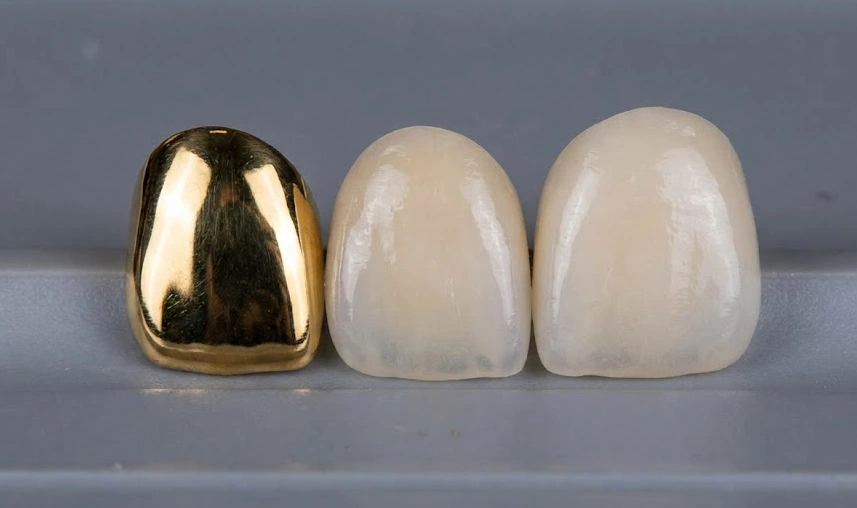
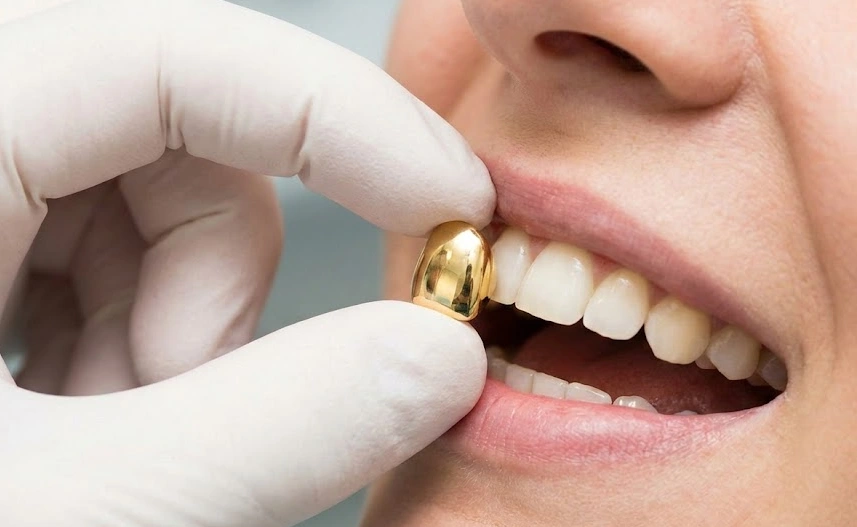
It is well known that gold is a great material for molars because of its superior strength. However, the whole matter becomes something else when you put it right at the front. In our clinical experience at Lema Dental Clinic, patients often choose gold for the front teeth to create a specific “look” or simply because they value the extraordinary durability of the material.
Professor Doctor Coşkun Yıldız frequently emphasizes that, in all likelihood, gold is the material that we can put in the human mouth which is the most “forgiving”. In contrast to ceramics that can be quite brittle, gold possesses a certain level of “ductility.” Imagine it as a kind of high-end shock absorber for your bite; it allows just enough give to protect the tooth structure underneath without popping due to everyday pressure.
Why Gold? The Biological Advantage
On the other hand, let’s not forget that the doctor’s first preference in terms of materials may be gold, rather than porcelain, even for a front tooth, but only if the patient doesn’t mind the color.
- Biocompatibility: Gold is an excellent element chemically. It is not subject to corrosion, and it doesn’t cause the “black line” at the gum margin, such as older porcelain-fused-to-metal (PFM) crowns often do.
- Enamel Friendliness: Gold gets worn out almost exactly at the same rate as human enamel. Suppose you’ve got a gold crown on your top teeth; in that case, it’s not going to grind down your natural bottom teeth like some harder porcelains might.
- Minimal Preparation: Since gold is very tough even when it is used in thin layers, Dentist Polen Akkılıç and her team are sometimes able to conserve more of the patient’s natural tooth structure during the tooth preparation phase.
Comparing the “Front Row” Candidates
When you visit us in Turkey, we walk you through every option. The reality is that your choice depends on whether you want your dental work to “blend in” or “stand out.”
| Feature | Gold Alloy Crown | Zirconium (Prettau) | E-max (Lithium Disilicate) |
| Visibility | High (Metallic Gold) | Low (Matches Teeth) | Extremely Low (Very Natural) |
| Durability | Highest (Lifetime) | Very High | High |
| Tooth Prep | Minimal (Thin Walls) | Moderate | Moderate |
| Gingival Health | Excellent | Excellent | Good |
| Best For | Bold Aesthetics / Bruxisers | Strength & Beauty | Ultimate Natural Look |
The Lema Approach: Artistry in Turkey
The question remains: how do we make a gold crown look like a piece of jewelry rather than just a “metal tooth“? This is where the expertise of Dentist Polen Akkılıç and her team comes into play. At Lema Dental Clinic, we believe that a gold restoration should reflect the natural tooth and hence, we do not merely use a standard mold. We sculpt the gold as if it were a central incisor with all its lobes, mamelons, and gentle curves that play with the light.
The process in Turkey is streamlined but never rushed. We ensure the fit is “passive,” meaning it sits on your tooth with microscopic precision. A poor fit can lead to decay underneath, but a Lema-standard fit ensures that the gold remains a permanent part of your identity for decades.
A Metaphor for Your Smile
Think of the bone in your jaw as the foundation of a building, and the crown as the roof. A ceramic roof looks stunning and blends in with the surroundings very well. A gold roof, on the other hand, is like bronze—it’s a very old, reliable material that lasts through the toughest weather without a leak. At Lema, we offer the architectural know-how to make sure that whatever “roof” you pick, your foundation will stay strong.
FAQ: Direct Insights from Our Doctors
Absolutely. In a clinical setting, we use high-noble alloys, usually 18 to 22 karats. We don’t use pure 24k gold because it’s too soft for biting. We blend it with small amounts of platinum or palladium to ensure it doesn’t deform over time.
The reality is, yes. Because gold requires less tooth removal, if you decide in five years you want a white smile again, we usually have plenty of natural tooth left to work with for a Zirconium or E-max replacement.
Not at all. High-quality gold is chemically inert. It doesn’t react with saliva or food. If you experience a metallic taste, it’s usually a sign of a lower-quality base metal, which we never use at Lema Dental Clinic.
We typically complete the entire process in 3 to 5 days. This includes the initial preparation, the digital scanning, the custom casting in our lab, and the final fit. We want you to enjoy Istanbul while your smile is being crafted.
The sensation is identical to any other crown procedure. We use advanced local anesthesia to ensure you feel nothing. The ‘healing’ is actually often faster because gold is so gentle on the surrounding gums.
- Anusavice, K. J., Shen, C., & Rawls, H. R. (2012). Phillips’ Science of Dental Materials. Elsevier Health Sciences.
- Donovan, T. E., & Cho, G. C. (2001). Materials for conservative posterior restorations. Journal of the California Dental Association, 29(2), 121–127.
- Kelly, J. R., & Nishimura, I. (2008). Science-based decision making in fixed prosthodontics. Journal of Prosthetic Dentistry, 99(2), 82–97.
- Knosp, H., Holliday, R. J., & Schnorr, R. (2003). Gold in dentistry: Alloys, uses and performance. Gold Bulletin, 36(3), 91–102.
- Rosenstiel, S. F., Land, M. F., & Fujimoto, J. (2015). Contemporary Fixed Prosthodontics. Mosby.

