


Yes, you can eat most foods, but avoid very hard or sticky ones.
Can I Eat Anything I Want with Cosmetic Teeth?
An emotional moment is usually when you first gaze at your reflection at Lema Dental Clinic and spot your changed smile. Perhaps, via porcelain veneers, zirconia crowns, or full-arch implants, you are essentially holding a work of art in modern bioengineering.However, as soon as the initial excitement fades, a very common practical question almost always comes to one’s mind: “Is it really possible for me to eat anything I want with these?”
It is a completely reasonable concern. You have gone to Turkey to get top-level treatment and naturally, you want the smile to be your lifetime companion. The brief answer is: Yes, you can eat almost any kind of food, but there is a bit of a nuance in how you do it.

The Strength of Modern Materials: It’s More Than Just Looks
Historically, cosmetic teeth have been thought of as “delicate.” That has changed drastically nowadays. Professor Coşkun Yıldız often points out to our patients that the materials we use nowadays—mainly E-max and Zirconia—are manufactured to have the same structural strength as natural tooth enamel.
Imagine a top-grade veneer just like the windshield of a luxury car. Once it’s bonded to the frame it is very difficult to break, however, if you hit it with a localized, sharp force (like a flying stone), it can crack. That’s the kind of situation where your teeth are the same. They can handle the “daily commute” of chewing, but they are not intended for “off-road” use with non-food items.
The First 48 Hours: The Adjustment Period
It really is true that the “honeymoon period” with your new teeth requires a bit of perseverance. Dentist Polen Akkılıç and her team strongly recommend a soft-food diet for only the first few days. This suggestion does not imply that the teeth are fragile but simply that your gums and jaw muscles have to get used to the new bite and thus require some rest.
What we witness at the clinic is this: a patient who doesn’t hold back and immediately chomps down on a crusty baguette may have his/her teeth become sensitive in no time, not because the tooth gave in, but because the nerves are “retracing” to the new restorations.
Navigating the “Danger Zone” Foods
Your smile makeover may be sturdy, but there are habits that will speed up its wear. We love to split food into three “risk” levels.
1. The Hard Offenders
Ice cubes, popcorn kernels, and hard candies form the triad of a nightmare for your cosmetic-treated teeth. The problem goes beyond the hardness factor; it is more about the exposure to an unexpected force. When you bite down on an unpopped kernel, you could get a “point-load” which means a force that is concentrated on a very small area and can cause even the strongest porcelain to be damaged.
2. The “Tug-of-War” Foods
What if you have veneers on your front teeth but still want to eat corn on the cob and ribs? Dentist Polen Akkılıç gives a hint: rather than biting directly into the corn on the cob or ribs, just remove the corn from the cob and cut the meat. This little change stops the “shearing force” which if left for years could eventually lead to a bond coming off.
3. Staining Agents
Every time we use them in Turkey, we are totally surprised that Zirconia and E-max can keep their colors just like the first day even though they are subjected to all kinds of staining agents. On the other hand, natural enamel is porous, but top-grade porcelain does not have pores practically. The truth is, the resin cement that is used to glue the porcelain onto the tooth can get stained if you neglect this over a long period of time. In case you are obsessed with red wine, turmeric or a good cup of black coffee, simply make sure that you rinse your mouth with water immediately after and wear the bright smile margin.
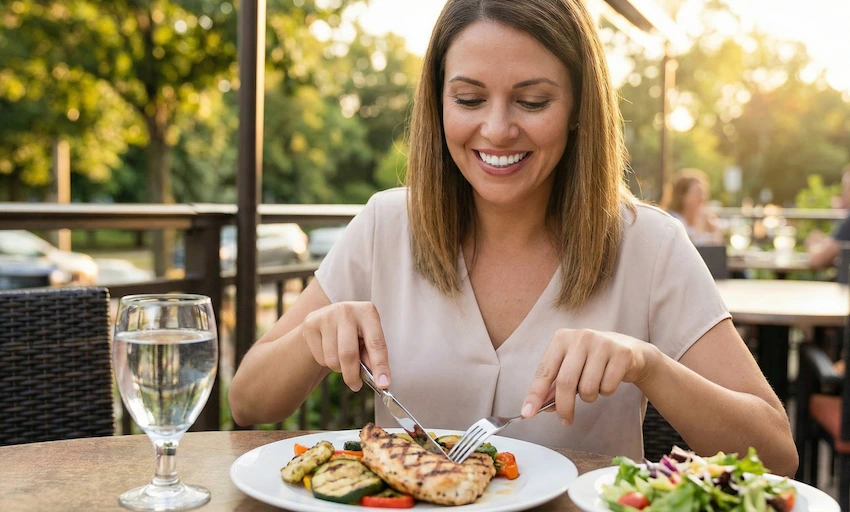
Comparison: Eating with Different Cosmetic Options
| Treatment Type | “Safe” Foods | Foods to Avoid/Limit | Longevity Tip |
| Porcelain Veneers | Pasta, Fish, Cooked Veggies | Hard Nuts, Biting Nails | Avoid using front teeth as “tools.” |
| Zirconia Crowns | Most Steaks, Poultry | Extremely Sticky Toffee | Floss regularly at the gum line. |
| Dental Implants | Full Normal Diet | Ice Cubes, Hard Bones | Treat them like natural teeth; brush & floss. |
| Composite Bonding | Soft Foods, Fruits | Hard Crusts, Coffee, Tea | High risk of staining; avoid tobacco. |
The Lema Dental Clinic Philosophy: Living Without Fear
We don’t want you to leave our clinic in Turkey feeling like you are wearing “glass teeth.” The goal of Professor Doctor Coşkun Yıldız is to restore function just as much as beauty.
But let’s look closer at the mechanics of the jaw. Your masseter muscle is one of the strongest in the human body. It can exert incredible force. When you have cosmetic teeth, you aren’t just protecting the porcelain; you are protecting the harmony of your bite. This is why we often provide a custom night guard for our patients—to protect that investment from the silent stress of nighttime grinding.
FAQ: Common Concerns from Our Patients
A: Yeah, but be careful. If we have injected local anesthesia, you should give it some time before you drink or eat so you won’t injure your lip or tongue by biting them. Your new teeth won’t have any problem with temperature changes but your natural tooth structure underneath may get a slight “zing” sensation for a few days.
Not at all. To avoid using a toothpaste with abrasive action. You should also avoid using “whitening” toothpastes that contain grit as these may cause tiny scratches on the surface of your restorations which will accumulate over time.
No, that’s not true. You can still enjoy apples. However, rather than biting into a whole, hard Granny Smith apple with your front teeth, you could simply make slices. It is healthier for the teeth and actually, much less effort to eat!
Try not to worry. Though it is very unlikely when we use high-grade materials at Lema, it can happen. Because we have digital records of your smile design, we can usually produce a replacement that matches your set perfectly.
In most cases, yes. Sugar-free gum is okay. Nevertheless, if you have temporary restorations while waiting for your permanent ones, you should avoid gum completely, as it can loosen the temporary cement adhesion.
- Anusavice, K. J., Shen, C., & Rawls, H. R. (2012). Phillips’ Science of Dental Materials. Elsevier Health Sciences.
- Gürel, G. (2003). The Science and Art of Porcelain Laminate Veneers. Quintessence Publishing.
- Kelly, J. R., & Nishimura, I. (2008). Science-based guidelines for maximizing outcomes through the use of zirconia in dentistry. Journal of Prosthodontics.
- Magne, P., & Belser, U. (2002). Bonded Porcelain Restorations in the Anterior Dentition: A Biomimetic Approach. Quintessence Publishing.
- Strassler, H. E. (2007). Minimally invasive porcelain veneers: indications for a conservative esthetic dentistry approach. Dental Clinics of North America.

