


Rare but biologically possible.
When we discuss the ‘gold standard’ of tooth replacement at Lema Dental Clinic, titanium dental implants are inevitably the main topic. They have essentially powered the field of restorative dentistry for years because of their unique capacity to fuse with the human bone—a process referred to as osseointegration. Yet, as patients become more conscious about what they put inside their bodies, a crucial question has emerged: Can a person really be allergic to titanium?
Titanium is often praised as a “biocompatible” material; however, the fact is that the human body is a complicated, individual ecosystem. Something that works for 99% of people may not necessarily work for everyone.
Metal Sensitivity: The Body’s Security Guard
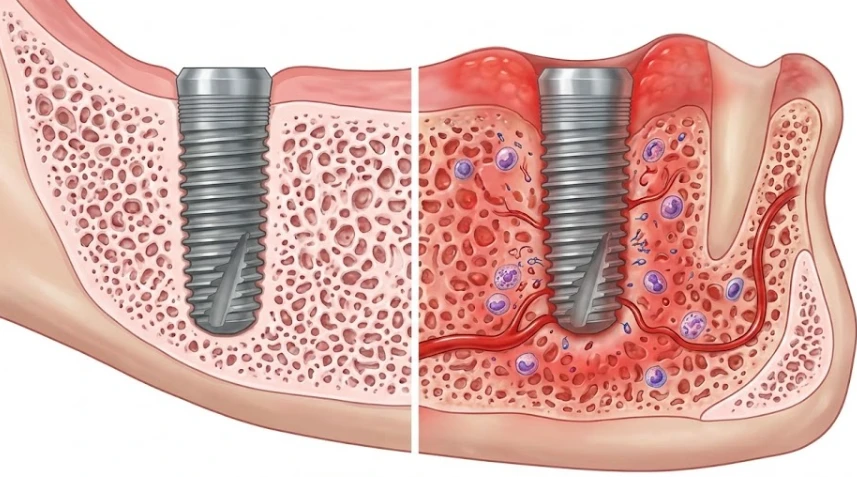
A good way to learn about a titanium allergy is to imagine your immune system as a security man who is extremely watchful. Most of the time, this security man identifies titanium as a “good friend,” and so, he lets it bond with the bone without any problem. However, a very small number of individuals, this security man picks out the titanium ions as the dangerous ones.
Professor Doctor Coşkun Yıldız points out that real titanium allergy cases are so rare that they only make up 0.6% of the world’s population. Anyway, let’s see why. The actual reason for the reaction is usually not titanium but the presence of trace elements like nickel or aluminum which have been used to make the alloy.
Detecting the Signs: Symptoms of Titanium Sensitivity
The next question is: how do you know if you are that 0.6%? The reaction of a metal allergy in the mouth may not always resemble a typical skin rash. At Lema Dental Clinic, as part of our expertise, we monitor subtle indications of the body rejecting the “visitor”.
- Persistent Inflammation: The gums continue being red and swollen long after the surgical healing has been done.
- Unhealed Tissues: The surgical area is always open or “leaking”.
- Hives or Other Skin Disorders: The reaction may not be in the mouth, but in some other parts of the body that become itchy.
- Loose Implant: If the bone does not want to “hold” the implant, this can be a sign of a biological rejection instead of a mechanical failure.
Titanium or Zirconia: Pick Your Base
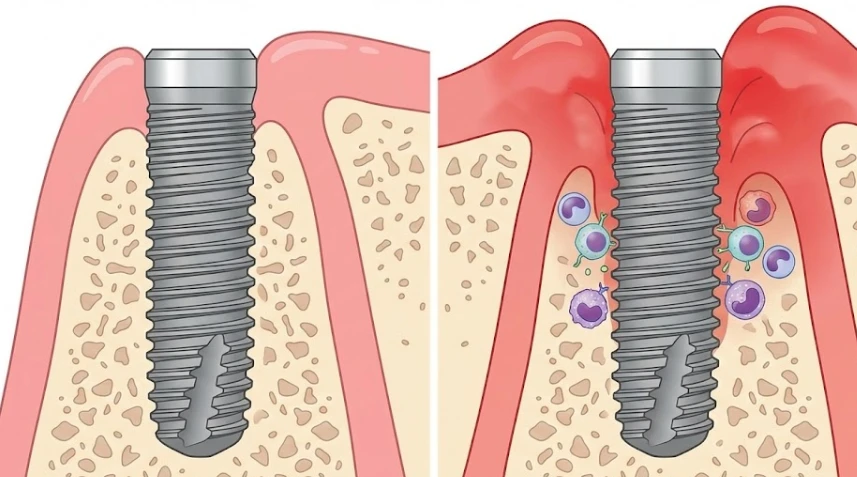
If you know that you react to cheap jewelry or certain watches, we do not gamble. At Lema Dental Clinic in Turkey, Dentist Polen Akkılıç and her crew usually suggest a MELISA test (Memory Lymphocyte Immunostimulation Assay) before the operation. Through this blood test, we can know with absolute certainty how your white blood cells will respond to various metals.
But what if you are indeed allergic? This is when we turn to the fabulous choice that modern material science has given us: Zirconia Implants.
Titanium can be compared to one strong metal beam, whereas zirconia is like a high-strength ceramic “diamond“. Both are very strong materials but the latter is completely metal-free.
| Feature | Titanium Implants | Zirconia Implants |
| Material Type | Metal Alloy (Ti-6Al-4V) | Ceramic (Zirconium Dioxide) |
| Allergy Risk | Extremely Low (0.6%) | Virtually Non-existent |
| Aesthetics | Darker metal may show through thin gums | Tooth-colored (white), ideal for thin tissue |
| Biocompatibility | Excellent | Excellent (Bio-inert) |
| Clinical History | 50+ years of data | 15+ years of data |
The Lema Approach in Turkey: Pre-Surgical Wisdom
Choosing to get dental implants in Turkey shouldn’t just be about the cost; it should be about the depth of the pre-surgical screening. Professor Doctor Coşkun Yıldız insists on a “biological-first” approach. We don’t just look at your X-rays; we look at your medical history. If you have a known nickel allergy or a history of autoimmune sensitivity, we pivot our strategy.
The reality is that a successful implant is like a successful marriage; there needs to be total compatibility between the host and the guest for the relationship to last twenty or thirty years.
FAQ: Direct Insights for the Patient
It is highly unlikely. Most allergic reactions happen within the first few weeks or months of placement. If an implant fails after five years, the cause is almost always hygiene-related (peri-implantitis) rather than an allergy.
Yes. Modern zirconia is “yüttria-stabilized,” making it incredibly resistant to cracking. It can handle the heavy forces of chewing just like its titanium counterpart.
The test is a simple blood draw. While it adds a small step to your journey in Turkey, the peace of mind it provides—knowing your body won’t fight the implant—is worth the extra few days.
Not necessarily. Most jewelry allergies are caused by nickel. While some titanium alloys contain trace nickel, high-grade medical titanium is often nickel-free. However, we always prefer to test rather than guess.
If a true allergy is confirmed, the reality is that the implant usually needs to be removed. Once the site heals, Dentist Polen Akkılıç and her team can typically replace it with a metal-free zirconia option.
- Harloff, T., et al. (2010). Titanium allergy or not? “Impurity” of titanium implants as a possible cause. Journal of Materials Science: Materials in Medicine.
- Müller, K., & Valentine-Thon, E. (2006). Hypersensitivity to titanium: Clinical and laboratory evidence. Neuro Endocrinology Letters.
- Siddiqi, A., et al. (2011). Titanium allergy: Could it affect dental implant survival? Clinical Oral Implants Research.
- Valentine-Thon, E., & Schiwara, H. W. (2003). Validity of MELISA® for metal sensitivity testing. Neuro Endocrinology Letters.
- Yıldız, C. (2024). The Biological Interface: Ceramic vs. Metal in Modern Implantology. Lema Clinical Press.

