


Yes, veneers can be applied without a gingivectomy if your natural gum line is already symmetrical.
Imagine your smile like a painting made just for you. Teeth are your paint, and gums are the frame. So if the frame isn’t straight, even a great picture will look odd.
But what if your frame is perfect? Would you still have to change it?
In our experience, here at Lema Dental Clinic in Turkey, patients wonder about this quite often. They dream about beautiful porcelain veneers, but the mention of “gingivectomy” scares them. Reshaping gums is what this term medically means.
Yes, it is possible to get veneers without a gingivectomy. However, we also try to help you understand why, sometimes,s it is necessary, and other times you can do without it.
Definition of a Gingivectomy
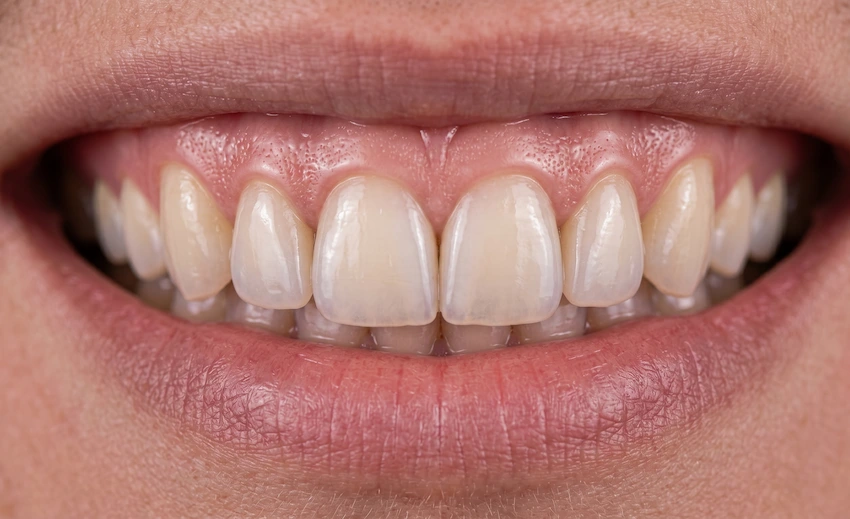
A gingivectomy is a tiny and pretty much painless surgical procedure where the dentist adjusts the line of your gums. This is done so that cells are more exposed and the overall smile is totally symmetrical.
If you have a lovely suit on, but one of the sleeves is way too long, the overall suit will be amazing; however, the uneven fit will spoil the look. Gums are the same. So if a gum line is lower for one tooth than for the other, the veneers you put in will hardly be pleasing to the eye.
Is It Possible to Avoid Gum Reshaping?
According to what we observe in our practice, the majority of patients do not actually require a gingivectomy.
Polen Akkılıç, the dentist, and her team examine your face profoundly before anything else. They know your speech, rest, and smile very well. And if:
- Your gums are in harmony. The highest points of your gum line up perfectly from one side to another.
- Your teeth are of sufficient length. Enough of the natural tooth is left for the veneer to bond properly.
- You don’t smile like a character out of a cartoon book, showing too much gum. When you laugh, there is a nice balance between white teeth and pink gums.
Once you’ve passed the test, it’s veneers on.
In Which Cases is a Gingivectomy Needed?
Not doing a gum lift when it is really needed can spoil your final result entirely.
Prof. Dr. Coşkun Yıldız stresses time and again that “it is impossible to construct a smile that will last forever on an uneven base. Thus, it is the biology that should lead us.”
We recommend a fast, pain-free laser gingivectomy if you have any of the following issues:
- Short, Square Teeth: This is the case when your gums never completely rolled back during the years of your growth. Your teeth appear to be small, like they’re wearing big sweaters. To see the real tooth beneath the gum, we have to go down with the gum tissue.
- Uneven Gums: Your gum level goes up and down all over the place.
- Severe Tooth Injury: If a tooth breaks right where the gum should be a gel, the gum must be lowered down until we reach the enamel surface. Otherwise, the gum will always be inflamed and in a state of shedding a little blood.
The Treatment Process: Your Guide
We want you to understand your treatment better, so here is what your gums determine it to be.
| Gum Condition | Treatment at Lema Clinic | Recovery Period | Result |
| Fine gum line and gum health | Veneer Preparation Directly | No waiting | Lovely, natural forms. |
| Inequality in the gum line | Laser Gingivectomy | 3 to 7 days | A frame of your smile that is perfectly harmonious. |
| Overeminent “Gummy Smile” | Extensive Crown Lengthening | 6 to 8 weeks | A stunning solution for teeth that appear very short. |
The Lema Dental Clinic Philosophy

One of the strongest reasons that makes people book their appointment with us in Turkey is that we go a mile further to give personalized attention. For us, a gingivectomy is only a means or a method. It is not a fixed rule.
Digital tools enable us to display the expected outcome for you on a screen. If you require a gum lift, we carry it out with the help of a soft-tissue laser, which is not only painless but also faster in healing,g and only a few days after the procedure, you will most likely be back to your normal activities. Also, if you don’t require it, then we will definitely be praising your magnificent genetic makeup and right afterwards start your veneers.
5 Questions You Shouldn’t Forget to Ask
Not even a bit. We will make sure the area is fully numbed before starting. Also, since the latest dental lasers are being used instead of scalpels, the bleeding levels are incredibly low. Most patients experience a slight tickle only. Using standard painkillers, you will be able to get rid of any minor discomfort.
To some extent, sure. There will be no need for the healing time. The work on veneers can commence right away. But do not forget that the efficiency of our in-house lab is quite high,h and we manage to complete the makeover of your entire smile within 5 to 7 days, ys even with minor gum contouring.
Nobody can make you do anything. However, don’t expect to be treated like a kid with a parent. On the other hand, this may result in your new veneers being short or uneven. We want you to be completely satisfied with the final look of your smile.
The wound restoration happens quite quickly after a simple gum lift done with a laser; hence, we do a follow-up within a week or so. We must be sure that the gums have fully stabilized and that the tooth surface is very well sealed before proceeding to the placement of the porcelain.
Not necessarily! In a lot of cases, all it takes is the removal of the excess gum tissue to reveal the natural beauty of the teeth that are hidden. Provided your teeth are healthy and, what is more, white, a mere laser gingivectomy will do the trick and give you an ideal smile.
- Chu, S. J., Tarnow, D. P., Tan, J. H., & Stappert, C. F. (2009). Papillary proportions in the maxillary anterior dentition. The International Journal of Periodontics & Restorative Dentistry, 29(4), 385–393.
- Garber, D. A., & Salama, M. A. (1996). The aesthetic smile: diagnosis and treatment. Periodontology 2000, 11, 18–28.
- Kois, J. C. (1996). Altering gingival levels: The restorative connection. Part I: Biologic variables. Journal of Esthetic and Restorative Dentistry, 8(1), 3–9.
- Levine, R. A., & McGuire, M. (1997). The diagnosis and treatment of the gummy smile. Compendium of Continuing Education in Dentistry, 18(8), 757–762.
- Robbins, J. W. (1999). Differential diagnosis and treatment of excess gingival display. Practical Periodontics and Aesthetic Dentistry, 11(2), 265–272.

