


Yes, improper tartar removal can loosen diamond teeth.
It is a classic modern dental aesthetics dilemma: You have gotten a brilliant, “diamond” smile—maybe actual tooth jewelry, a custom grill, or just the highest grade, diamond-polished veneers from Turkey. You really love the sparkle. But then the inevitable happens. Along the gum line, you see and feel a rough, chalky buildup of tartar.
The fear is very real. You wonder if the scaler’s high-frequency vibration might pop off your gem, scratch the pristine surface, or ruin the investment you made in your smile.
We at Lema Dental Clinic hear this concern almost every day. Along with their luggage, patients come to us from all over the world, bringing their anxieties. The short answer? If the removal of tartar is done properly, then it should not damage your diamond teeth.
However, the question is, where does this scare come from, and how do we organize it differently from your run-of-the-mill local dentist?
The Mechanics of the Clean: Hardness vs. Vibration
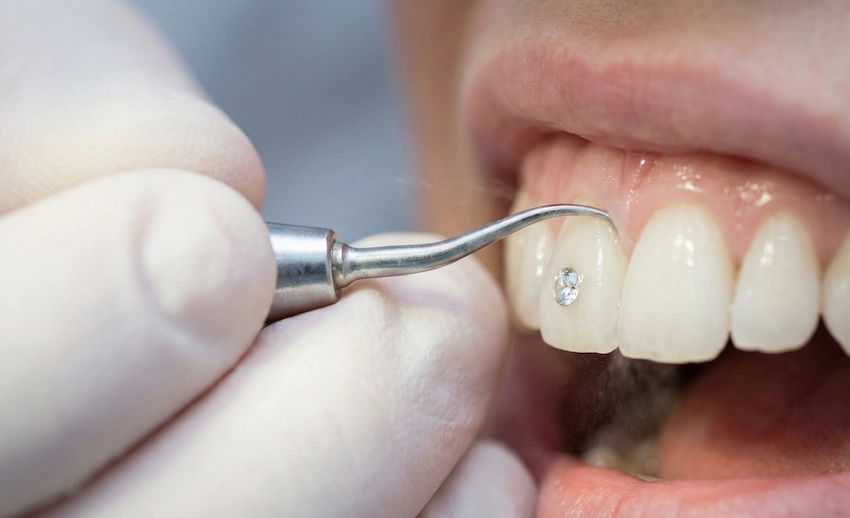
To get why your diamond teeth are generally safe, you need to get the physics behind the dental tools that are used.
Tartar, also called dental calculus, is calcified plaque. It is hard, very much like concrete. Ultrasonic scalers are used to get rid of it. The vibrating tip of these scalers mmovesat anultra-highh frequency that they shatter tartar deposits.
Here is what you need to be comforted with: a dental scaler cannot actually scratch a diamond.
The Mohs scale of mineral hardness rates a diamond as a perfect 10. It is the hardest natural material known. The stainless steel dental tools generally are around 5.5 to 6. Trying to scratch a real diamond with a dental scaler is like trying to scratch a glass window with a marshmallow. It just will never happen.
And yet, the story is different for the bond that holds the diamond.
Tooth Gem Bonding Risks: Protecting the Adhesive and Gum Health
Even though a diamond is immortal to the scaler, the adhesive (composite bonding) that holds the stone to your tooth is not.
Dr. Polen Akkılıç and her team often use the following metaphor to describe it: A tooth gem is like a barnacle on a ship. The ship (your tooth) is strong. The barnacle (the diamond) is strong. But if you hit the glue with a big enough dose of direct, high-frequency vibration, then theoretically, you could shake the barnacle off.
Damage in a clinical setting is only possible when the hygienists:
- Rushing: Hasty movement leading to hitting the base of the jewelry.
- Using the wrong angle: Focusing ultrasonic energy directly at the adhesive joint.
- Ignoring the “No-Go” Zone: Not switching to manual hand scaling around the fragile gem edge.
Clinical Note: The risk switches from “popping off” to “bacterial trapping” if you have a permanent retainer or a “grill” that is cemented in. We see really bad gum inflammation around permanent metal fixtures because patients are so scared that they don’t clean them properly.
Professor Doctor Coşkun Yıldız’s Method: “Micro-Precision”
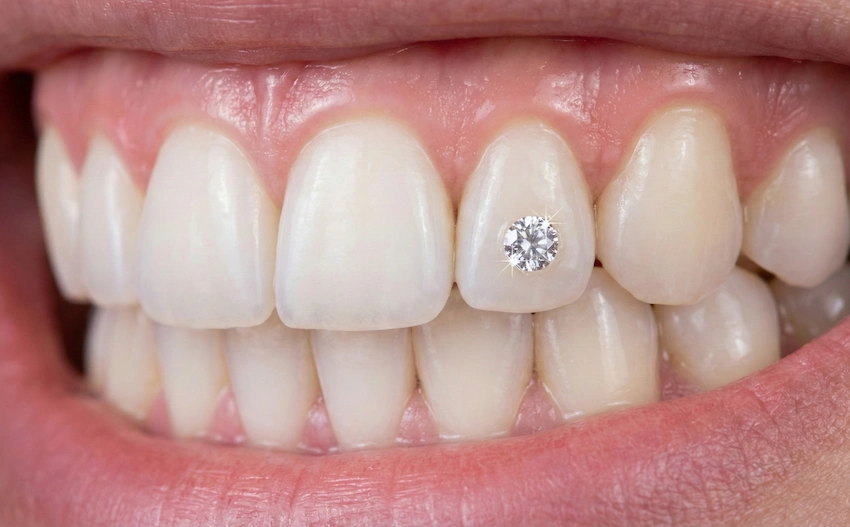
By the way, when you are here in Turkey your decision is made under anesthesia not by a mere hygienist. Professor Doctor Coşkun Yıldız stresses that a different cleaning protocol is needed for aesthetic dentistry compared to general dentistry.
We consider a diamond tooth (or a high-end veneer) as a museum artifact. A Van Gogh is not pressure-washed; a fine brush is used.
When a patient shows up with a large number of tooth jewelry or high-gloss aesthetic work:
- We Lower the Power: We lower the ultrasonic frequency when we get close to the tooth that is decorated.
- We Switch to Manual: Sometimes, we use completely fine, hand-held curettes only without the machine for that one tooth.
- We Polish, We Don’t Scrape: The last step is to use a rubber cup polish to make sure that the diamond shines even more than when you walked in.
The Risks Compared: Standard vs. Specialized Care
What is essential to understand is that not all cleanings are equal. This is what we get in the clinic when hygienists’ standard practices are compared to those that are aesthetic-focused.
| Feature | Standard Dental Cleaning | Aesthetic / Diamond-Safe Cleaning |
| Tool Used | Ultrasonic scaler with high power | Low-power ultrasonic + hand scaling |
| Risk to Bonding | Moderate (vibrations can weaken the glue) | Low (vibrations kept away from the bond) |
| Polish Type | Gritty prophy paste | Fine, non-abrasive diamond polish |
| Focus Area | General calculus removal | Margin integrity & gem preservation |
| Outcome | Clean teeth, possible loosening | Clean teeth, sparkling gems, intact bond |
Why Should You Never Skip the Cleaning?
Ironically, the act of avoiding a dentist just to “protect” your diamond is what will eventually ruin it.
The edges of tooth gems and grills are favorite hiding places for tartar. There, a rough ledge is created, and bacteria have a party. If you leave it, the gum will recede (i.e., pull away). A diamond is great for a white tooth; it is awful on an exposed, yellow tooth root.
We advise our patients: Guard the foundation. When the gums get sick, the teeth become loose. The diamond won’t mean anything when the teeth are loose.
Frequently Asked Questions
Not at all. If it is a real diamond or a nice crystal, it is much harder than our steel instruments. The only risk is to the composite cement that keeps the diamond glued. We use hand instruments around the edges because of this.
It is not normal and the bleeding is a sign of warning. Bleeding is a symptom of inflammation (Gingivitis). The plaque is under the metal or around the gem. You need a professional cleaning first to stop the problem before bone loss occurs.
A sonic toothbrush is wonderful at cleaning the gum area. Remember not to push down hard – the bristles will do the work. You shouldn’t worry that the vibration will be enough to pop off the gem.
Yes, we could re-bond it in the clinic right away if (the very rare event) it changed hands with us. If the bond was probably old or poorly done with the material, the cleaning might have just been the final nudge it needed. You are better off having the piece come off in the chair rather than while you are eating.
Absolutely! In fact, aesthetic dentistry is a global hub in Turkey. Our hygiene teams are highly skilled in managing complex veneers, crowns, and jewelry because this is the majority of our work. “Diamond teeth” is the work that we see almost every day.
- Magne, P., & Belser, U. (2022). Bonded Porcelain Restorations in the Anterior Dentition: A Biomimetic Approach. Quintessence Publishing.
- Donos, N. (2018). The periodontal-restorative interface: biological considerations. Periodontology 2000, 77(1), 16-25.
- Sijbanq, A. (2020). Dental Adhesives and Their Durability in the Oral Environment. Journal of Adhesive Dentistry, 22(3), 230-245.
- Lijian, J. (2019). Ultrasonic Scaling and Its Effect on Restorative Materials: A Review. International Journal of Dental Hygiene, 17(2), 101-112.
- World Health Organization. (2023). Global Oral Health Status Report. WHO Press.

