


Yes, it is highly recommended.
That is a legitimate worry. You have just come back from your treatment in Turkey, the healing caps have been removed, and your new smile feels strong. But when you get your electric toothbrush, a thought occurs to you: Could these vibrations possibly shake the screw loose?
It is like using a jackhammer on a fresh concrete line.
However, here is the reality that we communicate to each patient of Lema Dental Clinic: In fact, you don’t just have the option to use an electric toothbrush on dental implants, but in many cases, we almost exclusively want you to do so. The enemy of a dental implant is not vibration; it is bacteria. And manual brushing is sometimes almost defenseless against bacteria in the battle.
The Physics of Fear: Why Your Implant Won’t “Unscrew”
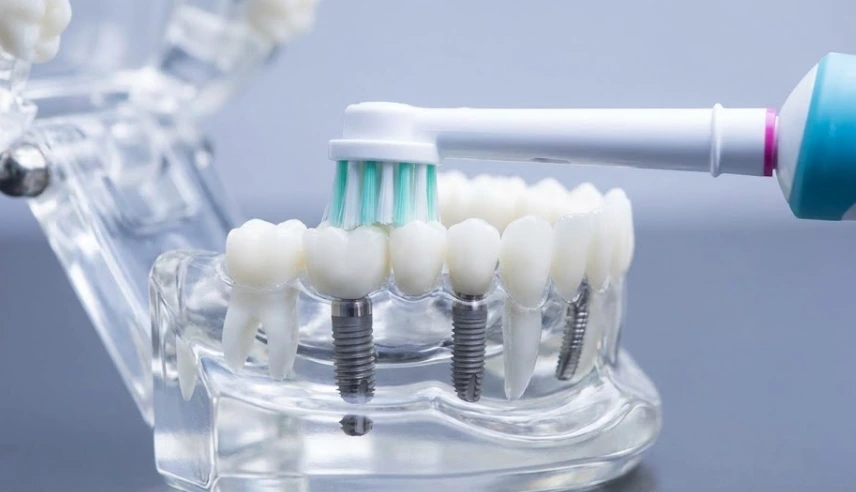
The first step in understanding how a toothbrush can be harmless is to figure out what is inside your jaw that makes it safe.
Prof. Dr. Coşkun Yıldız often tells our patients that once an implant has successfully integrated, it is not just “screwed in” like a photo frame on a wall. It experiences osseointegration. This biological process is when bone cells living in your body attach to the titanium’s microscopic pores.
When that happens, the implant becomes a part of your skeleton. The tiny motions of a sonic or oscillating toothbrush are simply powerless to break this union. To make an implant that is healthy and well-implanted by osseointegration come loose, you would have to use a traumatic force—like hitting a car or a heavy blow—not the soft sound of a Philips Sonicare or Oral-B.
Consider this analogy: A luxurious car being driven on a slightly uneven road does not cause the wheels to come off. The car’s construction is meant to endure forces several times larger than the “bumps.”
The Real Threat: Peri-Implantitis
So, if vibration is not the danger, then what is it?
Peri-implantitis is a disease that destroys implants very quietly. It is basically gum disease for implants. Since implants do not have a natural periodontal ligament like natural teeth, they have less blood supply to fight off infection. If plaque accumulates at the gumline, the inflammation will rapidly spread and the bone that holds the screw will be eaten away.
In our clinical practice, we have noticed that manual brushers are missing the area where the tooth and the gums meet (the cervical margin). They either brush too hard (which causes the gums to recede) or too gently (which leaves plaque behind).
Dentist Polen Akkılıç, together with her aesthetic team endorse the use of electric toothbrushes since most of the modern models are equipped with pressure sensors. Pressure sensors warn you when you are brushing too hard by flashing a red light. This gives a signal to your new gums while the bristles clean your teeth, removing the bacterial film that leads to peri-implantitis.
Selecting the Right Tool for Your New Smile
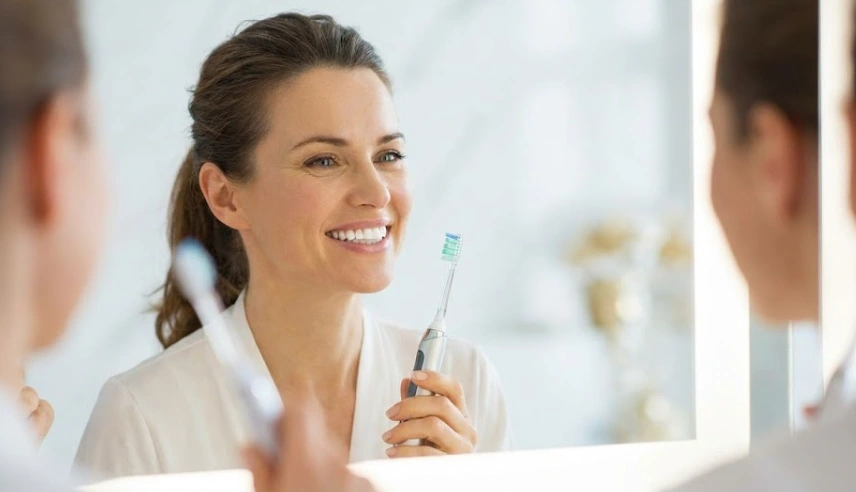
Not every vibration is the same. When you choose a device to protect your investment, make sure it has these features:
- Pressure Sensor: This is a must-have feature. It will save the gum tissue by not allowing you to over-brush.
- Soft Bristles: Medium and hard bristles are unnecessary when it comes to porcelain. Besides, soft bristles are not only enough, but they are also much safer for the gum seal.
- Timer: The standard is two minutes. However, most people manually brush for less than 45 seconds without even realizing it.
Comparison of Cleaning Methods for Implants
Below is a comparison of different hygiene methods to help you maintain your treatment results from Turkey.
| Feature | Manual Toothbrush | Electric (Sonic/Oscillating) | Water Flosser |
| Plaque Removal | Moderate. Relies heavily on user technique. | Superior. High-frequency movements break up biofilm. | Adjunct. Excellent for flushing, but doesn’t “scrub.” |
| Safety for Gums | Variable. Easy to press too hard (abrasion). | High. Pressure sensors prevent damage. | High. Very gentle on soft tissue. |
| Risk to Implant Screw | Zero. | Zero. Vibrations are negligible compared to bite force. | Zero. |
| Access to Hard Spots | Difficult. Hard to reach back molars effectively. | Easy. Smaller heads navigate tight spaces better. | Excellent. Cleans under bridges effectively. |
Urgent Questions on Implant Maintenance & Hygiene
In the first week after surgery, yes, it might be too aggressive. During the immediate healing phase (the first 7-10 days after your operation in Turkey), we usually recommend a manual, ultra-soft surgical brush. You should avoid the surgical site entirely until the sutures are removed. Once the gums have healed and the permanent crowns are placed, you can switch to electric.
The brush itself won’t scratch the porcelain, but abrasive toothpaste might. Dentist Polen Akkılıç warns against using “Whitening” toothpastes with high RDA (Relative Dentin Abrasivity) values. These gritty pastes can dull the shine of your veneers or crowns over time. Use a non-abrasive gel toothpaste instead.
No studies support this. The chewing forces you exert on your implant during dinner (which can exceed 200 psi) are vastly more powerful than the tiny motor in your toothbrush. If an abutment screw loosens, it is typically due to occlusal trauma (an unbalanced bite) or bruxism (grinding), not hygiene habits.
Both are excellent, but they work differently. Sonic brushes (like Sonicare) vibrate side-to-side and force fluids between teeth. Oscillating brushes (like Oral-B) spin in a circle. Some patients find the sonic vibration “tickles” too much initially. We recommend whichever one you will actually use twice a day.
Yes. Look for heads labeled “Sensitive” or “Gum Care.” These have softer, tapered bristles that can slide slightly under the gumline without irritating. Avoid “Whitening” heads, which often have rubber polishing cups that are unnecessary for porcelain and can be too stiff.
- Vandekerckhove, B., et al. (2015). The safety and efficacy of a powered toothbrush on soft tissues in patients with implant-supported fixed prostheses. Clinical Oral Investigations, 19(5), 1279-1290.
- Swierkot, K., et al. (2013). Mucositis, peri-implantitis, and survival of dental implants in patients treated with manual or powered toothbrushes: A randomized clinical trial. Journal of Periodontology, 84(9), 1321-1331.
- Tawse-Smith, A., et al. (2002). Electric toothbrushes and dental implants: A systematic review. International Journal of Oral & Maxillofacial Implants, 17(4).
- De Jager, M., et al. (2017). The effectiveness of manual versus high-frequency mechanical toothbrushes for plaque control: A systematic review. Journal of Clinical Dentistry, 28(1), 13-20.
- Heasman, P. A., et al. (1999). Comparative study of the efficiency of manual and powered toothbrushes for patients with dental implants. Journal of Clinical Periodontology, 26(1), 63-67.

