


Yes, with minor dietary adjustments.
Missing a front tooth is more than just a cosmetic hurdle; it changes how you interact with the world and, more importantly, how you enjoy your favorite meals. At Lema Dental Clinic in Turkey, we often see patients who choose the Maryland bridge because it is conservative—it doesn’t require grinding down healthy neighboring teeth into “pegs.”
But after the bond has been fixed and you have left our place, the question is still there: Are you really able to eat in a normal way?
The short answer is yes, but with a few clinical caveats. Think of a Maryland bridge like a high-end “sidecar” attached to a motorcycle. It is incredibly stable and functional, but it doesn’t have its own engine (a root or an implant) and relies entirely on the strength of the bond to the adjacent teeth.
The First 48 Hours: Setting the Foundation

In our clinical experience at Lema Dental Clinic, the first two days are the most critical. While the resin cement we use is incredibly strong, it undergoes a microscopic settling period. Dentist Polen Akkılıç and her team usually recommend a “test drive” approach during this window.
Keep away from any food that is going to have a big “tug” on your teeth.
Basically, this is a no to crispy sourdough bread and pizza with a thick crust that is chewy. Instead, pick easily digestible proteins such as fish that you can break apart with your fingers, scrambled eggs, or pasta that’s been cooked thoroughly. Besides saving the bridge from getting damaged, the intention here is to give your brain and bite time to get used to the new “tenant” in your mouth.’
The “Normal” Diet: What Does it Actually Mean?
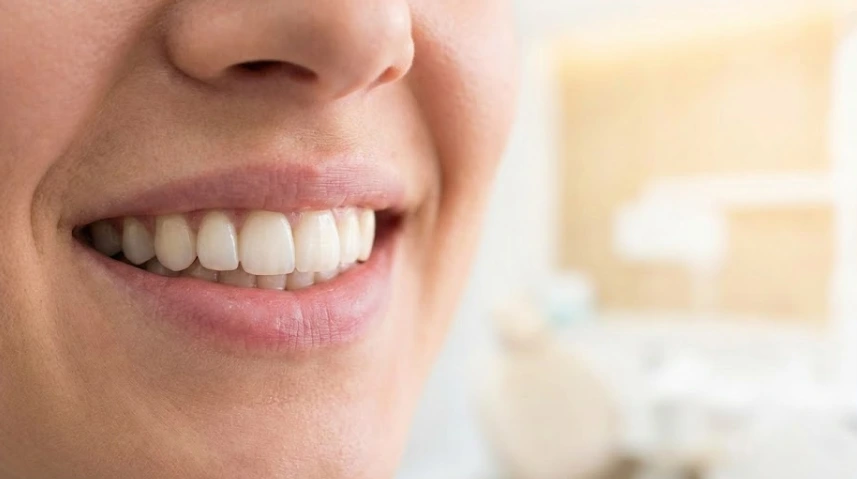
When patients ask Professor Doctor Coşkun Yıldız about returning to a normal diet, he often uses a specific analogy: “Treat your Maryland bridge like a delicate piece of porcelain, not a nutcracker.”
Because a Maryland bridge is held in place by metal or porcelain “wings” bonded to the back of your teeth, it lacks the “bolted-down” security of a dental implant.
The “No-Go” Zone
The reality is that some foods will always carry a risk. You should be cautious with:
- The “Tear and Pull” Foods: Avoid biting directly into apples, corn on the cob, or hard baguettes using the bridge. Instead, cut these into smaller, bite-sized pieces.
- Sticky Saboteurs: Caramel, taffy, and heavy gummies can create a suction effect. Over time, this repetitive “pulling” can fatigue the medical-grade bond.
- Ice and Hard Candies: Biting down on ice is the fastest way to fracture the porcelain or pop the wings loose.
Comparing Your Options: Strength and Lifestyle
To give you a better perspective on how the Maryland bridge stacks up against other restorations we provide in Turkey, let’s look at the functional data.
| Restoration Type | Bite Force Capacity | Preparation Required | Dietary Freedom |
| Maryland Bridge | Moderate (Best for front teeth) | Minimal (No shaving) | Caution with hard/sticky foods |
| Traditional Bridge | High | Significant (Crowning neighbors) | Near-normal |
| Dental Implant | Very High (Same as natural) | Surgical | Full freedom after healing |
| Partial Denture | Low to Moderate | None | Frequent restrictions |
Why the Bond Matters: The Lema Approach
In Turkey, we’ve refined the bonding process to ensure maximum longevity. Dentist Polen Akkılıç and her team utilize advanced acid-etching techniques on the “wings” of the bridge to create a microscopic texture that the cement can “grab” onto.
But even the best bond can’t fight physics. A Maryland bridge is designed for the anterior (front) region, where the biting forces are shearing rather than crushing. If you try to chew a steak using only your front teeth, you’re putting the bridge under a type of stress it wasn’t built to handle.
Maintaining Your Bridge for the Long Haul
Here is what we see in the clinic: patients who treat their bridge with a bit of “mindful eating” keep them for 10 to 15 years. Those who treat them like natural teeth often find themselves back in the chair for a re-bonding within three.
- Cut, Don’t Tear: Use a knife and fork more often.
- Chew on the Molars: Let your back teeth do the heavy lifting.
- Regular Hygiene: Plaque can build up around the “wings,” leading to decay on the supporting teeth.
FAQ: Questions We Hear Every Day at Lema Dental Clinic
Initially, you might feel the “wings” with your tongue on the back of your teeth. Most of our patients tell us that within a week, the brain “filters out” this sensation, and it feels like a natural part of their smile.
We generally advise against it. The constant, repetitive sticking and pulling of gum can slowly weaken the resin bond. If you must, try to keep the gum on the opposite side of your mouth.
Don’t panic! Because we don’t shave down the neighboring teeth, a Maryland bridge failing isn’t a medical emergency. Keep the bridge safe, and call us immediately. At Lema Dental Clinic, we can usually re-bond it quite easily.
Yes. The thermal expansion of the materials we use in Turkey is very similar to natural tooth enamel. Just be mindful that extreme temperature shifts can occasionally cause temporary sensitivity in the “anchor” teeth.
A Turkish kebab is usually fine because the meat is tender. However, be very careful with the crunchy pide bread or any hard vegetables. Professor Doctor Coşkun Yıldız always suggests taking smaller bites to be safe.
- Botelho, M. G. (2017). Resin-bonded joints: The dental perspective. Journal of the Mechanical Behavior of Biomedical Materials, 67, 1-10.
- Kern, M. (2017). Fifteen-year survival of anterior all-ceramic cantilever resin-bonded fixed dental prostheses. Journal of Dentistry, 56, 133-135.
- Prasad, K., & Sanyal, S. (2020). Longevity and clinical performance of Maryland bridges: A systematic review. International Journal of Prosthodontics and Restorative Dentistry, 10(2), 55-61.
- Thoma, D. S., et al. (2012). A systematic review of the survival and complication rates of resin-bonded fixed dental prostheses after a mean observation period of at least 5 years. Clinical Oral Implants Research, 23(11), 1260-1271.
- Zhi-Quang, L., et al. (2021). Biomechanical analysis of Maryland bridges: A finite element study. Journal of Prosthetic Dentistry, 125(3), 480-488.

