


Choking is rare; gagging is common.
This is the image that keeps sneaking up on the brains of the nervous patients even before the plane touches down in Turkey. You somehow see the dentist’s tray loaded with thick, cold paste. You see it going back too far. You see the closing of the airway.
Let’s consider this issue without any beating about the bush: The feeling of choking when taking dental impressions is one of the most dreadful phobias in dentistry. However, the physiological reality of an actual case of choking happening is extremely rare.
Among thousands of international patients coming to us with dental anxiety, we at Lema Dental Clinic are lucky to witness how a protective reflex is very different from a medical emergency. The panic you experience is genuine, but it is mostly a false alarm. The key is to understand how your mouth works to fight this fear.
The Body’s Bouncer: Gagging vs. Choking
When you ask why you feel that you are choking, you have to consider the anatomy. Your body has a naturally built security system that is called the pharyngeal reflex—more commonly known as the gag reflex.
Imagine the gag reflex as a far too enthusiastic bouncer in a nightclub. Its task is to force out anything that tries to get into the throat without being invited (swallowing). Once a dental tray touches the soft palate, the bouncer gets confused and spasms the throat muscles to push the object out.
Professor Doctor Coşkun Yıldız regularly tells the story to his patients: “Gagging is loud, uncomfortable, and scary. Choking is quiet”.
- Gagging: Your airway is open. You can breathe and talk, and your body is actively fighting the foreign object.
- Choking: The airway is physically blocked. You cannot talk.
The material used for dental impressions is a gel—please, imagine dough. It should remain in the tray rather than drip like water. The combination of gravity and the shape of the tray is what keeps the material in the mouth area and not in the throat.
The Digital Solution: How Lema Dental Clinic Changed the Game
Our good news for those of you who can’t stand the thought of a “goopy” impression material is that most probably minutes of struggling with suffocating putty are now a thing of the past.
Thanks to the fantastic work by Dentist Polen Akkılıç and her aesthetic team, our clinic in Turkey is leveraging Digital Smile Design (DSD) and intraoral scanning technology.
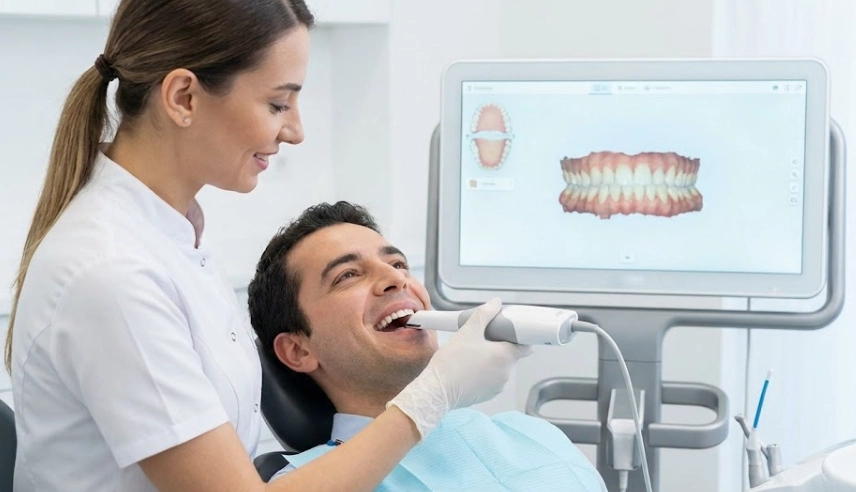
Here there is no alginate-filled tray. Here we got a slim, pen-sized camera (a scanner wand). We move the wand around your mouth while thousands of images are taken every second. This way, a 3D model of your mouth is created.
- Absolutely no goop: There is nothing to swallow.
- On-demand break: In case you need a break, we take the wand out right away.
- Rapid process: This is much faster than putting up with the setting of putty.
We rarely make a physical impression for Hollywood smiles and veneer cases. In fact, for 95% of them it is unnecessary.
Protocol for the “Gaggers”: When Putty is Necessary
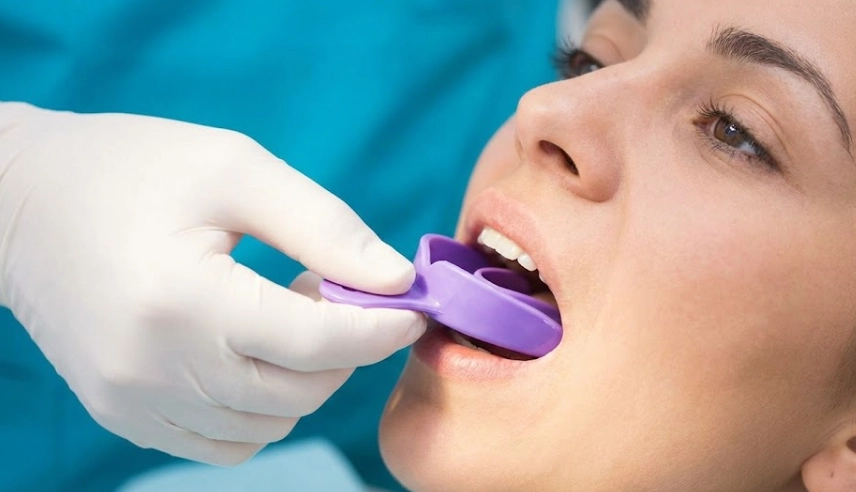
There is a smattering of cases—implant transfers or special diagnostic models—when a physical impression is still the best option. If this is the case for you, please do not worry because we have a plan that is already tested and works well. There is no panic in this situation.
Usually, we give a scared patient a faster-setting material. The set time can be only a few seconds instead of the standard one minute. In addition, we avoid letting you lie down. When you lie flat, the tongue goes back due to gravity; on the contrary, when you sit up, the airway remains open.
In the clinic, the ‘distraction’ technique is highly appreciated. You may be asked to raise and hold your left leg. It is a bit absurd, but your brain not only has to focus on one task, holding the leg, but also on quite another one, gagging, which is against the idea altogether. Consequently, the ‘bouncers’ in your throat get distracted, and before you realize it, the impression is over.
Comparison of Impression Technologies
These different methods’ safety and comfort aspects are compared below in case of your visit to Turkey.
| Feature | Traditional Alginate (The “Goo”) | Digital Intraoral Scanner (The “Wand”) | Sedated Impression |
| Choking Risk | Low. The wand stays on the teeth. | Zero. Nothing enters the throat. | Very Low. Airway is monitored. |
| Gag Trigger | High. Touches the soft palate. | Low. Wand stays on the teeth. | None. Patient is asleep/relaxed. |
| Time in Mouth | 2–5 Minutes (feels like forever). | 1–3 Minutes (intermittent). | N/A |
| Patient Control | Low. Once it’s in, it stays until set. | High. Can pause anytime. | Total. You wake up when it’s done. |
Top Queries on Airway Safety and Impression Comfort
It is structurally impossible. The dental trays used at Lema Dental Clinic are significantly wider than the human esophagus. It is like trying to fit a dinner plate into a mail slot. While it may feel large and intrusive, the geometry simply does not allow it to slip down your throat.
Yes, it can be a powerful tool. We can apply a topical anesthetic spray (lidocaine) to the back of the soft palate. This temporarily numbs the sensory nerves that trigger the gag reflex. It doesn’t affect your ability to breathe, but it “blinds” the bouncer, allowing the tray to sit comfortably for the minute it needs to set.
For patients with extreme phobia, Professor Doctor Coşkun Yıldız may recommend sedation dentistry. In these cases, we can administer a mild sedative that relaxes your muscles and your mind. You remain conscious enough to follow instructions, but the anxiety—and the overactive reflexes—are dampened significantly.
It is the single most effective physiological hack. When you breathe through your mouth, your tongue rises, which can push the impression material further back. When you focus intently on deep, rhythmic nose breathing, your soft palate relaxes and seals off the back of the mouth from the airway, making choking mechanically difficult.
While Dentist Polen Akkılıç prefers digital workflows for veneers and crowns, physical impressions are sometimes needed for removable dentures or specific complex implant bars where the scanner might struggle with large gaps in soft tissue. However, we always prioritize the scanner whenever clinical precision allows.
- Dickinson, C. M., & Fiske, J. (2005). A review of gagging problems in dentistry: 1. Aetiology and classification. Dental Update, 32(1), 26-32.
- Mangano, F., Gandolfi, A., Luongo, G., & Logozzo, S. (2017). Intraoral scanners in dentistry: a review of the current literature. BMC Oral Health, 17(1), 149.
- Sason, G., Sason, H. B., & Alter, Z. (2016). Management of the gag reflex in dental patients. Refuat Hapeh Vehashinayim, 33(4), 19-25.
- Yuzbasioglu, E., Kurt, H., Turunc, R., & Bilir, H. (2014). Comparison of digital and conventional impression techniques: evaluation of patients’ perception, treatment comfort, and chairside time. BMC Oral Health, 14, 10.
- Neumann, J. K., & McCarty, G. A. (2001). Behavioral approaches to reduce hypersensitive gag response. The Journal of Prosthetic Dentistry, 85(3), 305.

