


Yes, it widens your jawline.
People usually associate teeth grinding, also known as bruxism, with being a “loud” habit—it is basically something that disturbs the partner during sleep or that gives us a dull headache in the morning. However, the physical reality is much deeper. In our daily practice at Lema Dental Clinic in Turkey, we see firsthand how chronic grinding doesn’t just wear down enamel; it actually reconfigures the architecture of the human face.
The question isn’t just about dental health. It’s about how your reflection changes over time.
The Muscular Shift: From Oval to Square
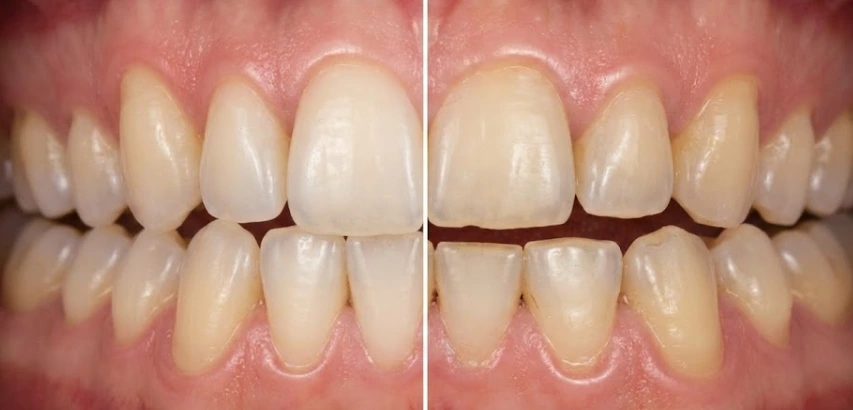
The masseter muscle is the main source of human jaw movement, and it is one of the strongest muscles in the entire body relative to its small size. You can think of it like a weightlifter’s bicep. In case of incessant teeth grinding, you are actually doing a high-intensity workout for that muscle every night.
The result? Masseter hypertrophy. The muscle grows larger and thicker. Over time, this transforms a soft, oval, or heart-shaped face into a more “square” or “boxy” appearance. The jawline becomes heavy and pronounced. Dentist Polen Akkılıç and her team often observe that patients don’t even realize their face shape has changed until they look at photos from five years ago.
The Foundation is Sinking
Imagine a house where the foundation is slowly being filed away. That is what happens to your “vertical dimension” when you grind. As your teeth become shorter and flatter, the distance between your nose and your chin decreases. This “collapse” leads to:
- Sagging skin around the mouth.
- The appearance of “jowl” formation.
- Deepening of the nasolabial folds (smile lines).
- A “sunken” look that mimics premature aging.
Comparing Treatment Approaches at Lema Dental Clinic
| Treatment Option | Primary Goal | Aesthetic Impact | Duration of Results |
| Masseter Botox | Relaxes the muscle | Slims the jawline (V-shape) | 4–6 months |
| Full Mouth Reconstruction | Restores tooth height | Reverses “sunken” face look | Long-term (10-15+ years) |
| Custom Night Guards | Prevents further wear | Stops further changes | Ongoing maintenance |
| Zirconium Crowns | Rebuilds anatomy | Restores smile “fullness” | Permanent/Long-term |
The Path to Restoration in Turkey
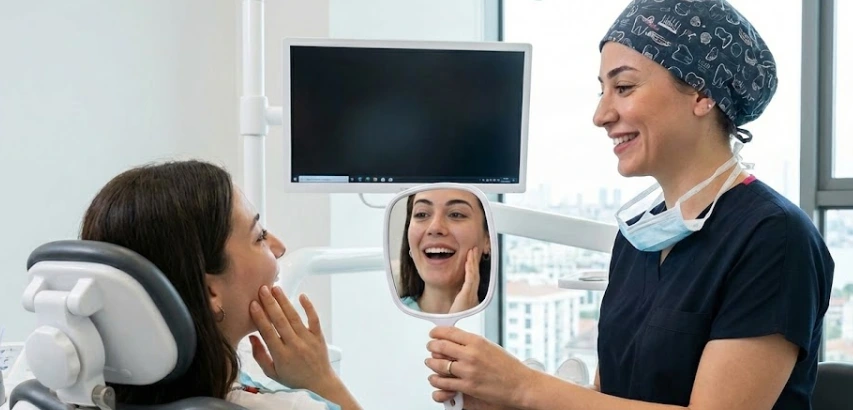
Turkey has become a global hub for specialized dental care because we combine advanced technology with an artistic eye for facial aesthetics. At Lema Dental Clinic, we don’t just fix teeth; we restore the facial “scaffolding.” Whether it is through precision-engineered veneers or therapeutic Botox to slim the jawline, the goal is to bring the face back into balance.
But let’s look closer at the most common concerns patients have when they visit us in Istanbul.
The Bruxism FAQ: Understanding the Transformation of Your Jawline
Not necessarily. While the bone and muscle changes are physical, they are often reversible. We use Botox to slim the masseter muscle and prosthetic restorations to ‘lift’ the lower third of your face back to its original height.
You’ve likely developed masseter hypertrophy. Your jaw muscles have bulked up from the constant ‘exercise’ of grinding. It’s a very common symptom we treat here at Lema Dental Clinic.
While we aren’t plastic surgeons, restoring your bite often acts like a ‘natural facelift.’ By lengthening the teeth, we provide the support your skin needs, which naturally smoothes out the folds around your mouth.
For most patients, a full smile makeover and bite realignment can be completed in just 5 to 7 days. We use digital scanning to ensure the new ‘height’ of your teeth is perfect for your facial structure.
The question remains: do you want to protect your teeth or fix the problem? Store-bought guards are often bulky and can actually increase grinding activity. We recommend custom-fitted orthotics that allow your jaw to rest in its natural, relaxed position.
- Al-Zarea, B. K. (2017). Tooth surface loss and associated factors in northern Saudi Arabia. Journal of Clinical and Diagnostic Research.
- Lobbezoo, F., et al. (2013). Bruxism defined and graded: an international consensus. Journal of Oral Rehabilitation.
- Mehta, N. R., & Abdallah, E. F. (2021). The relationship between vertical dimension of occlusion and facial aesthetics. International Journal of Esthetic Dentistry.
- Yıldız, C. (2022). Comprehensive approaches to masseteric hypertrophy and dental attrition. Turkish Journal of Dental Sciences.
- Schmitter, M., et al. (2015). Chronic stress and its influence on bruxism and facial muscle activity. Journal of Biomedical Science.

