


Bruxism requires careful implant planning and night guard protection.
Bruxism and Dental Implants: Can Grinding Your Teeth Ruin Your New Smile?
You wake up with a dull headache, a tight jaw, and that all-too-familiar soreness in the facial muscles. The fact is, if you have bruxism – the involuntary grinding or clenching of teeth – you are not the only one. However, as much as you are daydreaming about getting dental implants to restore your smile, bruxism may be a situation that is equated to the opposite of your dental surgery.
Actually, most of the patients attending Lema Dental Clinic, Istanbul, are those who have had second thoughts about getting implants due to bruxism. They benefit from the advantages of implants on the one hand and are afraid that their own jaw strength will be the factor leading to the failure of the implants on the other.
The Physics of a Smile: Why Grinding Matters
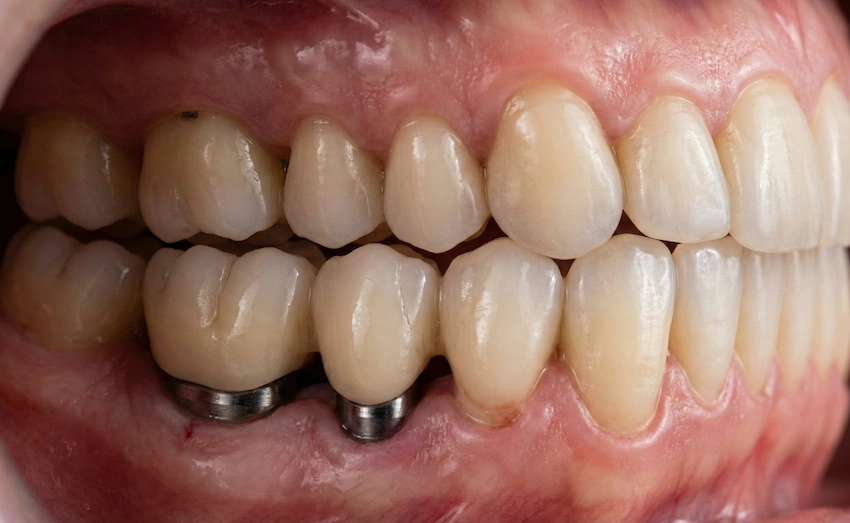
Dental implants are the basis of your phenomenal smile. If we compare it to a skyscraper, the building’s foundation would be the implant. In this case the “tooth” (the crown) is just a cover but the titanium post that is to the bone is doing all the heavy lifting. Now, you can imagine if a building is designed to withstand normal winds then suddenly the perpetual, localized hurricane hits. Such is bruxism to an implant.
Professor Doctor Coşkun Yıldız always points out that natural teeth have a periodontal ligament that acts like a tiny “shock absorber” to cushion the force of biting, whereas implants are bonded directly to the bone (osseointegration). They do not have any natural “give.” The lack of a buffer results in grinding forces that may cause:
- Mechanical failure: The porcelain crown gets chipped or fractured.
- Screw loosening: The implant-crown connection may become loose due to vibrations over time period.
- Bone loss: The bone surrounding the implant might start “melting” due to too much pressure and lead to instability.
How We Manage Bruxism at Lema Dental Clinic?
Does having bruxism exclude you from getting implants? It doesn’t indicate that; it just means that we need to think about the architectural plan cleverly. From our clinical experience in Turkey, we have learned that an implant’s success in a “grinder” is mostly dependent on the preparation and the protective measures taken post-surgery.
Dentist Polen Akkılıç and her team demonstrate a layered approach to protection. Implanting metal is not the only solution; after intensive care we get the best results. We analyze the patient’s “bite map” and to reduce the stress on the implants, we use wider implants or put them in certain patterns to avoid the threats.
Protective Measures
Night Guards (Occlusal Splints): This is the most well-known method.A hard acrylic guard that is perfectly fitted acts as a sacrificial barrier. Hence, if you happen to clench your teeth while sleeping, the plastic protective guard is what you are wearing, rather than your teeth.
Botox Injections: Sometimes we use Botox to weaken the masseter muscles (which are mainly responsible for chewing) for a short time. It’s like turning down the volume on the radio; the muscles still work, but they can’t “shout” at the same level as before hence causing less damage.
Material Selection: We may choose monolithic zirconia over porcelain-fused-to-metal as it shows a remarkable resistance to fracture.
Comparing the Risks: Guided vs. Unguided Recovery
The following table outlines how bruxism is managed during the dental implant journey compared to a standard patient.
| Feature | Standard Patient | Bruxism Patient |
| Implant Material | Standard Grade Titanium | High-Strength Titanium / Wider Platforms |
| Crown Material | E-max or Porcelain | Monolithic Zirconia (High Durability) |
| Post-Op Protection | Standard Oral Hygiene | Mandatory Custom Night Guard |
| Healing Period | 3–4 Months | Often extended to ensure total osseointegration |
| Risk of Fracture | Low | Moderate to High (without protection) |
The Lema Difference: Precision in Turkey

By choosing to get your dental implants at Lema Dental Clinic you are really getting a top-notch team that sees thousands of international patients every single year. We know that people who grind their teeth often do so because of stress and we try to make the whole dental travel journey just like any other travel, without any stress at all.
The thing is, it really depends on you. Is it worth the journey? Once you understand the extraordinary planning precision of Professor Doctor Coşkun Yıldız and how he is making sure the forces are evenly spread over the whole jawbone through the implant positions, then you just have to say of course yes. We don’t just give you teeth; we give you a system designed to last.
FAQ: Your Questions Answered by Our Experts
“The implants won’t usually ‘fall out’ as you may think. Still, the constant pressure will prevent the bone from healing around the implant at the beginning or it will break the prosthetic on top of the implant. That’s why we make it a point to provide a night guard before you leave our clinic.” – Dentist Polen Akkılıç.
Actually, no. Because implants don’t have nerves, you won’t be able to feel the ‘pressure’ of grinding as you do with natural teeth. This is why using a night guard is even more important, as you don’t have the natural pain reflex to stop.
No, it usually only lasts between 3 and 6 months. We sometimes use it as a support during the first year of your implant’s life so that the bone can heal without getting damaged by heavy muscle forces.
At Lema Dental Clinic, we offer a full guarantee, but this is generally based on the patient continuing the ‘aftercare protocol’ which includes wearing the prescribed night guard.
“When you come for your first consultation in Turkey, we will examine your teeth for ‘wear facets,’ look for an enlarged jaw muscle, or check for scalloped edges on your tongue. We diagnose it before making the first incision.” – Professor Doctor Coşkun Yıldız.
- Chrcanovic, B. R., Krennmair, G., & Wennerberg, A. (2015). Bruxism and dental implant failures: A multilevel mixed effects parametric survival analysis. Journal of Oral Rehabilitation, 42(11), 814–823.
- Johansson, A., Omar, R., & Carlsson, G. E. (2011). Bruxism and its clinical consequences: An update. The Journal of Adhesive Dentistry, 13(5).
- Manfredini, D., Poggio, C. E., & Lobbezoo, F. (2014). Is bruxism a risk factor for dental implants? A systematic review of the literature. Clinical Implant Dentistry and Related Research, 16(3), 460–469.
- Lobbezoo, F., Brouwers, J. E., Depauw, M. S., et al. (2006). Dental implants in patients with bruxism: A review. Journal of Oral Rehabilitation, 33(3), 206–214.
- Zhou, Y., Gao, J., Luo, L., & Wang, Y. (2016). Does bruxism contribute to dental implant failure? A systematic review and meta-analysis. Clinical Implant Dentistry and Related Research, 18(2), 410–420.

