


Floss daily to stop plaque-induced bleeding, but see a dentist if it persists.
Sometimes, when people see their gums bleeding after flossing, they immediately stop the habit. And then, they wonder: are they brushing too hard, maybe? The truth is, red gums can be such a widespread issue that it’s almost impossible not to be confronted with it at some point in history. After all, that’s one of the principal motives why patients visit our office. And if you need help in that matter, there is no reason to be ashamed of it.
Based on those patients and our expertise in Lema Dental Clinic in Turkey, we regard your gums as the safety layers of your very own smile. You can draw an analogy between your gums and the protective rubber seal that a thick submarine door has. Strictly speaking, the seal of utmost airtightness means the inside is totally safe. And if the bacteria find a way of disassembling that seal, then the gums will start to swell. Besides, the tissues will become weaker, and the grip of their firmness will be loosened…”
So, what have we gotten ourselves into? Why do gums bleed? Are we all able to find the right oral care routine for our bodies? And when should one step in to call a professional? Well, these questions might be answered in their consideration below.
Why Do Gums Bleed When Flossing?
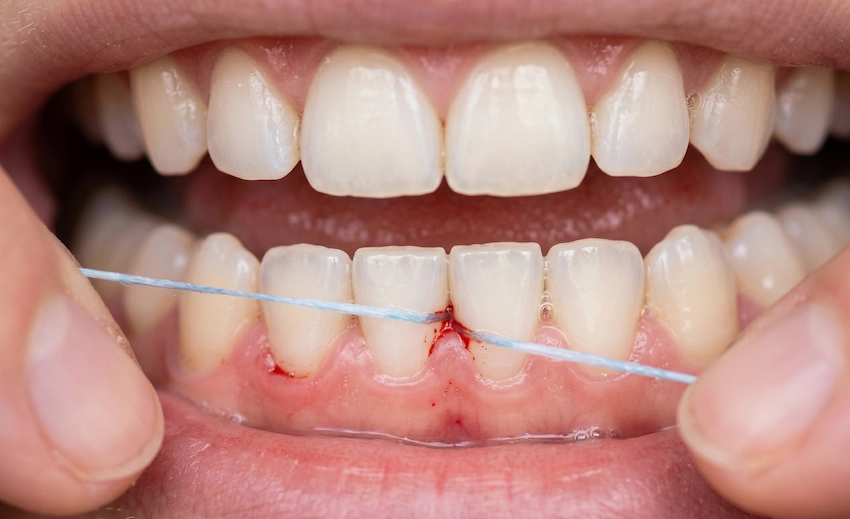
In fact, a healthy gum is a resilient one and compacted. They simply don’t bleed just because you are brushing or flossing. Anyway, your body simply manifests its first warnings through red lights if that happens. Your immune system decides to send extra blood to that spot to fight the infection. Plaque, in this case, is the infecting agent, which is a thin layer of bacteria that accumulates on your teeth daily.
Sadly, if a plaque layer is still there even for one day, it will become tartar. Brushing will not do the trick anymore with tartar. What it does is irritate the gum tissue in a similar way as a grain of sand trapped in your eye would do, by causing small cuts. So, bleeding may happen regularly at any time this area is touched.
The Most Common Causes
Thanks to the plaque being washed away quite quickly. So, here are some of the very common causes:
- Interruption of Routines: Life suddenly gets very busy. Mental health issues, tiredness, or changing daily routines can prevent us from flossing every single day. When you finally start the new routine, your gums are, so to speak, unfamiliar with the use of floss.
- Problems with Dexterity: On the other hand, let’s have a look at how we clean. Regular string floss needs quite a bit of fine finger mobility. In case you have joint pain, arthritis, or other motor differences, you may accidentally cut the gums by snapping the floss down hard. You might need to use some kind of adaptive tool.
- Hormonal Changes: Hormonal changes lead to the gums becoming very sensitive to the presence of plaque. This is the reason why they can get so quickly swollen.
- Medications Taken Daily: Some blood thinners and blood pressure medicines may cause you to bleed more easily while performing your regular oral care.
When to Worry About Bleeding Gums
That leaves us with a question – how can one tell if the little pink blood on the basin is a sign of real trouble?
Usually, bleeding is the first sign that your body needs major help; it is the way your body screams for assistance, says Prof. Coşkun Yıldız. It’s like ignoring a fire alarm because you cannot see any flames. On top of this, what bleeding also indicates is the initial stages of swelling of the gums, which can even lead to gum disease.
Severe gum disease leads to the destruction of the bone holding your teeth. At first, you will not notice any bone loss as there are no symptoms. Eventually, however, if the condition is not reversed, teeth become so loose that they may even fall out. And that is where the situation turns into a problem, and we are talking about complex care. Zygomatic implants and full-mouth rehabs are the solutions we mostly consider in order to build the infected smile once again.
The Stages of Gum Disease
| Overall Health | Main Symptoms | Risk Level | Recommended Action |
| Excellent Gum Health | Adaptable, pale pink, and no bleeding | Nonthreatening | Maintain proper oral hygiene with brushing and flossing daily |
| Minor Soft Tissue Swelling | Fluffy, red gums that bleed during flossing | Medium Level (Reversible) | Brush and floss more efficiently and get a thorough cleaning |
| Moderate Stage | Shrinking gums or recession with a smell of bad breath, accompanied by the beginning of bone loss | Alarmingly High Level (Irreversible Damage) | Make an appointment with your dentist for a root planing and scaling session |
| Extreme Stage | Very loose teeth (might be lost), large gaps between teeth, extensive damage to the bone | Extremely High Level (Edentulous) | Usually, surgery or dental implants are the required treatment |
Welcoming Expert Care at Lema Dental Clinic
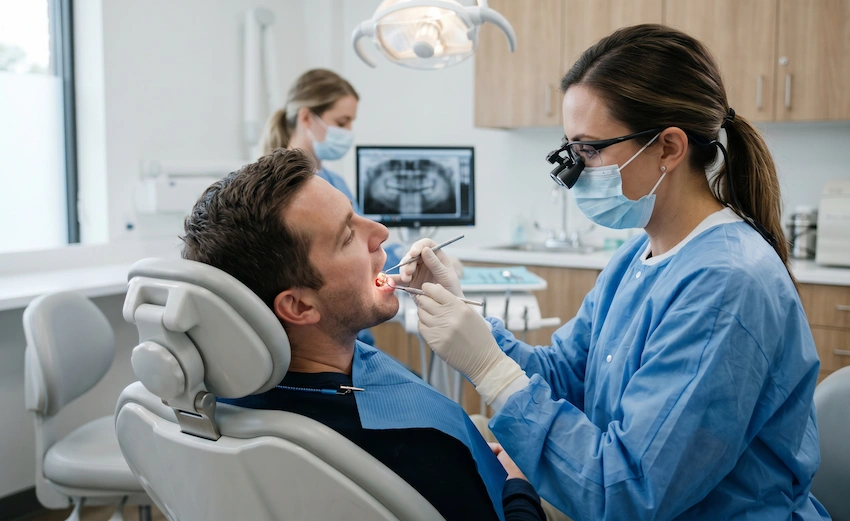
This is what we see in the clinic. It is an occurrence for patients to arrive in a state of high anxiety. Most of them have been avoiding the dentist for years because their bleeding gums made them feel ashamed, or they simply didn’t know how to maintain oral hygiene properly. There is no judgment here, never. We greet you as you are.
Dentist Polen Akkılıç, along with her team, relies on deeply caring and accessible attitudes. We employ very gentle, yet high-tech equipment to clean the surface of the gums thoroughly. We get rid of the hard tartar that you cannot feasibly reach through your cleaning at home.
For our global patients flying to Turkey, we must fix this gum base first. We cannot place luxury veneers or new dental implants on sick gums. A beautiful house cannot stand on a sinking base.
Good home care is your best shield. Brush twice a day with a soft brush. Find an interdental cleaning tool that fits your physical needs, and always visit your dental team twice a year.
Frequently Asked Questions (FAQ)
I always give a very strong NO to my patients. Though it is hard to believe, persistent bleeding is a sign that the area around the gum line is seriously inflamed; you will experience the bleeding less if you continue with the cleaning properly. The key is to remove the bacteria that cause inflammation and swelling, which cannot worsen infection but only will.
Of course, both tools will help you keep your mouth clean. Besides, for anyone who is experiencing hand discomfort and hence cannot use string floss, a water flosser is not only an effective tool but also very gentle. It can reach and clean gum pockets that have not been exposed thus far, while interdental brushes are also a top-notch alternative to traditional floss.
When you do your interproximal cleaning and brushing properly, you are likely to witness such an amazing result that it will make your gums happy within a week to two weeks. On the other hand, coming to us is unavoidable if you have been bleeding for more than two weeks, for a supportive deep cleaning.
No, it is not possible. Mouthwash can only temporarily make bad breath disappear. What’s more, it is unable to break or remove the tartar underneath the gums that is extremely hard to the point of being almost impossible without the removal of the assistance of professionals only.
Not really, but it is definitely a sign of a very big problem. If the swelling and the infected area are caught at an early stage, the treatment can completely eradicate these symptoms. If signs are ignored, bone loss is physically present as a result of adults losing teeth that are mainly due to bone loss, which adults suffering from gum diseases all around the world.
- Chapple, I. L., Van der Weijden, F., Doerfer, C., Herrera, D., Shapira, L., Polak, D., … & Graziani, F. (2015). Primary prevention of periodontitis: managing gingivitis. Journal of Clinical Periodontology, 42, S71-S76.
- Kinane, D. F., Stathopoulou, P. G., & Papapanou, P. N. (2017). Periodontal diseases. Nature Reviews Disease Primers, 3(1), 1-14.
- Lang, N. P., & Bartold, P. M. (2018). Periodontal health. Journal of Periodontology, 89, S9-S16.
- Löe, H., Theilade, E., & Jensen, S. B. (1965). Experimental gingivitis in man. Journal of Periodontology, 36(3), 177-187.
- Mariotti, A. (1999). Dental plaque-induced gingival diseases. Annals of Periodontology, 4(1), 7-19.

