


Best All-on-4 Care Guide
After your trip to Lema Dental Clinic in Istanbul, you must be feeling like you are at the top of the world because of your new smile, which is like your whole life is unfolding anew. The lost faith in oneself is restored. Still, there is in most cases a question left after the excitement fades away: How do I keep this masterpiece in a perfect condition? The reality is that although your new teeth are replicas, your “base” – your jawbone and gum tissue – is still alive tissue. Imagine the All-on-4 bridge is your luxury rooftop terrace which is supported by four very strong columns. Thus, if you want to keep the building in good condition, it’s not enough to simply clean the outdoor terrace; you also have to make sure that the area underneath the pillars is free of garbage.
Why Cleaning All-on-4 is Different
Traditional dentures are removed at night. Natural teeth have individual gaps. All-on-4 is a different beast entirely. It is a fixed bridge that sits snugly against your gums. This creates a “hygiene gap” where food particles and bacteria thrive.
Professor Doctor Coşkun Yıldız often notes to our patients that the most critical area isn’t the white part of the tooth you see in the mirror. It is the “junction”—the microscopic meeting point where the implant enters the gum. If bacteria colonize this area, they can lead to peri-implantitis which is a condition similar to gum disease and can jeopardize the very bone that supports your implants.
The Daily Routine: Your Toolkit for Success
At our clinic in Turkey, Dentist Polen Akkılıç and her team emphasize that “good enough” isn’t enough when it comes to All-on-4 maintenance. You need the right tools for the job.
1. The Power of the Water Flosser
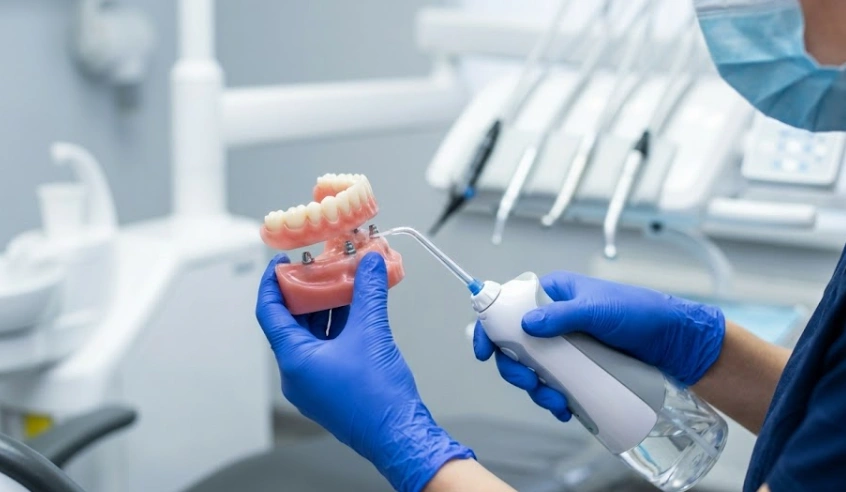
If there is one thing that truly cannot be compromised, it is an oral irrigator (Waterpik). Consider it a power washer for your teeth and gums. It reaches the nooks and crannies under the bridge where a standard string of floss simply cannot go. We recommend using it at a medium setting to flush out the “tunnel” between the bridge and the gum line.
2. Specialized Flossing (Superfloss)
Standard floss is too thin. You need something called “Superfloss” or “Proxy-floss,” which has a stiffened end and a spongy middle. The stiff end allows you to thread the floss through the gap, while the spongy part “mops” the underside of the bridge.
3. The Sulcus Brush
A regular toothbrush is great for the chewing surfaces, but a sulcus brush—a tiny, single-tufted brush—is your best friend for cleaning the base of each of the four implants.
Maintenance Comparison: Tools at a Glance
| Tool | Purpose | Frequency | Why it’s Essential |
| Water Flosser | Flushes debris under the bridge | Twice Daily | Reaches areas mechanical brushing misses. |
| Superfloss | Deep cleaning of the titanium posts | Once Daily | “Mops” the implant-gum interface. |
| Interproximal Brush | Cleans between the bridge and gums | As needed | Perfect for post-meal quick cleans. |
| Non-Abrasive Paste | Cleaning the prosthetic material | Twice Daily | Prevents micro-scratches on the porcelain/zirconia. |
The “Lema Secret”: Professional Maintenance in Turkey
We should, however, drill down into the long-term perspective. Mineralized plaque (calculus) may be formed even if one practices home care with utmost diligence. Here is what we observe in the clinic: patients returning to Lema Dental Clinic for their 6-month or yearly check-up have a considerably higher rate of smiling success.
During these visits, Dentist Polen Akkılıç and her team may occasionally remove the bridge to perform a deep clinical cleaning of the abutments. This is almost like getting a full engine service for your car rather than just a car wash. It makes certain that the “base” will be just as sturdy as the first day it was fixed.
Common Mistakes to Avoid
The question remains: what should you not do?
- Avoid Abrasive Toothpaste: Many “whitening” toothpastes contain silica that can scratch your bridge, making it lose its luster and providing a textured surface for bacteria to cling to.
- Avoid Using Metal Tools: Never attempt to remove debris from your implants with metal toothpicks or scrapers. You risk scratching the titanium, which is an invitation for infection.
- Don’t Ignore Bleeding: If your gums bleed when you clean, it’s not a sign to stop. It’s a signal that there is inflammation. This is when you should contact your clinical partner at Lema immediately.
FAQ: Directly from the Doctor’s Desk
In our clinical experience, no. If the bridge is properly designed, there should be enough space for cleaning without causing pain. If you feel sharp pain, it might indicate an adjustment is needed.
Yes, but look for alcohol-free versions. Alcohol can dry out the mouth and, over time, potentially affect some of the bonding materials used in certain types of prosthetics.
We generally recommend a professional check-up every 6 to 12 months. Many of our international patients coordinate this with a short holiday in Istanbul!
The mouth is a high-bacteria environment. Within 48 hours, a “biofilm” begins to harden. Skipping even a few days allows that film to start mineralizing, which is much harder to remove at home.
Absolutely. In fact, we encourage it. The high-frequency vibrations are excellent for breaking up plaque. Just ensure the bristles are soft.
- Malo, P., de Araújo Nobre, M., Lopes, A., Moss, S. M., & Molina, G. J. (2011). A longitudinal study of the survival of All-on-4 implants in the mandible with up to 10 years of follow-up. Journal of the American Dental Association.
- Taruna, M., Bengalimal, J. S., Zadir, A. S., & Singh, N. (2014). Prosthodontic perspectives of All-on-4 concept for rehabilitating edentulous arches. Journal of Clinical and Diagnostic Research.
- Babbush, C. A., Kutsko, G. T., & Brokloff, J. (2011). The All-on-Four immediate function treatment concept with NobelActive implants: a retrospective study. Journal of Oral Implantology.
- Weinstein, R., Agliardi, E., Fabbro, M. D., Romeo, D., & Francetti, L. (2012). Immediate rehabilitation of the extremely atrophic mandible with fixed full-prosthesis supported by four implants. Clinical Implant Dentistry and Related Research.
- Chan, M. H., & Holmes, C. (2015). Hygiene maintenance for the All-on-4 prosthesis: A review of protocols. International Journal of Dental Hygiene.

