


Make brushing fun and supervise.
Parents frequently underestimate the physiological differences between primary (baby) and permanent teeth, according to our observations at Lema Dental Clinic in Turkey. Professor Doctor Coşkun Yıldız points out that the enamel of primary teeth is much thinner and less mineralized than that of adult teeth. Hence, the bacterial acid process will go to the nerve (pulp) much faster, turning even a minor negligence in hygiene into an emergency in dental care.
Biofilm disruption is what makes the difference here. Without the mechanical removal, bacteria such as Streptococcus mutans settle on the tooth surface, producing acid that breaks down the enamel matrix.
The Developmental Physiology of Brushing
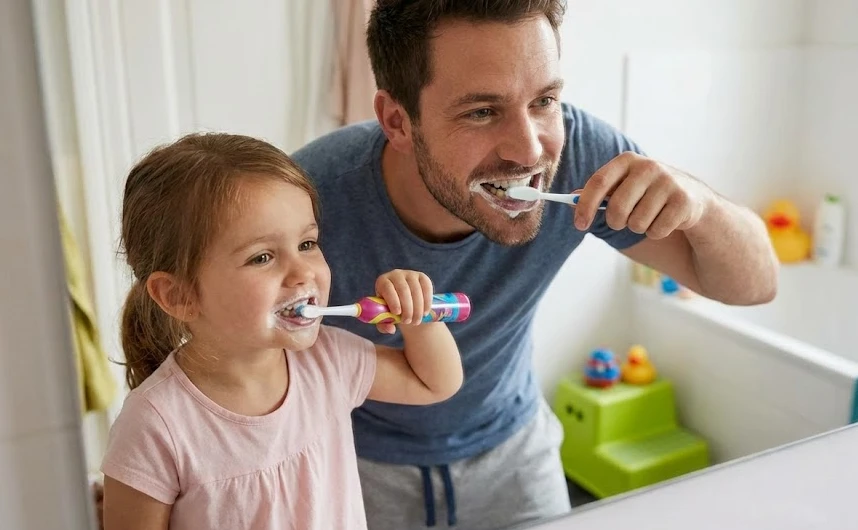
Their lack of sufficiently developed fine motor skills may be a motive behind children’s ineffective brushing. For this, clinicians use neuromuscular maturation to classify the quality of brushing.
Until a child has enough hand dexterity to do simple tasks such as tying shoelaces or writing in cursive, he or she still lacks the rotary wrist motion necessary for properly cleaning the gumline. This is what Dentist Polen Akkılıç and her team mean when they say they use the “Parental Supervision Protocol.”
A child under 7 is basically left to his/her own devices, medically speaking, and it is ineffective. While they tend to focus on the occlusal (biting) surfaces by scrubbing, they generally neglect the critical gingival areas where plaque accumulation leads to inflammation.
The Chemistry of Fluoride: Safety and Efficacy
Among various topics, the one on fluoride usage is highly controversial. However, the scientific basis cannot be changed. Remineralizing agents such as fluoride can help in this. When fluoride comes into contact with the enamel’s hydroxyapatite crystals, it results in the formation of fluoroapatite which has a higher resistance to acids.
In our day-to-day practice at Lema Dental Clinic, we follow the smear-layer protocol which is a good balance between effectiveness and safety (avoiding fluorosis):
Age 3 to 6: Increase the amount to a “pea-sized”. Since the swallowing reflex during this stage is better controlled, the child can spit out the excess.
First Tooth Eruption (about 6 months): Apply a “smear” (rice-grain size) of fluoride toothpaste (1000 ppm). By doing this, you will make sure that the protection is only topical and there is no systemic fluoride ingestion.
Technique Over Force: The Modified Bass Method
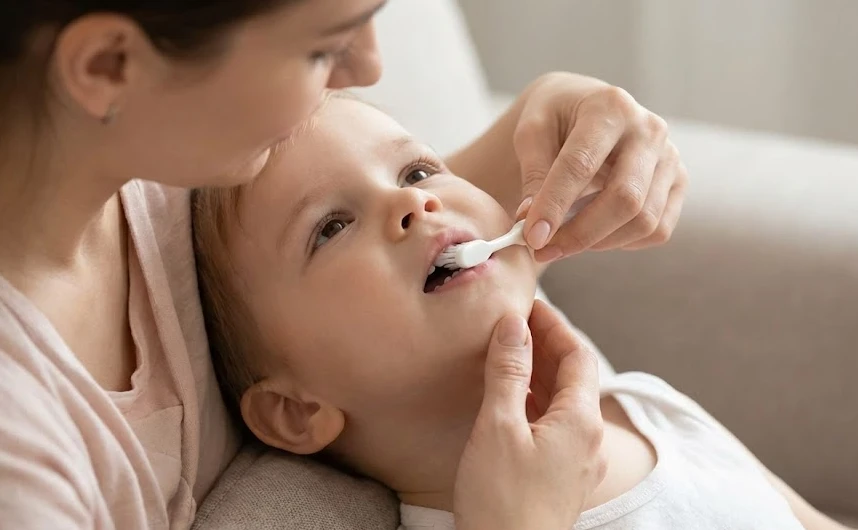
While children often scrub back and forth (horizontal scrubbing), this can cause gingival recession over time. We teach parents to guide their children towards the Modified Fones Technique (circular motions) for younger kids, and eventually the Modified Bass Technique for older children.
The objective is not to “scrub” the teeth white, but to disturb the organized colony of bacteria (plaque) sitting at a 45-degree angle to the gumline.
Clinical Timeline for Hygiene Intervention
At Lema Dental Clinic, we structure our pediatric guidance based on dental eruption stages:
| Developmental Stage | Dentition Status | Clinical Hygiene Goal |
| Infancy (0-1 Year) | Edentulous / First Incisors | Wipe gums with gauze to remove milk residue and acclimatize mucosa. |
| Early Toddler (1-3 Years) | Primary Molars Erupting | Strict Parental Brushing. Disruption of biofilm on pit and fissure surfaces. |
| Preschool (3-6 Years) | Full Primary Dentition | Assisted brushing. Introduction of flossing to close contact points. |
| School Age (6-12 Years) | Mixed Dentition (Exfoliation) | Focus on erupting permanent molars (sealants recommended). Independent brushing with checks. |
The Consequences of Premature Loss
Why do we fight so hard to save a baby tooth that will fall out anyway? Professor Doctor Coşkun Yıldız explains that primary teeth act as natural “space maintainers.”
If a baby tooth is lost prematurely due to untreated ECC, the surrounding teeth drift into the space. This blocks the permanent tooth underneath from erupting correctly, leading to severe malocclusion (crowding) that requires complex orthodontic treatment later in life. Brushing today is essentially “preventive orthodontics.”
FAQ: Medical Insights for Parents
Absolutely. If a child sleeps with a bottle containing milk or juice, the liquid pools around the upper front teeth, creating a petri dish for bacteria all night. We call this ‘Baby Bottle Tooth Decay,’ and it typically requires extensive restoration under sedation.
Acute toxicity requires a large amount (like eating a whole tube). However, chronic ingestion of large amounts can lead to dental fluorosis (white spots on permanent teeth). This is why we restrict the amount to a ‘smear’ or ‘pea size’ until the spitting reflex is fully developed.
Flossing is clinically indicated as soon as two teeth touch (interproximal contact). A toothbrush bristles cannot reach between tight contacts, which is where the majority of pediatric cavities start.
Sealants are a preventive resin coating applied to the deep grooves of molars. They create a physical barrier against bacteria. At Lema Dental Clinic, we recommend sealants as soon as the first permanent molars erupt (around age 6).
Frequency matters more than quantity. Every time a child eats a carbohydrate, the pH in the mouth drops for 30 minutes (acid attack). If a child snacks constantly, the saliva never has a chance to neutralize the acid, rendering brushing less effective. We advise consolidated meal times.
- American Academy of Pediatric Dentistry (AAPD). (2022). Guideline on Fluoride Therapy. The Reference Manual of Pediatric Dentistry.
- Tinanoff, N., & Baez, R. J. (2019). Early Childhood Caries: Epidemiology, Aetiology, and Prevention. International Journal of Paediatric Dentistry.
- Featherstone, J. D. (2000). The science and practice of caries prevention. Journal of the American Dental Association, 131(7), 887-899.
- Marinho, V. C., et al. (2003). Fluoride toothpastes for preventing dental caries in children and adolescents. Cochrane Database of Systematic Reviews.
- Casamassimo, P. S., et al. (2009). Beyond the dmft: The human and economic cost of early childhood caries. Journal of the American Dental Association, 140(6), 650-657.

