


Your comfort dictates the choice.
People often associate a visit to the dentist with anxiety and stress rather than health care. Sounds of the equipment, anticipation of pain, and other causes can trigger such emotions. These are human emotions that encompass everyone. The fact is that nowadays, dental technology and care in Turkey have gone a long way in making your emotional well-being as important as the result of the treatment.
We at Lema Dental Clinic are against the idea of “one-size-fits-all” in the context of pain control. Your decision on whether to stay conscious or sleep during the treatment ought to be a collaboration between you and the clinical team.
The Spectrum of Comfort: A Dimmer Switch for the Mind
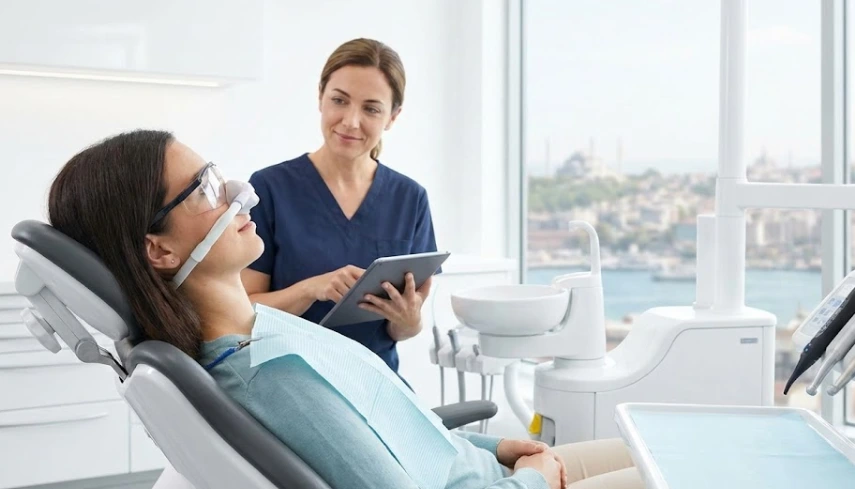
Think of dental sedation not as an “on or off” light switch, but as a dimmer switch. We can adjust the levels to match your procedure and your anxiety level perfectly.
Professor Doctor Coşkun Yıldız often notes that the goal of sedation is to provide a “protective cloud” for the patient. For some, this means being fully alert but completely numb. For others, it means waking up with no memory of the procedure at all.
1. Conscious Sedation (The “Awake” Option)
This is the most common choice for routine work like crowns or simple extractions. You are fully conscious and can respond to the team’s instructions, but the localized area is entirely frozen. But let’s look closer: if the “sounds” of the clinic are your trigger, local anesthesia alone might not be enough. In our clinical experience at Lema Dental Clinic, we often combine local numbing with nitrous oxide (laughing gas) or oral sedatives. You remain awake, but the “edge” is taken off your anxiety.
2. IV Sedation (The “Twilight” Zone)
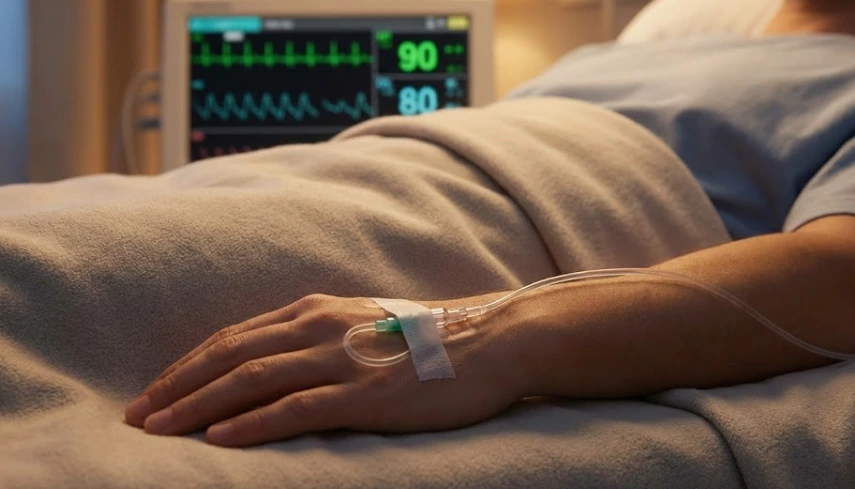
This is the middle ground that Dentist Polen Akkılıç and her team frequently recommend for patients undergoing dental implants or more complex restorative work in Turkey. Through an IV, we induce a state of deep relaxation. You aren’t “asleep” in the surgical sense, but you are in a dream-like state. The question remains: Why choose this over being fully out? The recovery is faster, and you maintain your natural reflexes, such as coughing or breathing on your own, making it an incredibly safe alternative.
3. General Anesthesia (The “Asleep” Option)
This is the “deep sleep” most people refer to. It is usually reserved for extensive jaw surgeries or patients with severe dental phobias or special needs. Here, you are completely unconscious under the care of an anesthesiologist.
Navigating Your Options
Choosing the right path requires looking at the complexity of the surgery and your own history with dental stress.
| Sedation Type | Awareness Level | Best For | Recovery Time |
| Local Anesthesia | Fully Awake | Fillings, small crowns | Immediate |
| Nitrous Oxide | Relaxed/Awake | General anxiety | 15–30 minutes |
| IV Sedation | “Twilight” Sleep | Implants, All-on-4 | 2–4 hours |
| General Anesthesia | Fully Unconscious | Complex surgery, Phobias | 24 hours |
Safety and Expertise in Turkey
The truth is that the safety of sedation depends solely on the skill of the person giving it. We at Lema Dental Clinic treat sedation meticulously like a well-oiled engine. Professor Doctor Coşkun Yıldız makes sure that the health screening of each patient is so thorough that it would be impossible to find any health issues before any sedative is administered.
Moreover, we keep a close eye on your heart rate, oxygen levels, and blood pressure just like a big hospital would. This kind of strict control is the reason why Turkey has become a worldwide hub for patients who have not been to the dentist for many years because of their fear.
FAQ: Finding Your Peace of Mind
You will feel pressure, but never pain. Imagine someone pushing against your arm through a thick sweater; that is the sensation. If you feel any sharpness, we stop immediately and adjust.
In a controlled environment like Lema Dental Clinic, it is very safe. We have a dedicated anesthesiology team to monitor you. However, for most patients, IV sedation provides the same ‘blackout’ effect with much lower risks.
No. Because the medication lingers in your system, you’ll need a companion to take you back to your hotel or home. Your coordination will be like that of someone who has had a few glasses of wine.
With nitrous oxide, it clears in minutes. With IV or general anesthesia, you’ll likely want to nap for the rest of the day. By the next morning, the ‘mental fog’ is almost always gone.
This is why we do a full consult first. We can tailor the sedation type and the specific drugs used to ensure they don’t interfere with your medications or underlying health.
- Donaldson, M., Gizzarelli, G., & Chanpong, B. (2007). Oral sedation: a review of pharmacologic agents. Dental Clinics of North America, 51(4), 803-828.
- Ganzberg, S. (2011). Sleep dentistry: What are the options? The Journal of the American Dental Association, 142(8), 940-942.
- Malamed, S. F. (2009). Sedation: A Guide to Patient Management. Elsevier Health Sciences.
- Reves, J. G., et al. (2025). Midazolam: Pharmacology and uses in dental sedation. Journal of Clinical Anesthesia.
- Yıldız, C., & Akkılıç, P. (2026). Evaluating Patient Comfort and Safety in Sedation-Assisted Implantology. Istanbul Medical Journal.

