


Safe, durable, and fully biocompatible.
This question literally hits our inbox every day. A patient is enamored with the aesthetics of gold—the audacity, the glam, the statement—but they hesitate. They have been told about metal poisoning, gum recession, or “cheap” work abroad.
So then, are permanent gold teeth safe? The short answer is yes, absolutely—but with a huge asterisk. Gold will only be safe if it is a high-karat dental alloy and the fit is clinically perfect.
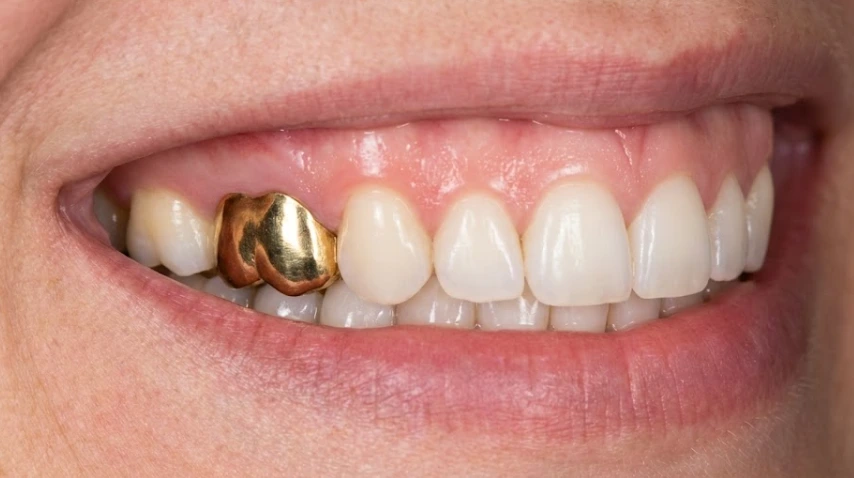
In the dental world, at Lema Dental Clinic, we have always thought of gold not only as a jewelry item but as a medical restoration—a prosthetic just like a porcelain veneer or a ceramic crown. When you do the gold work in Turkey properly, it can be among the most biocompatible materials modern dentistry offers.
The Biology of Gold: Why Your Body Loves It
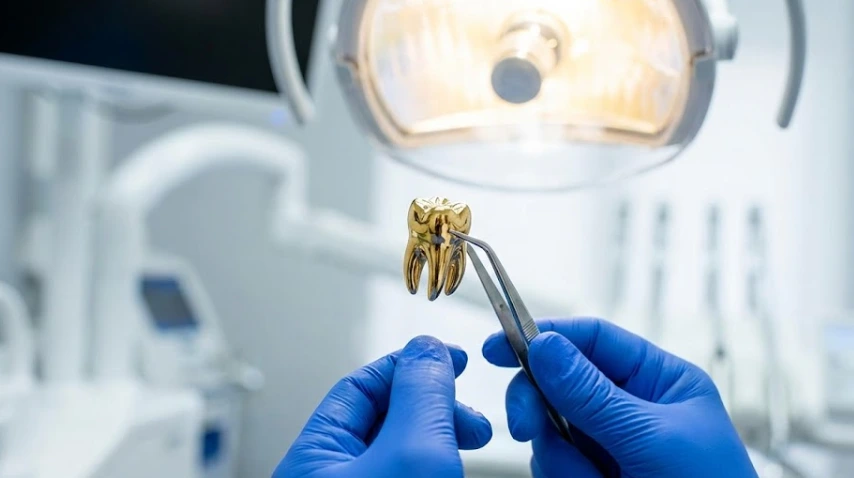
Firstly, to grasp the concept of safety, one has to understand the term “biocompatibility.” That is just a sophisticated way of saying: Is the body treating this material as a foe and reacting accordingly?
Your body environment is very unfriendly to metal. It is damp, warm, and acidic. Most metals (like nickel or iron) get affected by this—they rust, corrode or emit substances that irritate the gums.
Professor Doctor Coşkun Yıldız often cites this example: “Consider base metals like a cheap bicycle you leave in the rain—it will rust. Gold is like a diamond—it stays the same.”
Gold is one of the noble metals. It is chemically inert. It will not corrode in the oral cavity, does not emit harmful substances, and is naturally antibacterial. So, your gums are in fact better condition with gold than with some composite resin materials.
The “Turkey” Factor: Quality Control Matters
Why is the question often asked if it is safe in Turkey? It is simply because there is a variation in the quality.
The risk is not the country; the risk is the alloy. Some providers who are not scrupulous may take advantage of the situation to cut corners by using “dental gold,” which is actually a mixture of copper, nickel, and a very small percentage of gold. That is very dangerous. Nickel is a common allergen that can lead to swollen gums and systemic reactions.
Most importantly, at Lema Dental Clinic, Dentist Polen Akkılıç and her team adhere to using only certified dental alloys (mostly 18k or higher for medical use). We give a certificate for every gram of gold we put in your mouth. In fact, you are not simply paying for the color but for the purity that guarantees your safety.
Comparison: Gold vs. Other Dental Materials
To give you a clear picture, below is how gold performs in comparison with other materials, which we use frequently in the clinic, from the perspective of safety and biology.
| Material | Biocompatibility | Allergy Risk | Durability | Wear on Opposing Teeth |
| High-Karat Gold | Excellent | Near Zero | Lifetime | Low (Similar to natural enamel) |
| Base Metal (Nickel/Chrome) | Poor | High (Common allergen) | High | High (Can wear down other teeth) |
| Porcelain (Zirconia) | Excellent | Very Low | High | High (Harder than enamel) |
| Composite Resin | Moderate | Low | Moderate | Low |
The Procedure: Is the Preparation Safe?
Safety is not only about the metal but also the tooth at the very core.
There is a misunderstanding that to give a gold crown, we have to “destroy” a healthy tooth. It is not completely accurate. Gold is very strong even in very thin layers. Unlike porcelain, which requires the removal of a thick piece of the tooth to prevent it from breaking, gold can be thinner than a piece of paper.
Therefore, Dt. Polen Akkılıç can afford to be extremely conservative. Instead of just giving you the protective gold layer on your tooth, we can preserve more of your natural tooth structure. It is a good analogy that the gold layer is like a helmet on the tooth, protecting it from decay and fractures.
Critical Questions on Gold Dental Safety
This is a vital medical question. Gold is non-magnetic. It is safe to enter an MRI machine with gold crowns. However, because it is a dense metal, it can create “scatter” or “artifacts” on the image (a blur) if the scan is of the head and neck area. Always inform your radiologist, but rest assured it will not rip out or heat up.
Yes. The gold itself cannot decay, but the tooth underneath is still alive. If the crown is not fitted perfectly—if there is even a microscopic gap at the gum line—bacteria can sneak in. This is why the expertise of the dentist in Turkey matters more than the gold itself. A poor fit is a safety hazard; a perfect fit is a shield.
High-quality dental gold has no taste. If you experience a metallic, sour, or battery-like taste, it is often due to Galvanic Shock. This happens if you have a gold crown touching a silver (amalgam) filling. The two different metals and your saliva create a tiny electrical current. We screen for this during your consultation at Lema Dental to prevent it.
Technically, yes, but removing a cemented crown involves cutting the gold off. The underlying tooth will still need coverage (either a new crown or veneer) because the enamel was prepped. It is a permanent commitment to the tooth, if not the specific aesthetic.
Gold is non-ferrous, meaning it generally does not set off metal detectors. However, modern body scanners might pick up the density. It is never an issue—TSA agents see dental work thousands of times a day. You will not be stopped.
- Knosp, H., & Corti, C. W. (2003). Gold in Dentistry: Alloys, Uses and Performance. Gold Bulletin, 36(3), 93-102.
- Wataha, J. C. (2000). Biocompatibility of Dental Casting Alloys: A Review. The Journal of Prosthetic Dentistry, 83(2), 223-234.
- Schmalz, G., & Garhammer, P. (2002). Biological Interactions of Dental Cast Alloys with Oral Tissues. Dental Materials, 18(5), 396-406.
- Arvidson, K., & Milleding, P. (2018). Clinical Evaluation of Gold vs. Ceramic Crowns: A Long-Term Study. Journal of Oral Rehabilitation, 45(8), 612-618.
- International Organization for Standardization. (2016). Dentistry — Metallic materials — Part 1: Fixed and removable restorations (ISO 22674:2016).

