


They restore teeth in severe upper jaw bone loss cases.
The Life-Changing Reality of Zygomatic and Quad Zygoma Implants
Many of the patients who come to Lema Dental Clinic in Turkey are longtime sufferers, often feeling quite discouraged. They have been blamed by previous dentists for having such a poor “foundation”—in other words, that the years of losing teeth or wearing dentures have caused the jawbone to shrink so much that normal implants no longer have anything to grip onto.
The truth is, conventional bone grafting is not necessarily the right solution in all cases. Occasionally, what we require is a different kind of structure. Zygomatic implants along with the state-of-the-art Quad Zygoma technique are the options available in such cases. The team led by Professor Doctor Coşkun Yıldız and Dentist Polen Akkılıç considers these not as mere clinical operations but as the last, triumphant battle against complete tooth loss.
What Are Zygomatic Implants?
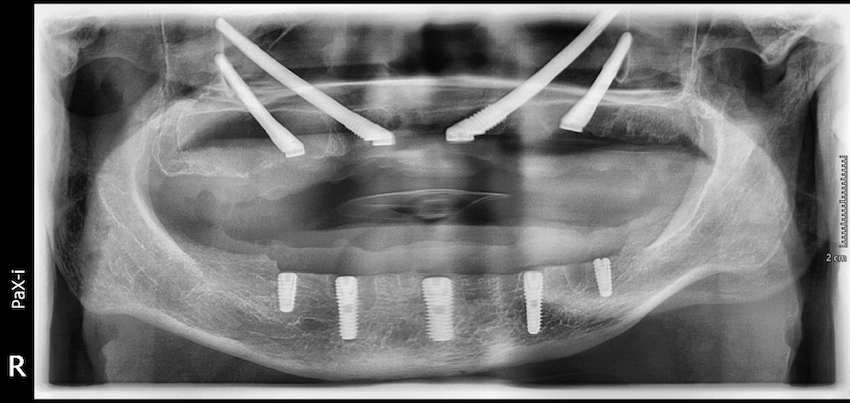
It is useful to compare a regular dental implant to a wood screw. The wood in this case is the jawbone. So, if the wood (jawbone) is thin or rotten, the screw (implant) will not hold. Zygomatic implants completely avoid the problem of a “thin piece of wood” or a bone-deficient upper jaw, since they are fixed into the zygoma or cheekbone.
The cheekbone can be compared to the “granite” of the facial structure. It is extremely stiff, stable and, unlike the jawbone, it does not shrink after tooth loss. By means of these longer, specially designed implants, a skeletal framework can be built that will hold a whole bridge of teeth, in many cases, without the requirement for bone grafting fraught with pain and lasting for years.
The “Quad Zygoma” Evolution
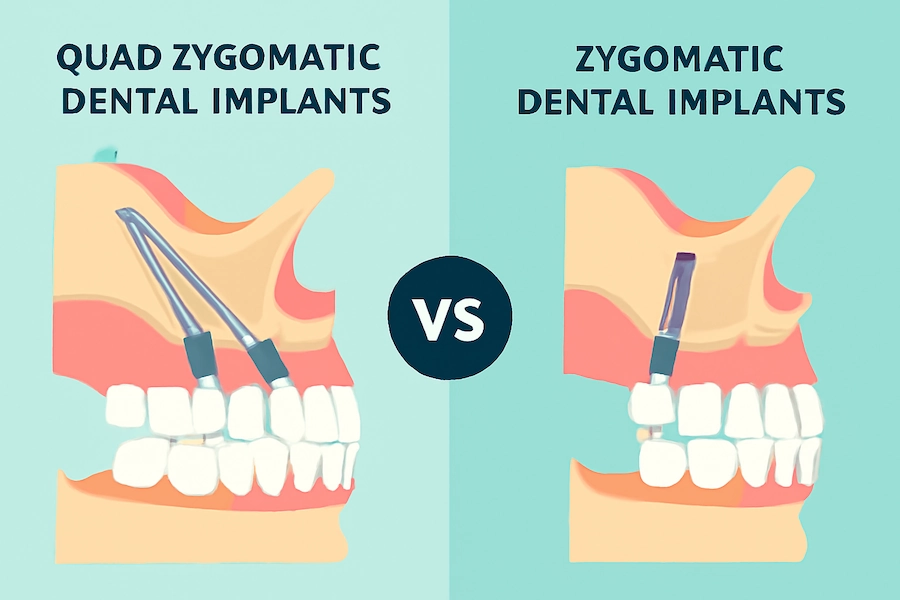
Now, let’s focus on those people who are in the most challenging situation. If the upper jaw bone is so totally deteriorated that there is hardly any bone at the front and also at the back for support, then the Quad Zygoma method has to be used.
For a regular zygomatic case, we might put two implants in the zygomatic area and two regular implants in the front. However, we put all four cheekbone implants in a Quad Zygoma operation. It’s a perfect example of how biomechanical engineering can work. The procedure is often called the “gold standard” by Professor Doctor Coşkun Yıldız when referring to a situation where a patient has been told that their case is “beyond hope” at some other clinic.
Comparing Your Restoration Options
Choosing the right path depends entirely on your unique anatomy. Here is what we see in the clinic when we compare these advanced solutions:
| Feature | Standard Dental Implants | Zygomatic Implants | Quad Zygoma Implants |
| Primary Anchor | Jawbone (Alveolar) | Cheekbone (Zygoma) | Cheekbone (Zygoma) |
| Bone Grafting | Often required | Rarely required | Rarely required |
| Number of Implants | 4 to 8 per arch | 2 Zygomatic + 2-4 Standard | 4 Zygomatic Implants |
| Ideal Candidate | Good bone density | Moderate to severe bone loss | Extreme maxillary atrophy |
| Time to New Teeth | 3–9 months | Often “Teeth in a Day” | Often “Teeth in a Day” |
The Lema Dental Clinic Experience in Turkey
The question may still linger: Why come to Turkey for such an intricate procedure? The real secret is the great combination of advanced technology and skill. At Lema Dental Clinic, we don’t merely “sit” implants; we even go as far as planning your entire facial harmony.
Lead surgeon Polen Akkılıç and her crew are making use of 3D surgical guides and digital smile design for teeth attached to those zygomatic implants to be not only functional but also aesthetic as if they have been growing there forever. The reason for Turkey’s status as a world center for this kind of operation is the combination of the top-notch Maxillofacial skills in our clinic with a human touch that makes the “doctor-patient” relationship more of a collaboration.
The Procedure: What to Expect
‘Zygomatic implants’ may get your imagination running wild with not-so-pleasant ideas. But actually, everything turns out to be very much like conventional dentistry:
- Digital Mapping: CBCT scans are made and from those we produce a 3D print of your skull.
- Surgical phase: With local amnesia and even general anesthesia if that’s needed, the implants are put in place. Since the cheekbone hardly ever moves, there is no necessity to wait for ‘osseointegration’ for months if we don’t want to!
- Phase of Immediate Loading: The solution for a missing tooth problem can usually be fabricated and fixed in its place the very same day. So, you enter the clinic without teeth and exit with a smile on your face.
Frequently Asked Questions
Typically, many of my patients find the recovery surprisingly easy. Though there may be some swelling around the cheek area after the operation for a couple of days, due to the absence of extensive bone grafting, it usually results in less ‘deep’ pain. We take care of your comfort with routine standard protocols.
It is hardly the age; rather the condition that matters. In fact, we have already done the procedure for the elderly patients of 70 and 80 who wanted to get rid of their annoying dentures and chew meat again.
Provided they are well looked after – which entails the same thoroughness of cleaning and professional dental scaling as for natural teeth – they are aimed to be a lifelong solution. The cheekbone is a very good host for titanium.
Zygomatic and Quad Zygoma surgeries necessitate special Maxillofacial training which most dentists in general practice lack. It is a rather rare department and one that requires getting through a high number of cases for the proficiency to be established which is why we are doing this work here in Turkey.
Usually, we advise you not to leave Turkey earlier than 7 to 10 days. This allows Dentist Polen Akkılıç to check on your healing progress and make any necessary bite adjustments before your departure.
- Aparicio, C., et al. (2014). Zygomatic implants: Indications, techniques and outcomes, and the Zygomatic Success Code. Periodontology 2000.
- Bedrossian, E. (2010). Rehabilitation of the Atrophic Posterior Maxilla: Zygomatic Implants. Dental Clinics of North America.
- Chrcanovic, B. R., & Abreu, M. H. (2013). Survival and complications of zygomatic implants: An updated systematic review. Journal of Oral & Maxillofacial Surgery.
- Davó, R., & Pons, O. (2015). 5-year outcome of cross-arch fixed prostheses supported by four zygomatic implants: A prospective study. European Journal of Oral Implantology.
- Malevez, C., et al. (2004). Clinical outcome of 103 consecutive zygomatic implants: A 6- to 48-month follow-up study. Clinical Oral Implants Research.

