


Chronic irritation
Benign alveolar ridge keratosis is a non-malignant mucosal condition of the mouth that arises from the alveolar ridge which is the gum tissue area covering the jawbone that holds the teeth. This condition develops as a defensive tissue reaction to repeated mechanical trauma.
Oral mucosa responds to continuous friction by producing more keratin. This reaction is aimed at strengthening the surface layer of the tissue thus allowing less damage to the deeper layers.
| Title | Description |
|---|---|
| Definition | Benign keratosis is the one that occurs spontaneously on the alveolar ridge of the mouth. |
| Causes | Continuous friction due to mechanical actions, bruxism, wrong-fitting dentures, and oral habits. |
| Symptoms | White, rough, or flat patches; generally painless. |
| Diagnosis | A clinical examination is carried out and, if required, a biopsy is taken. |
| Treatment | Removing the source of irritation; usually, there is no need for surgery. |
| Prognosis | Benign; usually resolves after irritant removal. |
What Is Benign Alveolar Ridge Keratosis?
Benign alveolar ridge keratosis is a local proliferation of the oral epithelium due to chronic physical stress. The word benign is used to denote that the condition has no risk of malignancy and does not lead to cancer of the mouth.
From the medical point of view, it presents itself as a white, non-removable patch with a smooth or slightly rough surface. The sore is not uncomfortable and is generally found during a routine dental check-up.
Why Does This Condition Develop in the Mouth?
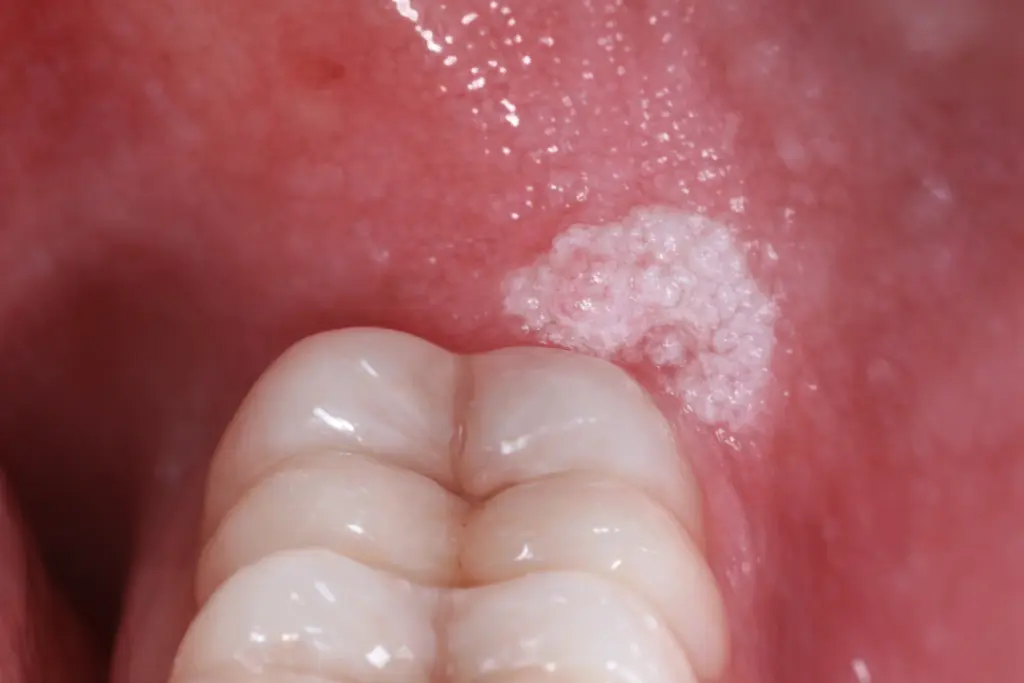
The mouth is exposed to different forces of chewing, contact with teeth and dental appliances. Whenever these forces hit the same spot repeatedly, the mucosa reacts by producing a thicker keratin layer.
This process of adaptation protects the inner tissues from the continuation of the trauma. Thus, benign alveolar ridge keratosis is not a sign of a disease but rather an indication of tissue strength and ability to withstand.
Common Mechanical Causes
Bruxism is the leading one among those that result in alveolar ridge keratosis. The continuous and repetitive action of clenching and grinding places on the alveolar ridge excessively and thus, keratin formation is the result.
Similarly, ill-fitting dentures, unstable partial prostheses, and sharp dental restoration can also be the cause of repetitive irritation of the mucous membrane. The mucosa can also get keratosis with just mild friction but the exposure has to be long-term.
The Role of Oral Habits
Cheek and lip biting, which are examples of parafunctional habits, raise localized mechanical stress. If these habits involve contact with the alveolar ridge, the keratotic lesions may appear.
Most of the time, patients do not realize that they have these habits. When they are identified and stopped, the mucosa will be less traumatized and will be able to heal.
Is Benign Alveolar Ridge Keratosis Dangerous?
Benign alveolar ridge keratosis in itself does not carry any risk and no danger comes out of it when a thorough examination is made. What sets it apart from the precancerous oral lesions is that there is no coexistence of dysplasia or malignant transformation in the condition. The patients can be rest assured that the condition is safe and there is nothing to worry about.
Still, it is advisable to have any unhealed white patches in the mouth checked by a dentist for the correct diagnosis. A thorough and careful clinical evaluation, along with patient history, is most of the time enough. In cases where it is challenging to make a decision, the most reliable confirmation and emotional relief is a biopsy.
Getting examined promptly will result in the right diagnosis and thus, eliminate the unnecessary bother. Besides, it gives the doctors the opportunity to dismiss other possible conditions that may need different treatments.
How Is It Diagnosed?
Diagnosis is primarily done by looking at the lesions on the patient, their location and by taking the patient’s history into consideration. Usually, these types of lesions are found in areas that are chronically exposed to friction.
The need for a biopsy only arises if the image presented is uncommon or there are high-risk factors for oral cancer.
Management and Treatment
The primary goal of treatment is to eliminate the source of pain and irritation. It is not uncommon for the lesion to disappear spontaneously once the friction has stopped.
In most cases, the only things necessary will be dental adjustments, occlusal splints, and modification of habits. Surgery is the last option that is seldom required.
Prevention and Oral Care
It is advantageous to have regular visits to the dentist because it helps spot any mechanical problems at an early stage. Proper fit for the denture and maintaining the appliance also helps alleviate stress on the mucosa. Understanding of oral and stress-related habits ensures the health of the oral tissues in the long run.
When Should a Dentist Be Consulted?
It is advisable to get an opinion from a dentist if a person discovers a white patch in their mouth that has been there for longer than two weeks and does not go away. While benign alveolar ridge keratosis is not something to be concerned about, assessment by a professional ensures that the right diagnosis is made.
If the patch increases in size, changes color, or texture, then a visit to the dentist without delay is a must. The presence of pain, bleeding, or an ulcer, on the other hand, needs immediate dental attention. This is because they are not typical signs of benign keratosis.
The timely professional intervention not only brings confidence through reassurance but also makes the management suitable and allows for keeping the good state of one’s oral health.
Frequently Asked Questions About Benign Alveolar Ridge Keratosis
Benign alveolar ridge keratosis is a noncancerous condition of the oral mucosa of the alveolar ridge that is characterized by tissue thickening and is frequently the result of continuous mechanical trauma.
It results from recurrent mechanical trauma such as grinding the teeth, ill-fitting dentures, or oral habits like cheek and lip chewing.
Benign alveolar ridge keratosis is not a serious condition and does not raise the risk of cancer.
Therapy beforehand should focus on removing it if the irritant is responsible. For example, modification of dental appliances or breakdown of oral habits. Its presence disappears almost completely when the irritant is taken out.
If the cause of the irritation is left untreated, then yes, Benign alveolar ridge keratosis can resurface. Being diligent with one’s oral hygiene and regular dental visits can be greatly helpful in avoiding the issue’s reappearance.
Neville, B. W., Damm, D. D., Allen, C. M., & Chi, A. C. (2022). Oral and Maxillofacial Pathology (5th ed.). Elsevier.
Regezi, J. A., Sciubba, J. J., & Jordan, R. C. K. (2017). Oral Pathology: Clinical Pathologic Correlations (7th ed.). Elsevier.
Scully, C. (2013). Oral and Maxillofacial Medicine: The Basis of Diagnosis and Treatment (3rd ed.). Churchill Livingstone.

