


Because infection or inflammation persists around the tooth.
Why a “Dead” Tooth Can Still Cause Agony?
It sounds like a physiological paradox, doesn’t it? You have been told that the nerve was dead or perhaps you have already had a root canal done years ago. By all laws of logic, the tooth should not be able to provide a pavilion in your mouth. However, there remains a throbbing, sharp, or dull ache that should to be ignored.
In fact, a “dead” tooth is not just a piece of anatomy; it can be a gateway of infection. At Lema Dental Clinic, we often encounter patients coming from Istanbul who are quite tired and puzzled exactly because of this. They wonder if the nerve is no more, where does the sensation come from?
The Science of “Zombie” Pain

We call a tooth dead when it has no more dental pulp, the soft part in the center that contains blood vessels and nerves. But the tooth doesn’t exist as an isolated entity. It is connected to your jaw by a network of ligaments and tissues.
Professor Doctor Coşkun Yıldız frequently uses a figure of speech to illustrate a case like this: Your tooth is a house. Even if the electricity (the nerve) is switched off, the water can still leak and the basement can still rot. If a “leak” (infection) gets to the soil surrounding the house, the neighbors (the jaw nerves) will inevitably have to be disturbed.
1. The Pressure Cooker Effect
The most common culprit is the gas. When bacteria feed on the necrotic (dead) tissue in the tooth, they release the gas. Since the tooth has a strong and rigid shell, the gas has no way out. The pressure caused by the gas at the tip of the root pushes the periodontal ligament which is very sensitive.
2. The Periapical Abscess
After the infection moves away from the root tip, it leads to the formation of a pus-filled sac known as an abscess. By then, the discomfort is not caused by the inside of the tooth but the surrounding bone and gum tissue. This is the reason why you experience pain when you chew or when the tooth is tapped.
3. High-Friction “Phantom” Pain
The tooth is sometimes physically broken. Dentist Polen Akkılıç and her crew discover that a dead tooth has microscopic cracks that allow the tooth to bend a little under the pressure thus every time you chew the irritates the neighboring tissues.
What Are Your Options?
Ignoring a painful dead tooth is a gamble you don’t want to take. Left unchecked, the infection can spread to the jawbone or even enter the bloodstream. Here is how we typically approach this at our clinic in Turkey:
| Treatment Option | Primary Goal | Typical Timeline | Recovery Level |
| Root Canal Therapy | Clean out the “dead” interior and seal it. | 1 – 2 appointments | High (Saves the tooth) |
| Root Canal Retreatment | Fix a previous canal that has been re-infected. | 2 appointments | Moderate (Complex) |
| Apicoectomy | Surgically remove the tip of the root. | 1 – 2 hours | Moderate |
| Extraction & Implant | Replace the tooth entirely with a titanium post. | 3 – 6 months | Permanent Solution |
Why Patients Select Lema Dental Clinic for Root Canal Treatment?
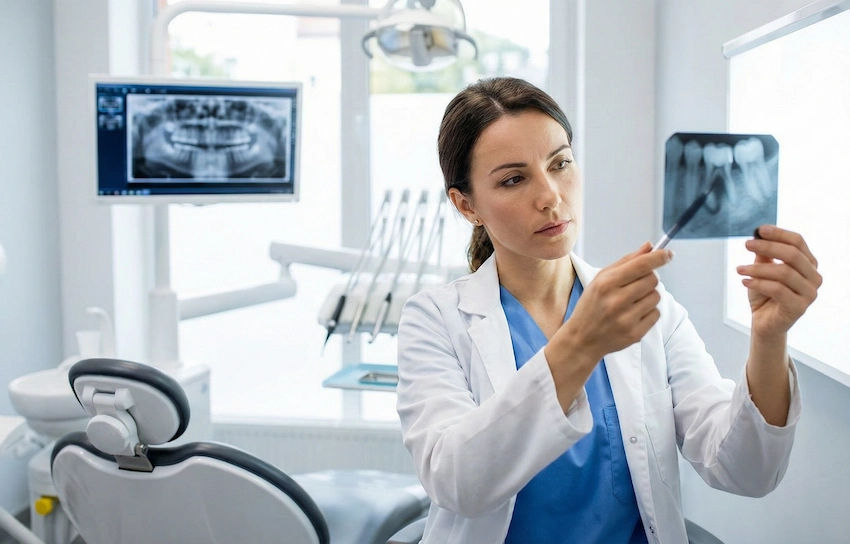
It is not only about the lower prices that attract people to come to Turkey for their dental work but also it is about the high level of precision that balances technology with a human level of understanding. As far as our clinical experience is concerned, we have found out that many unexplained tooth aches are the consequence of a root canal being missed or the use of outdated methods in the previous treatments.
Dentist Polen Akkılıç and her staff employ 3D imaging to unveil even the smallest of your tooth root details. We do more than just pain relief; we look at the problem at the very root. Whether it is an additional fourth canal or a hairline fracture, our goal is that the pain once eliminated should never return.
Using the Metaphor of a Building “Foundation”
We always compare the jawbone to a building’s foundation when explaining to our patients. Neglecting a dead, infected tooth is like allowing a silent leak to slowly destroy the concrete. It’s only when the structure starts to lean that you realize the extent of the damage. Timely intervention preserves not only your bone density but also your charming smile.
FAQ: Straight Talk from Our Doctors
Actually, when experiencing nerve pain from a cold stimulus, the nerve is most probably not totally dead but it might be dying. However, if the heat causes pain and the cold relieves it, this is a classic sign of gas expanding from a dead nerve. You need to be here for us right away.
Antibiotics are just a temporary truce in a war. They may reduce inflammation and relieve pain for a while, but since a dead tooth doesn’t have any blood flow, the medicine simply can’t get to the source of the bacteria to kill them. The “troops” will come back.
The discomfort people typically associate with a root canal is actually the pain from an infection before the operation. With the use of the most up-to-date anesthesia and the techniques that we follow at Lema Dental Clinic, the treatment goes practically painlessly like getting a regular filling.
Not very long. A dead tooth is like a time bomb waiting to go off. Once the infection gets into the bone, you will lose your tooth or even worse, you will get a systemic infection.
In addition to the major cost savings, Turkey and particularly Lema Dental Clinic is home to a pool of doctors who treat challenging cases daily. You benefit from exceptional specialists in a place that resembles a boutique hotel rather than a clinical hospital.
- Abbott, P. V. (2004). Classification and diagnosis of endodontic diseases. Australian Endodontic Journal, 30(3), 94-99.
- Nair, P. N. (2004). Pathogenesis of apical periodontitis and the causes of endodontic failures. Critical Reviews in Oral Biology & Medicine, 15(6), 348-381.
- Siqueira Jr., J. F. (2001). Aetiology of root canal treatment failure: why well‐treated teeth can fail. International Endodontic Journal, 34(1), 1-10.
- Trowbridge, H. O. (1981). Pathogenesis of pulpitis and marginal periodontitis. Journal of Endodontics, 7(7), 292-302.
- Yıldız, C., & Akkılıç, P. (2023). Advanced Endodontic Protocols in Modern Clinical Practice. Istanbul Medical Press.

