


To create enough strong bone for stable dental implant placement.
The Truth About Bone Grafts and Sinus Lifts
You have decided to get new dental implants to restore your beautiful smile. It is a brave first step. At your meeting with the dental surgeon, he or she might throw in a “bone graft” or a “sinus lift.” The procedure that at first glance seemed a walk in the park now looks like a mountain.
Patients often ask us at Lema Dental Clinic in Turkey: “Why can’t you just put the implant in now?”
Imagine an implant as a skyscraper. You may have the most amazing design in the world but the building will not stand if the ground beneath it is soft or shallow. Bone grafts and sinus lifts are procedures that help to make your “ground” strong.
The Jawbone: A “Use It or Lose It” System
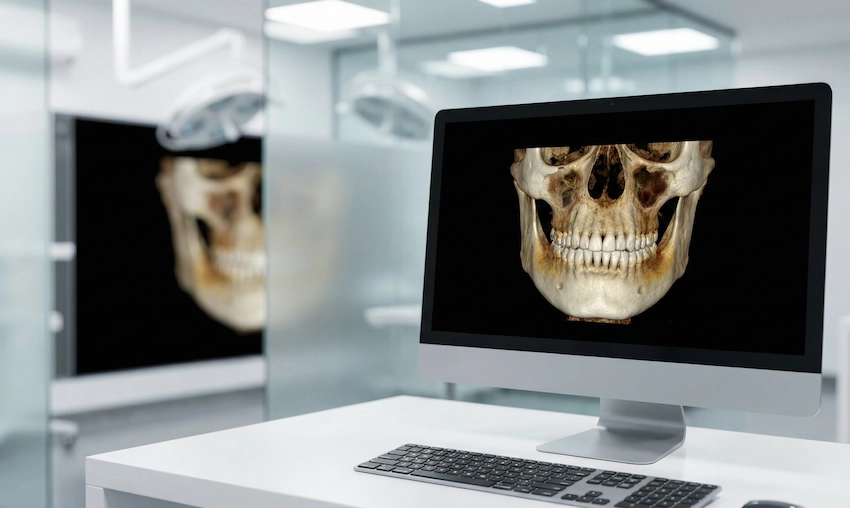
The human body is extremely clever. When one loses a tooth, the jawbone loses its job—supporting the tooth. Without the regular chewing stimulation, the bone starts to resorb, or shrink.
Professor Doctor Coşkun Yıldız frequently points out that we notice a considerable bone loss just within the first year after a tooth is missing. If an implant is put into a thin, fragile jawbone, it cannot get a good hold. We require volume, density, and height. A bone graft is the answer to that.
What Actually Happens During a Bone Graft?
A bone graft should not be seen as “putting a block of wood,” but more like “sowing the seeds.”
We fill the spaces where the bone has become thin with the help of a specialized bone mineral (either from your own body or a highly safe processed material).
Within a few months, your body carries out a wonderful function called osteogenesis, where it converts the graft to a new living bone that is brand-new. Before Dentist Polen Akkılıç and the team come for the implant, they will find that it is not a graft anymore, but your own jaw that has grown stronger.
The Sinus Lift: Making Room for Success
We may face an extra problem in the upper jaw: the maxillary sinuses. They are basically air-filled spaces located just above your upper back teeth.
Often, the space between the sinus bottom and the mouth roof is very narrow, sometimes as thin as an eggshell. If an implant were placed there unprepared, it would just break through into the sinus.
The “Eggshell” Metaphor
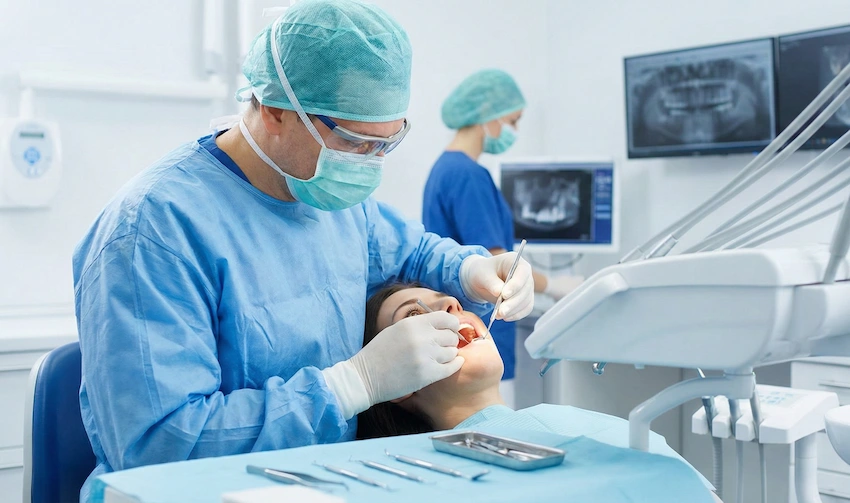
When explaining the sinus lift procedure to patients, we say: the sinus membrane is like the very thin, fragile skin on the inner side of an eggshell. You “lift” that skin up to make a small pocket underneath. Then, you fill that pocket with bone graft material.
There you go: an air-filled sinus has just got a “floor” thanks to the bone graft material. The procedure is very delicate, but it makes a great difference between one implant that fails in two years and another one that lasts a lifetime.
Comparing the Procedures: What to Expect
Every patient at Lema Dental Clinic receives a bespoke plan, but here is a general breakdown of how these foundational steps compare.
| Feature | Bone Graft (General) | Sinus Lift (Upper Jaw) |
| Primary Goal | Increase bone width/density | Increase bone height in the back upper jaw |
| Common Reason | Long-term tooth loss or trauma | Low-hanging sinuses or thin upper bone |
| Healing Time | 3 – 6 Months | 4 – 9 Months |
| Can it be done with an implant? | Often, if bone loss is minor | Sometimes, depending on the initial height |
| Success Rate | Extremely high (>95%) | Extremely high (>95%) |
Why Patients Choose Turkey for Advanced Surgery
The question remains: why travel to Istanbul for these procedures? Beyond the obvious cost benefits, the clinical expertise in Turkey regarding complex implantology is world-renowned. At Lema Dental Clinic, we utilize 3D CT scanning to map your bone structure with sub-millimeter precision before we even touch a surgical tool.
But let’s look closer at the human element. Dentist Polen Akkılıç emphasizes that we aren’t just treating a mouth; we are treating a person who wants to eat, speak, and laugh without fear. Our team handles the “scary” surgical parts with such precision and sedation options that most patients are surprised by how little discomfort they actually feel.
Frequently Asked Questions (From Our Doctors)
In fact, the procedure itself doesn’t hurt at all since we use local anesthesia or sedation. Then you may have some swelling and a mild pain, almost the same as a regular tooth removal. Most of our patients say that a timely dose of ibuprofen is enough for pain alleviation.
Patience is the secret ingredient to a permanent smile. While it varies, you’re usually looking at 3 to 6 months for the bone to fuse. We want that foundation to be “diamond-hard” before we put the pressure of chewing on it.
Yes, we can sometimes take a small amount from another part of your jaw. However, modern “bottled” bone (biomaterials) is so advanced and safe that most patients prefer it because it avoids a second surgical site.
If the bone is too thin and you skip the lift, the implant will likely become loose or cause a sinus infection. It’s one of those things where doing it right the first time saves you a lot of heartache (and money) later.
If anything, you’ll look younger! Significant bone loss causes the face to “collapse” or look sunken.
- Buser, D., Sennerby, L., & De Bruyn, H. (2017). Modern implant dentistry based on osseointegration. Periodontology 2000, 73(1), 7–21.
- Pjetursson, B. E., Tan, W. C., Lang, N. P., Brägger, U., & Egger, M. (2008). A systematic review of the success of sinus floor elevation and survival of implants inserted in combination with sinus floor elevation. Journal of Clinical Periodontology, 35, 216–240.
- Schmitt, C. M., Doering, H., Schmidt, T., Lutz, R., Neukam, F. W., & Schlegel, K. A. (2014). Inflammatory host response to different bone substitute materials. Journal of Biomedical Materials Research Part A, 102(12), 4345–4355.
- Tatum Jr, H. (1986). Maxillary and sinus implant reconstructions. Dental Clinics of North America, 30(2), 207–229.
- Wang, H. L., & Al-Shammari, K. (2002). Hilt Tatum: The man who pioneered the sinus lift. Implant Dentistry, 11(1), 5–7.

