


Permanent Full-Arch Implant Bridges
Losing all your teeth changes more than just your mouth – it affects the way you live, eat, and view yourself. We know that the absence of a smile can be a very loud void. At Lema Dental Clinic in Turkey, through our dental practice, we meet people every day who are fed up with hiding – fed up with the slipping, clicking, and unpredictability of the old solutions.
The most frequent question isn’t really a “how can I fix this?” but “what is the best way to get my identity back?“
And if you want the simple answer, it is full-arch dental implants (commonly referred to as All-on-4 or All-on-6). Nonetheless, why don’t we take a deeper look at the reasons behind this, not from the perspective of theory, but the real-life situations?
The “Floating” Problem: Why Dentures Fall Short
For many years, removable dentures were the only option. In its simplest form, dentures are like a wig. They are placed on the gums, giving the impression of teeth, but they do not have the structural connection with the body. They have to rely on suction or adhesives that can be quite messy to stay in place.
However, the real problem is happening below the surface. Your jawbone is like a muscle—you need to give it stimulation for it to remain strong. Natural teeth roots give that stimulation to the bone every time you bite and chew. Without teeth, there is no stimulation; hence, the bone starts shrinking (resorbing). It is the same way as a hill washed away when all the trees are cut down; without the roots to hold the soil, the ground just disappears.
Conventional dentures cause an even more rapid bone loss because they rub against the gums, instead of stimulating the bone from underneath.
The Gold Standard: All-on-4 and All-on-6 Implants
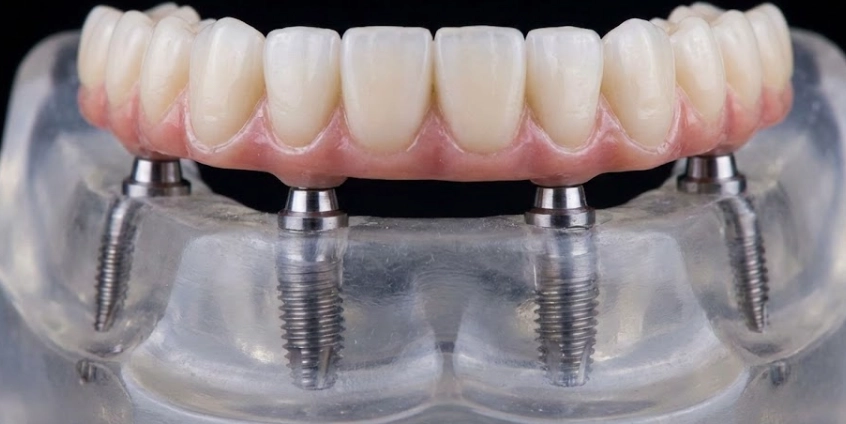
This is the point where advanced implantology comes in to save the situation. Dental implants, unlike dentures, serve as real roots. When we attach a full-arch fixed bridge (a set of upper or lower teeth) to four or six dental implants, it’s not only the part of the tooth that is visible that we substitute—we are also maintaining the basics of your face.
Professor Doctor Coşkun Yıldız, a leading oral and maxillofacial surgeon on our team, often says that the jawbone’s structural integrity is the true fountain of youth. “According to him, we’re effectively stopping the aging process of the lower face when we do the implant placement. We are ‘telling’ the body that the jawbone is still needed.”
How It Works
Think of a table. To render a table stable, you do not necessarily have to place a leg under every little inch of the tabletop. In fact, just four legs at the corners of the table are enough to keep the table steady. The physical concept of All-on-4 is the same. We can maximize the contact area with the bone of the titanium posts by placing them at an angle. Once the four posts are in place, they can support an entire arch of 12 to 14 teeth.
For the All-on-6, we add two implants to the existing four for even more support—imagine it like putting two more legs under the table to make it super sturdy.

The Aesthetic Touch: It’s Not Just About Function
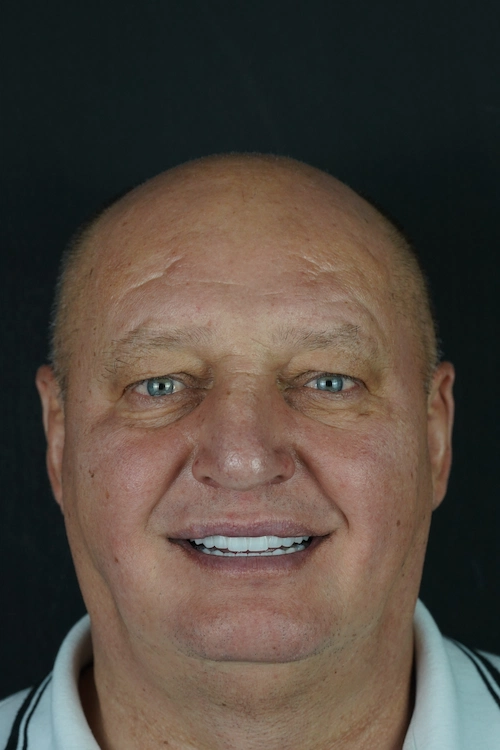
Function is very important, but frankly, you want to look good too. This is what Dentist Polen Akkılıç and her team are experts in. The dental implants create a platform while the bridge is the finishing touch.
At Lema Dental Clinic, we are always against the so-called “chiclet teeth” — perfectly flat, very white and of the same size, but totally fake-looking rows. Not only do we take into account your facial features when designing your new smile, plus your skin and your character, but we also apply high-tech materials such as Zirconia or Monolithic Zirconia which replicate the translucency of the tooth enamel as well as the reflection of light.
Comparison: Traditional Dentures vs. Implant Solutions
In order to better help you understand the compromises, here is what we observe in our clinic regarding patient satisfaction over time.
| Feature | Removable Dentures | All-on-4 / All-on-6 Implants |
| Stability | Low (Relies on suction/glue) | High (Fused to bone) |
| Chewing Power | 10-20% of natural bite | 90-95% of natural bite |
| Bone Health | Accelerates bone loss | Preserves jawbone |
| Comfort | Can cause sores/gagging | Feels like natural teeth |
| Maintenance | Must remove to clean nightly | Brush and floss like normal |
| Longevity | 5-7 years (needs relining) | 20+ years (lifetime for screws) |
Things to Ponder Deeply Before Reconstructing Your Smile

1. The Turkey Advantage
A trip to Turkey for this kind of treatment is not just a question of money (although the savings are considerable if compared to the UK or the US). It is a question of quantity and expertise. Our doctors perform thousands of implants each year. Such a high number of procedures is a great refinement of the level of accuracy that only a few low volume clinics can reach by a great measure.
2. The Timeline
You probably have heard of “Teeth in a Day.” In fact, very often you get to leave the clinic with new teeth the very same day, but these are mostly temporary “healing teeth.” The fact is the bone must get its time to bond with the titanium (this is the process of osseointegration). As a rule, we take you back to the clinic after a few months for your final, permanent zirconia smile.
Top Patient Concerns regarding Full Mouth Restoration
Pain is the number one fear we encounter, but the reality is surprising. Most patients report less discomfort after implant surgery than they did after having a tooth extracted. The procedure is performed under deep sedation or general anesthesia, so you sleep through the work. Post-op, Professor Doctor Coşkun Yıldız utilizes advanced anti-inflammatory protocols. Most of our patients are back to exploring Istanbul within a day or two, managing any soreness with standard painkillers.
Absolutely not. We never send a patient out of Lema Dental Clinic without a smile. On the day of your surgery, once the implants are placed, we attach a temporary fixed bridge. This allows you to eat (soft foods), talk, and smile immediately while your jaw heals. You are never “toothless” during the transition.
We hear this often from patients who have worn dentures for years. “My local dentist said I can’t have implants.” In many cases, this is incorrect. The All-on-4 technique was specifically designed for low-bone patients. By tilting the posterior implants at a 45-degree angle, we can utilize the available bone and avoid the need for bone grafting. Even in severe cases, we have zygomatic implants that anchor into the cheekbone rather than the jaw.
Treat them like the teeth you wish you always had. You cannot take them out at night (which is a huge psychological relief for many). You simply brush them twice a day and use a water flosser to clean underneath the bridge where it meets the gum. Dentist Polen Akkılıç and her team provide a specific hygiene protocol to ensure your gums remain pink and healthy around the titanium posts.
The titanium screw itself is designed to be permanent. Once it fuses with your bone, it becomes part of you. The prosthetic teeth (the bridge) may suffer wear and tear over decades, just like car tires, but Zirconia is incredibly durable. With proper hygiene and regular check-ups, we expect this to be a lifetime solution for the vast majority of our patients.
- Maló, P., de Araújo Nobre, M., Lopes, A., Ferro, A., & Nunes, M. (2019). The All-on-4 concept for full-arch rehabilitation of the edentulous maxillae: A longitudinal study with 5-13 years of follow-up. Clinical Implant Dentistry and Related Research, 21(4), 538–549.
- Buser, D., Sennerby, L., & De Bruyn, H. (2017). Modern implant dentistry based on osseointegration: 50 years of progress, current trends and open questions. Periodontology 2000, 73(1), 7–21.
- Papaspyridakos, P., Chen, C. J., Chuang, S. K., & Weber, H. P. (2012). A systematic review of biologic and technical complications with fixed implant rehabilitations for edentulous patients. The International Journal of Oral & Maxillofacial Implants, 27(1), 102-110.
- Misch, C. E. (2014). Dental implant prosthetics (2nd ed.). Elsevier Health Sciences.
- Branemark, P. I., Hansson, B. O., Adell, R., Breine, U., Lindstrom, J., Hallen, O., & Ohman, A. (1977). Osseointegrated implants in the treatment of the edentulous jaw. Experience from a 10-year period. Scandinavian Journal of Plastic and Reconstructive Surgery. Supplementum, 16, 1–132.

