


Gold inlays fill cavities, while gold onlays cover tooth cusps.
What are Gold Inlays and Onlays?
Gold inlays and onlays are personalized repair work for teeth that have been affected by decay or injury. The restorations are made using high-quality gold that is not only strong but also biocompatible, thus, a few of the patients at LEMA Dental Clinic choose it as their preferred material. Essentially, gold inlays are the fillings which are perfectly fitted into the tooth’s cavity while gold onlays cover one or more of the tooth’s cusps. Whichever the case, they both allow you to keep your natural tooth and regain functions at the same time, so the tooth stays strong even after a long period.
Gold inlays and onlays are the perfect choice if you require a restoration that can take heavy chewing forces that usually happen in the back teeth. Polen Akkılıç, the dentist, along with her team at LEMA Dental Clinic, always recommends these restorations because they look like natural teeth and provide superior protection as well. The patients who decide to have gold restorations experience the least chance of getting their teeth infected again as gold can tightly seal the tooth area that has been treated. It doesn’t matter if you are having an issue with decay or fractures, these alternatives are dependable and will last you a long time.
How do Gold Inlays and Onlays Protect Your Teeth?
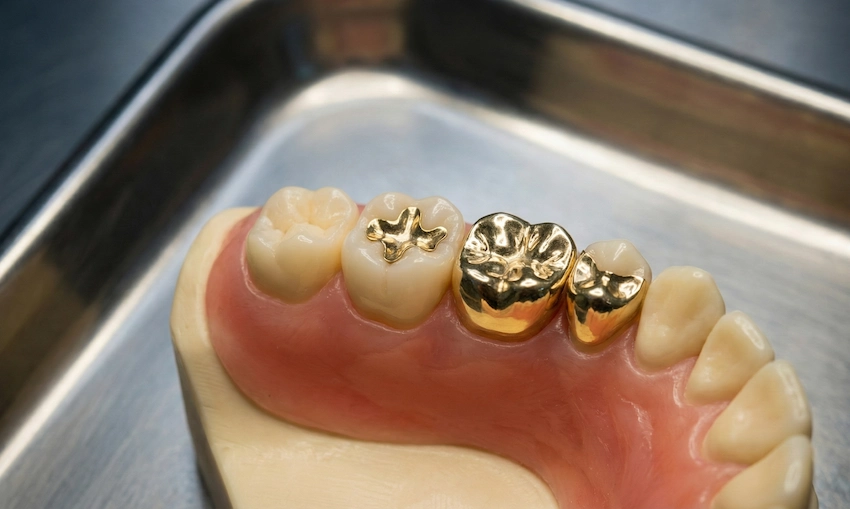
Gold inlays and onlays help to protect your teeth by filling the cavities and preventing further damage from occurring. The gold material used is highly durable and it not only strengthens your tooth but also prevents it from cracking under pressure. The restorations essentially are a protective shell that ensures the treated tooth will remain intact for many years, even when exposed to the stresses of chewing. Patients can be assured by the support of Dentist Polen Akkılıç that these restorations will keep the tooth’s structural integrity intact.
Moreover, gold inlays and onlays are a great way to preserve the natural tooth as only the decayed areas are removed, thus maintaining most of the natural tooth. This less invasive procedure leaves patients with a restoration that fits perfectly and at the same time retains the maximum healthy tooth structure. At LEMA Dental Clinic, it is their mission to not only make your teeth functional but also to provide you with long-lasting protection of your teeth.
Why Gold Inlays and Onlays? The Benefits of Gold Restorations
Among the significant advantages of gold inlays and onlays is definitely their longevity. Besides gold, no other material can endure such a high level of wear and tear, so gold is a fantastic option for people who have a habit of grinding their teeth or have very strong chewing forces. Other than these advantages, dental restorations are said to last up to 20 years, which makes them an extremely economical choice. Moreover, gold is a very good material from a biological point of view. The fact that a material is biocompatible means that it will not cause allergies or irritate the skin. The patients of LEMA Dental Clinic who receive treatment from Professor Doctor Coşkun Yıldız are aware of this side of gold dental restorations.
Gold inlays and onlays are exceptionally durable, almost indestructible, in fact, and aside from that, they are a real treat to the eyes. Due to gold being a metal, it is more noticeable than the other materials; however, due to its shiny nature, the glossy surface of the metal and also its ability to blend with the natural tooth shape, many patients choose this metal. Therefore, if your goal is a long-lasting restoration or a perfect combination of aesthetic and functional benefits, opt for gold restorations which are restorations made by the use of the metal gold.
The Process of Getting Gold Inlays and Onlays
Initial Consultation and Evaluation
- Dentist Polen Akkılıç or Professor Doctor Coşkun Yıldız will inspect the damaged tooth to decide if gold inlay or onlay is the most suitable treatment option.
- A detailed review is done, including X-rays to reveal the extent of decay or damage.
Tooth Preparation
- The rotten or damaged part of the tooth is completely taken out.
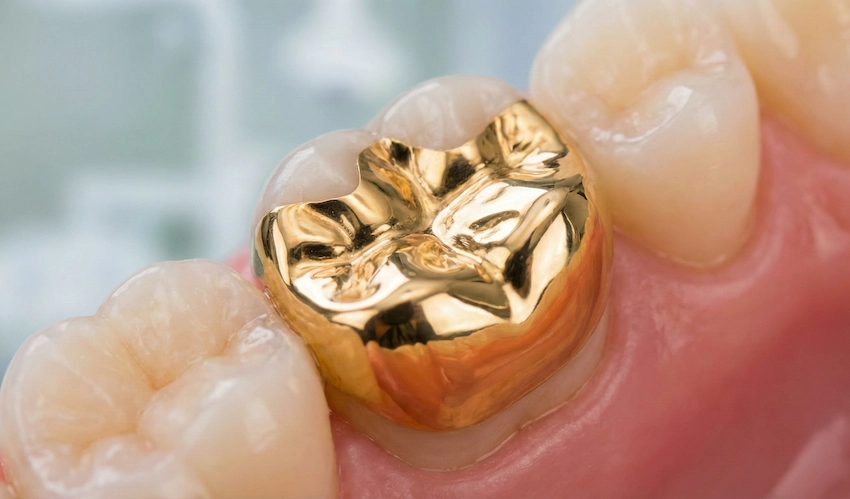
- After removing the tooth, it is reshaped so that the custom gold restoration can be properly placed, thus resulting in perfectly fitting inlays or onlays.
Impression of the Tooth
- An impression of the prepared tooth is made to have a scup accurate mold for the custom restoration.
- The mold is sent to a dental lab where the gold inlay or onlay will be made.
Temporary Restoration
- While the patient is waiting for the gold restoration, a temporary filling is placed in the tooth to protect it and keep the patient comfortable.
Fitting and Placement
- After the custom gold inlay or onlay has been made, the patient is asked to come back to LEMA Dental Clinic for the next step.
- The restoration is put in place and adjusted for a perfect fit. Tooth’s functionality and comfort are ensured through necessary adjustments.
Bonding the Restoration
- Gold inlay or onlay is firmly bonded onto the tooth with the help of a dental adhesive.
- The restoration is thoroughly polished so that it blends perfectly with the adjacent natural tooth structure.
Final Check and Follow-Up
- The dentist checks up on the patient’s bite and confirms that the restoration is fitting well.
- Another appointment might be scheduled to see how the restoration is going and to talk about any problems.
| Feature | Gold Inlay | Gold Onlay |
| Coverage | Fills the tooth cavity. | Covers tooth cusps and surface. |
| Tooth Prep | Requires minimal tooth removal. | Requires more tooth structure removal. |
| Use | Best for small to medium cavities. | Ideal for larger cavities or more extensive damage. |
| Durability | Lasts 15-20 years. | Lasts 20+ years. |
| Cost | Generally less expensive. | Usually more expensive. |
Frequently Asked Questions About Gold Inlays and Onlays
Gold inlays serve as a filling for a hollow part of a tooth, whereas gold onlays are larger and they not only cover the surface of a tooth but also one or more cusps.
It is right that around molars due to the strength of gold and the fact that it can bear heavy chewing forces, the choice is a good one.
Metal is an element that has been used in the manufacture of dental restorations which are very tough and can stay in use for a very long time, sometimes even for 20 years.
It is conceivable that gold restorations can be quite expensive initially but their durability and longevity make them a cost-effective option in the long run.
Actually, these kinds of restorations can be done with great care and the adjacent tooth structure will be left untouched.
- Kassebaum, N. J., Smith, A. G., & Bernabé, E. (2017). Global burden of oral conditions: A systematic analysis of the Global Burden of Disease Study 2015. Journal of Dental Research, 96(7), 582-591.
- Tjan, A. H., & Hsu, Y. C. (2007). Longevity of gold inlays and onlays: A retrospective clinical study. The Journal of Prosthetic Dentistry, 98(6), 413-420.
- Sadeghi, M., & Shetty, S. (2014). Comparison of gold inlays, onlays, and composite restorations: A clinical study. Journal of Clinical and Experimental Dentistry, 6(3), 281-285.

