


Picture a visit to the dentist, but instead of feeling terror or pain, you only feel self-assurance. Isn’t it great? This is exactly what dental anesthetic sprays communicate to the dentist’s chair. They speed up your treatment and make it less intimidating. No matter if you want a short cleaning or if you are about to get the smile of your dreams, this small spray has a big role in the painless dentistry of the present times.
In the case of a new smile, you can still keep your comfort but also add some taste to it. At Lema Dental Clinic in Istanbul, you are not just a patient but the next Hollywood Smile. We are using anesthesia and cosmetic procedures, such as veneers, implants, and digital smile design, that are of world-class standards, combined with the latest technology.
What Is Totally a Dental Anesthetic Spray?
A dental anesthetic spray is a topical anesthetic that is meant to numb the area of the gums, cheeks, or tongue, and then a dental procedure is carried out. It is needle-free and fast in the case of the injection method (yes, the one that you can’t help but feel cold when you just think about it), it works differently. One would say it is like a small piece of magic that helps you relax, in a literal way.
This pain-relieving spray for teeth is made with active ingredients such as lidocaine or benzocaine that, when applied to the area, temporarily hinder the transmission of nerve signals. When it is used, it should not take much longer than a few minutes for the numbing to start so that the person will feel very little, if any, discomfort when the more invasive anesthetics are introduced. For example, for children or people who suffer from dental anxiety, the use of this spray is an easy step for them to realize that dental visits are not as terrifying.
It must, however, be said that it is not only a cheap alternative to speed up the work but a significant element in the pain relief process of dental care. The dental anesthetic spray, no matter if you are having a cleaning, a filling, or a crown, sublimates the whole procedure, making it almost painless and hence a stress-free appointment.
When and Why Dentists Use Anesthetic Sprays
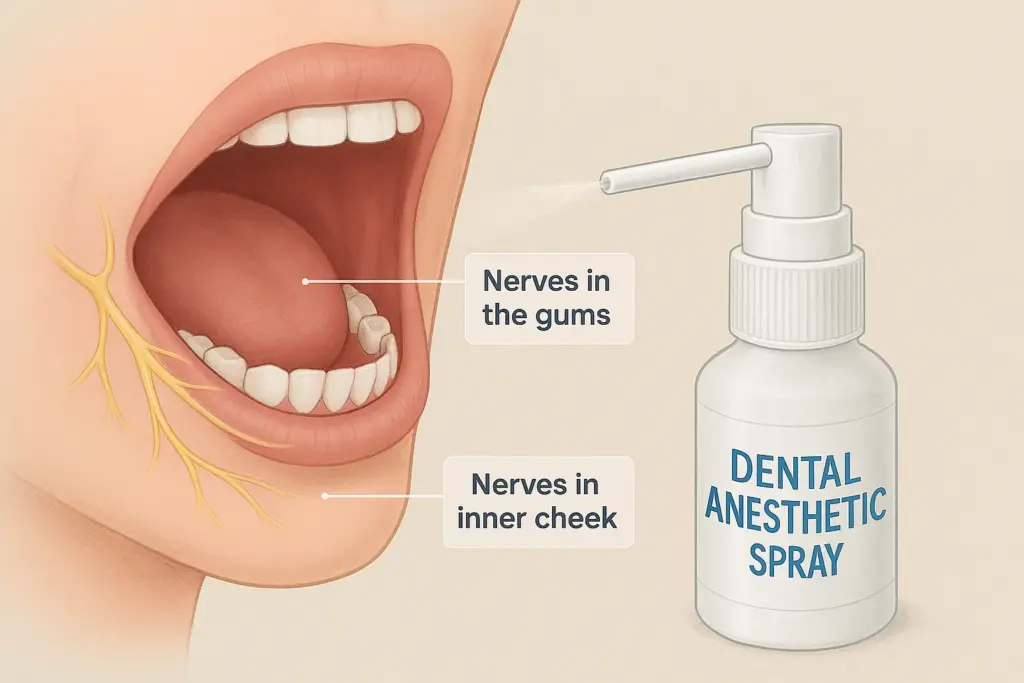
Topical dental anesthesia sprays are used in many different scenarios by dentists, and they aren’t just taking it out for show. One of the most frequent instances is certainly mouth preparation for the local anesthesia injection. If you have ever been scared at the sight of a needle, you will see the importance of making the surface numb first. The spray makes the area for injection numb so that the actual needle stab is like… well, nothing.
Another frequent use? Minor dental procedures or professional cleanings. Even for patients with sensitive gums, scaling and flossing can be uncomfortable during a deep cleaning. Here, the spray becomes the help between you and the pain, especially if you have the early stage of gum disease or you are the shaking teeth after braces.
It is also very often combined with children. Pediatric dentists frequently use sprays to make the kids feel comfortable during the dental checkup. No needles, no tears. Only a small spritz, and it’s go-time. Such is the scenario that accommodates both the dentist and the little nervous patient in the chair.
How Safe Are Numbing Sprays for Kids and Adults?
Just to be clear from the start: dental anesthetic sprays are safe when used by professionals. There are a lot of things that dentists are trained for, amongst them, the dosage and application are the key ones, and the sprays that are used in the dental offices are clearly designed for oral use.
Adults are in little danger of suffering major complications, especially if the dentist has already examined their medical history. A real question that parents often come up with is: Could a kid get through it without any problem? The answer? Yes, if a professional takes care of your child. Pediatric products are of lower concentrations of the active ingredient and are safety-tested. Furthermore, the majority are even flavored to make the child’s experience more pleasant.
However, home use is strictly prohibited. These sprays can be taken in higher-than-needed doses accidentally or because of an allergic reaction when the user is not careful. If a child is in pain due to teething or mouth ulcers, then a dentist or a pediatrician should be consulted before giving the child any medicine.
Most individuals do not have any problems with dental sprays, and the scenario is similar to any medication, even though there could be some mild side effects. The most common? The temporary numbness extends somewhat more than it was expected. Also, you can get a tingling, little swelling, or a cold feeling in the sprayed place — these are all normal, and there is no need to worry.
On an extremely rare basis, a few patients may be exceptionally sensitive to benzocaine, which is the main source of one of the most common active ingredients. An allergic reaction is the possible outcome, which is the reason your dentist will always ask that you inform him of any forecast of allergies before he proceeds with installing the spray.
Here is another insider recommendation: be careful post-procedure. At the point when your mouth will still be numb, you might be biting your lip or cheek by accident, and not be able to figure it out. Do not attempt to eat until the feeling is gone completely. Most sprays lose their effect in 30–60 minutes, so just relax for a short while until the time for the post-dentist meal has passed.
Spray vs. Injection: Which Type of Anesthesia Is Better?

The truth is, a spray and an injection are not opponents but teammates who support each other. They are used to different things in the dental game. The dental spray is like the warm-up for dental operations — it makes you feel comfortable, soothes the nerves, and prepares your mouth for what is going to happen next. The injection? That is the pain relief champion of the heavy division for more difficult treatments.
Dental anesthetic spray can be sufficient if the patient is undergoing only a basic procedure, such as a cleaning or a surface-level treatment. However, a local anesthetic injection will be necessary to go further down the nerve for a root canal, extraction, or implant placement.
Nonetheless, the spray is not just a supporting role. It renders the injection part of the process painless. Remember the “pinch” that you are always afraid of? Get rid of it forever, assisted by the spray. It’s all part of the effort to make today’s dentistry as painless as possible.
FAQ: What Is a Dental Anesthetic Spray and How Does It Work?
Most sprays last around 30 minutes to an hour, giving you enough time to get through the procedure comfortably.
Yes, dentists use specially formulated sprays for children in small, safe doses to ease anxiety and prevent discomfort.
For surface-level treatments, yes — but for deeper procedures, injections are still more effective for long-lasting anesthesia.
Some people might feel tingling, numbness, or slight swelling. Rarely, allergic reactions can happen with ingredients like benzocaine.
You should wait until the numbness wears off to avoid accidentally biting your tongue or cheek.

