


A black tip is usually fixed with dental bonding or a filling.
Usually it happens when you first spot it in the mirror. There you notice a tiny, shadowy discoloration right at the edge of your tooth. It is no longer just a “coffee stain”; it appears like a small ink blot at the tip of the tooth. At first, you panic, of course. Has the tooth died? Is the cavity there?
Actually, a black tip on a tooth is the tooth’s way of biologically “S.O.S.”. We at Lema Dental Clinic, Istanbul, Turkey come across it quite often. Think of your tooth as a lighthouse; if the light at the topmost point goes out or getsdimk, it is a sign that there is a problem with the foundation or the internal wiring. It’s hardly ever a good idea to ignore the black tip no matter if it is the result of trauma, deep decay, or external staining.
Decoding the Darkness: Why is it Happening?
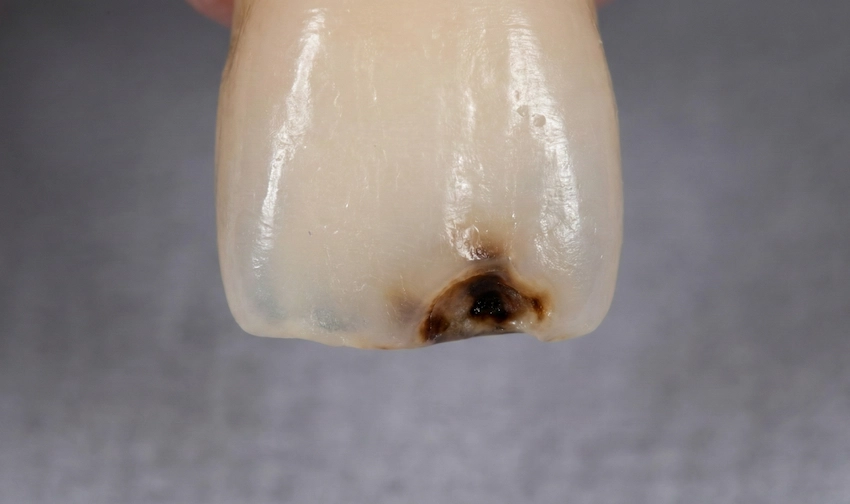
We shouldn’t take care of the “how” before addressing the “why”. Professor Doctor Coşkun Yıldız frequently emphasizes that the treatment procedure is determined by whether the darkness is only on the surface or if it penetrates the root.
- Dental Caries (Decay): This is the predominant one. The bacteria first break down enamel, and when they reach the dentin which is softer, the spot becomes black or dark brown in color.
- Pulpal Necrosis: If you had a previous trauma, e.g., from a fall or a sports accident, the “heart” of the tooth (the pulp) might have died. This can be compared to a bruise which occurs inside the tooth structure; the blood disintegrates and hence the tooth gets stained from the inside out.
- External Staining: It can be that the only reason is the particles from tobacco, red wine, or iron supplements which have managed to find a microscopic “corner” in the tooth’s edge and got stuck there.
The Clinical Toolkit: Procedures to Restore Your Smile
When you go to see Dentist Polen Akkılıç and her team, a high-resolution digital X-ray is the very first thing that they will take. We want to be sure that the root is fine. But let us check out in detail some of the actual procedures we have at our disposal to treat a black tip.
1. Composite Bonding: The Artistic “Quick Fix.”
If the black tip is due to a minor cavity or a tiny chip that has become discolored over time, dental bonding is likely to save the day. We get rid of the decay anduseg “sculpt” a resin which is tooth-colored onto the area. It is similar to a painter who is a master at blending colors and is covering a flaw on the canvas.
2. Porcelain Veneers: The Gold Standard in Turkey
At Lema Dental Clinic, for patients who are looking for a permanent, “red-carpet” type of result, veneers are their first-choice option. If the black tip is the result of a larger cosmetic issue, then we thin the enamel a bit and put a custom-made porcelain shell on the tooth. It does not just conceal the black tip; it completely changes the appearance of the smile.
3. Root Canal Therapy and Internal Bleaching
When the nerve inside the tooth is dead, it is impossible for a regular whitening to make the stains disappear. Our endodontic experts have to do a root canal in order to preserve the tooth structure. After that, they apply the method called “internal bleaching” whereby the whitening substance is put inside the tooth so as to remove the stain at its source.
Comparing Your Options at Lema Dental Clinic
| Procedure | Best For | Treatment Time | Durability |
| Composite Bonding | Small decay or minor chips | 1 Visit (approx. 60 mins) | 5–7 Years |
| Porcelain Veneers | Cosmetic masking & durability | 3–5 Days (2-3 Visits) | 15–20 Years |
| Dental Crowns | Severely decayed or brittle teeth | 3–5 Days (2-3 Visits) | 15+ Years |
| Internal Bleaching | Teeth darkened by nerve death | 1–2 Visits | Long-lasting |
Why Choose Turkey for Your Dental Restoration?
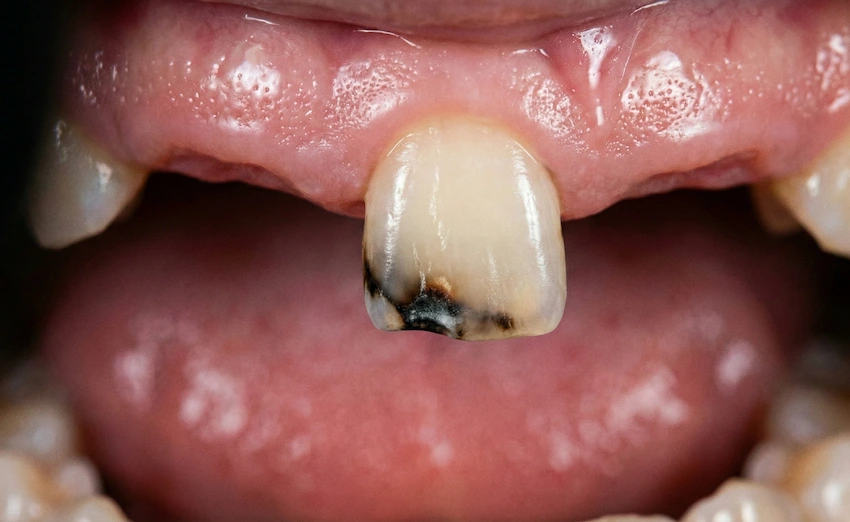
The question remains: why travel to Istanbul for a black tip? The answer lies in the intersection of advanced technology and clinical mastery. Dentist Polen Akkılıç and her team utilize CAD/CAM technology to ensure that the color match for your restoration is indistinguishable from your natural teeth.
At Lema, we don’t just “plug a hole.” We look at the architectural integrity of your bite. A black tip is often the first sign of a larger structural failure. By treating it in Turkey, you gain access to premium materials—like E-max or Zirconia—at a fraction of the cost you would find in the UK or the US, all while receiving care from world-renowned experts like Professor Doctor Coşkun Yıldız.
Frequently Asked Questions (FAQ)
It’s usually not something that requires an emergency, like a tooth knocked out, but it’s still a matter that should be resolved quite fast. A black tip reveals that the enamel layer has been broken through. Sooner detection and treatment of such a problem increases the chances of just needing a filling to save the tooth without going through a root canal treatment.
Suppose the black color is a result of a decomposed part of the tooth or from internal trauma, then no matter how great your toothbrush is, brushing your teeth won’t get the black off. Actually, aggressive brushing might even harm the infected area around the damaged gum. The only way out is proper professional treatment at a dental clinic.
Quite the contrary, there is no pain at all. At Lema Dental Clinic, we offer a local anaesthetic, and use the latest techniques so that you don’t feel anything at all. Most patients say their experience is like a regular cleaning, only a bit longer
Generally, porcelain veneers and crowns are substances that quite efficiently resist staining. However, the “junction” where the restoration meets your natural tooth is still a good spot to watch. The bottom line is to maintain a good oral hygiene regime so that your dental work can last for many years.
Naturally, this depends on the exact procedure we are referring to but a simple case of tooth bonding in general is pretty cheap. Even more advanced treatments such as veneers, on the other hand, are very cost-efficient in Turkey as compared to Western Europe, thus, giving patients the opportunity of saving up to 70% of their money.
- Aas, J. A., et al. (2005). Defining the Normal Bacterial Flora of the Oral Cavity. Journal of Clinical Microbiology.
- Goldstein, R. E. (2018). Esthetics in Dentistry. Wiley-Blackwell.
- Kihn, P. W. (2007). Vital Tooth Whitening: An Update for the 21st Century. Contemporary Esthetics.
- Sulieman, M. (2005). An analysis of the relative efficacy of intracoronal bleaching methods. Journal of Endodontics.
- Yıldız, C. (2022). Advanced Restorative Protocols in Modern Clinical Dentistry. Istanbul Medical Press.

