


They restore teeth through the nasal floor when upper jaw bone is limited.
A Deep Exploration of Trans-nasal Dental Implants at Lema Dental Clinic
The fixed smile that many patients of ours in Istanbul have dreamed of has often been met by rejection, something in fact other clinics have done to them. This is because when the upper jawbone – the maxilla – has lost its thickness due to years of tooth loss, traditional implants have no means to cling to. It is similar to trying to hang a heavy mirror on the wall covered with thin drywall; the mirror simply won’t stay.
Traditional sinus lifts and bone grafts are, in reality, not the solution to every case, especially for those who want to get their results faster. That is to say, the expertise of Professor Doctor Coşkun Yıldız, Dentist Polen Akkılıç, and her team is at your disposal if you so wish. Instead of the conventional “foundation,” we exploit the strong, dense bone of the nasal floor. Simply put, this is what trans-nasal dental implants are all about.
Definition of Trans-nasal Implant
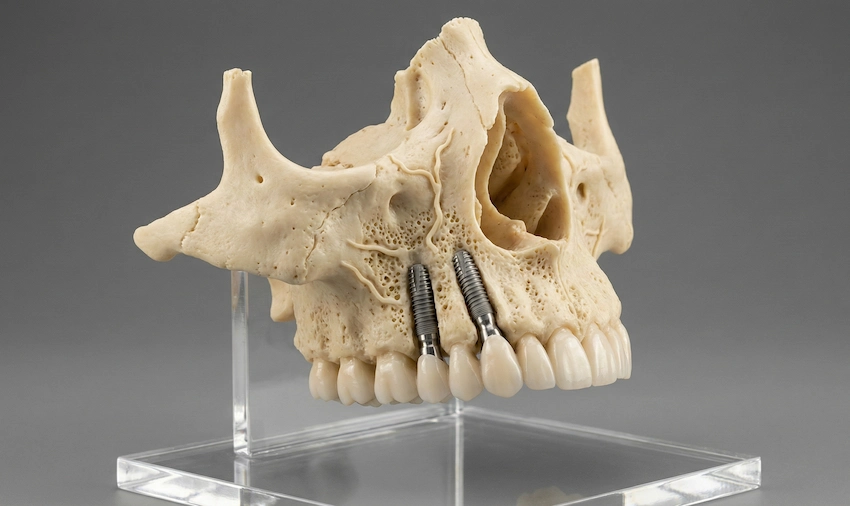
Imagine your face structure like a house. If so, the jawbone is like the ground floor and the nasal floor is like a reinforced concrete beam that runs through the house. So, even if the “floor” of the jaw is gone, the central “beam” remains resilient and strong.
Essentially, trans-nasal implants (or nasal implants) are very long implants that are fixed in the cortical bone of the nasal process. Professor Doctor Coşkun Yıldız frequently states that this particular bone is very strong and, therefore, it will provide the \”primary stability\” that is essential for supporting a full bridge of teeth even in those cases when the patient has experienced severe atrophy.
Detailed Process at Lema Dental Clinic
It really is normal to have some worries about just turning up at a clinic abroad. Lema Dental Clinic in Turkey, however, is a place where we totally go for openness. Here is what we get done in the trans-nasal operation:
1. The Digital Blueprint
One of the first things to do is to take high-resolution 3D CT scans (CBCT). We don’t guess; we map. Through these scans, we ascertain the exact density of your nasal floor. Dentist Polen Akkılıç and her team use specialized software to create a virtual 3D model of your skull, ensuring the implant path avoids all vital nerves and the sinus cavity.
2. Specialized Site Preparation
The patient will be put under sedation first, and then only a small, precise incision will be made. Normally, implants sit only in the gums but the trans-nasal approach demands a tilted trajectory. Imagine it like securing a tent peg at an angle into a rock so it does not move.
3. Anchoring into the “Bedrock.”
Using specialized, lengthened drills, we create a channel that reaches the nasal crest. The implant is then screwed into this dense bone. The sensation of \”torque\” or tightness that we experience at this stage is what permits most of our patients to get temporary teeth right after the operation.
4. The Healing Phase (Osseointegration)
The titanium object is supposed to become a part of the bone. Because the nasal bone is extremely dense, this \”biological handshake\” that takes place is in most cases successful. We keep a close eye on our patients during their stay in Turkey so that the initial healing stage goes smoothly.
5. Final Restoration
The temporary bridge is substituted with the final, tailor-made porcelain or zirconia bridge after a couple of months. In fact, the smile you get looks so real, it is hard to even distinguish the difference from natural teeth.
Comparing Your Options: Why Trans-nasal?
But let’s look closer at how this compares to other advanced techniques we use at Lema.
| Feature | Traditional Implants | Sinus Lift + Implants | Trans-nasal Implants |
| Bone Requirement | High | Low (requires grafting) | Very Low |
| Total Timeline | 3-4 Months | 9-12 Months | 3-4 Months |
| Surgery Complexity | Moderate | High | Advanced/Specialized |
| Primary Stability | Varies | Low initially | Very High |
| Success Rate | ~95% | ~90% | ~97% in atrophic cases |
The Question Remains: Is it Safe?
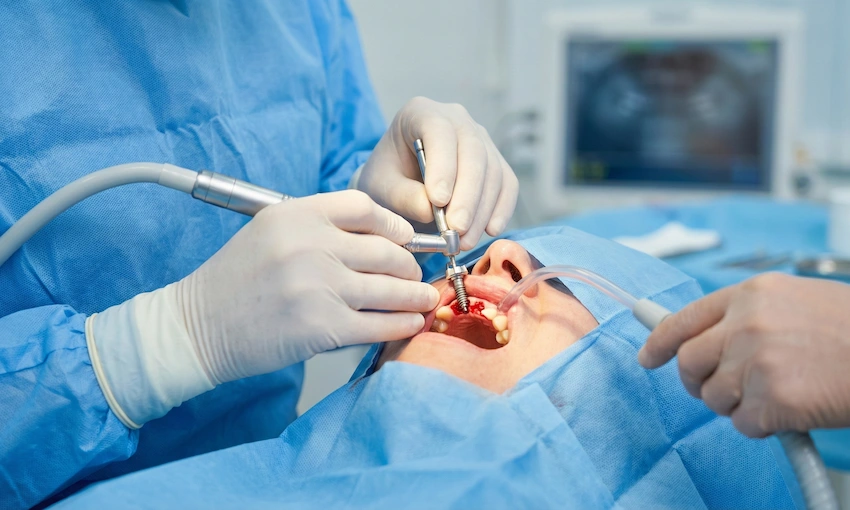
Arguably the most common question we are asked in the clinic is: “Will I feel the implant through my nose?” Our answer is absolutely no. The implant might be fixed onto the bone close to the floor of the nose, but it does not break the nasal lining. The implant is confined to the “chassis” of the bone alone. At Lema Dental Clinic, we have found that our patients experience no change in their breathing or nasal sensations when compared to receiving normal dental care.
This technique’s greatest advantage is that it often spares the patient the “bone graft trap”—a vicious circle of operations that could easily extend for more than a year. Instead of creating new structures, we just make use of what you already have, thereby reducing the waiting time by half.
FAQ: Speaking Directly to the Patient
Obviously, you will not feel any pain at all due to our combination of advanced sedation and local anesthesia. Afterwards, some swelling can be expected—similar to a wisdom tooth extraction—but since we try not to perform large “open” surgeries for sinus lifts, most people respond to the healing process as quite manageable and even surprising.
We usually advise a stay of 5 to 7 days for the first stage (implant placement). It gives Dentist Polen Akkılıç enough time to check on your healing process, and also to confirm that your temporary bridge fits perfectly before you go back to your country.
Never! No one at Lema is going to leave our premises without a smile. We only say at Lema that no one should leave our clinic without a smile because we really mean it. We almost always have a “fixed-temporary” bridge ready that lets you have your meals and smile to the camera, while your implants are getting integrated into your bone.
Practically, the answer is no. Trans-nasal implant is a complex surgical procedure that involves an anatomical study of the maxilla and face. Professor Doctor Coşkun Yıldız has been focusing on and perfecting safety and longevity through these innovative, angled approach techniques for years.
In general, you can care for them almost like your natural teeth. However, to clean underneath the bridge, in particular, it is advisable to use a water flosser (a Waterpik type). Of course constant regular check-ups with your dentist locally are a must, and you can always count on us for remote consultations when you are home and out of reach.
- Aparicio, C., et al. (2014). “The Use of Zygomatic and Nasal Implants for the Rehabilitation of the Severely Resorbed Maxilla.” Journal of Prosthetic Dentistry.
- Jensen, O. T., et al. (2010). “The Nasal Wall as an Implant Anchor Site.” Journal of Oral and Maxillofacial Surgery.
- Malo, P., et al. (2015). “The All-on-4 Concept with Trans-nasal Fixation: A Long-term Retrospective Study.” Clinical Implant Dentistry and Related Research.
- Yıldız, C., & Akkılıç, P. (Internal Clinical Archives 2023). “Comparative Success Rates of Pterygoid and Nasal Floor Anchoring in Istanbul Patient Demographics.”
- Branemark, P. I. (2005). “Advanced Anchorage Solutions in Maxillofacial Rehabilitation.” International Journal of Oral & Maxillofacial Implants.

