


Deflex dental prostheses are lightweight, flexible, metal-free dentures.
For many years, the term “denture” was almost synonymous with bulky plastic plates and metal clips that not only looked unsightly but felt like a foreign element in the mouth. Patient comfort is a factor that has been compromised in many cases in favor of structural strength. At Lema Dental Clinic, Istanbul, we strongly believe that you should not have to compromise between a functional bite and a natural feel.
You can call it the iocompatibility revolution: Deflex dental prostheses are a perfect example of this change in the field of biomaterials, as they have completely changed the perspective that treated acrylics must be “uniformly” rigid.
What Exactly is Deflex?
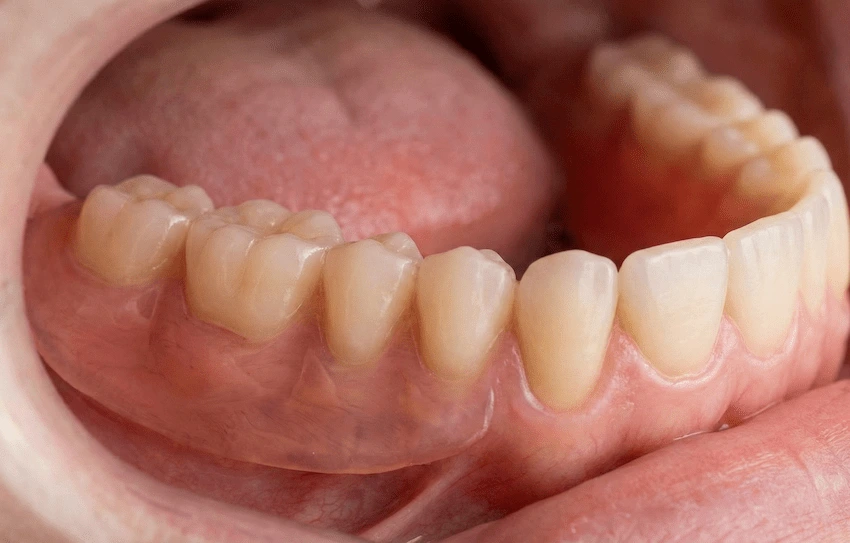
Ancient ceramics are a common metaphor for conventional dentures: hard, brittle and unreliable to withstand unequal pressure. Deflex is an advanced polymer, more like a high-tech polymer used in aerospace. Deflex is a high-quality, semi-flexible polyamide. Its properties are such that Deflex “remembers” mouth movements and bends in harmony with the latter without changing its original shape.
Deflex’s greatest ‘trick’ is, according to Prof. Dr. Coşkun Yıldız, the fact that it is translucent. Because the material is semi-transparent, it lets the natural color of your gums show through. This “chameleon effect” is what makes the prosthetic virtually disappear once it is placed.
The Advantages: Comfort Meets Engineering
Why are most patients making the switch to Deflex replacing traditional appliances? Here is what those who come to our clinic:
- Deflex is super light: Patients even after a one-hour experience with Dentist Polen Akkılıç and her team forget that they wear it.
- Hypoallergenic Properties: In some cases, patients encounter a burning sensation or irritation when acrylic monomers in their mouths are still fresh enough to cause a reaction. Deflex is a monomer-free material; it is the most tissue-friendly product for patients with sensitivities.
- Traditional partials: It have metal claws that grab tightly to healthier teeth and at the same time, as a slow-motion saw, they continuously wear down your natural enamel. Deflex uses flexible clasps that are usually tooth-colored or gum-colored instead.
- Strong as a rock: You can drop it on a bathroom tile, and it won’t shatter. It is the “safety glass” in the dental world.
Comparing Your Options at Lema Dental Clinic
If you get a restoration in Turkey, it is good to know the differences among the materials.
| Feature | Traditional Acrylic | Metal Framework (Chrome-Cobalt) | Deflex Polyamide |
| Aesthetics | Visible pink plastic | Metallic clasps visible | High, natural “chameleon effect.” |
| Flexibility | Rigid, brittle | Very rigid | Semi-flexible |
| Weight | Moderate | Heavy | Very light |
| Allergy Risk | Higher due to monomers | Low, possible nickel sensitivity | Virtually zero |
| Durability | Prone to fractures | High strength | Unbreakable |
The Clinical Perspective in Turkey
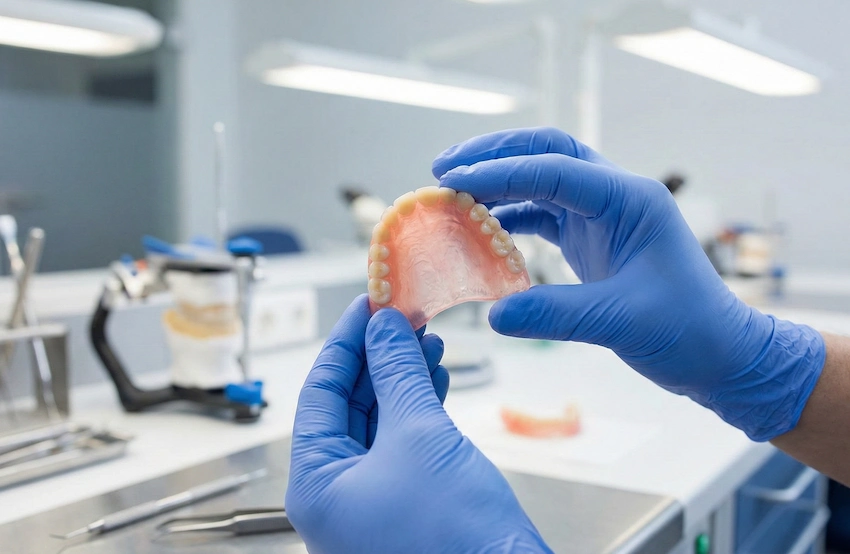
Further, let’s consider the patient experience with each one of the materials. Our clinical observations at Lema Dental Clinic have shown that the period of adjustment to Deflex prosthetic is much less compared to that of hard dentures. Also because of the material’s slightly flexible nature, it offers fewer ‘pressure spots’ or ulcers which are otherwise a result of hard dentures and usually need the intervention of a dentist 3 or 4 times. It is not in conflict with you but rather it is moving along with you.
Who is the Ideal Candidate?
We first think about recommending Deflex to a patient who still has some healthy teeth and needs a partial denture. Also, it will be the best” transitional” prosthesis for an implant patient whose mouth is healing. We also agree with Prof. Dr. Coşkun Yıldız that the beautiful surfaces of the prosthetics which give us pleasure at first glance come from careful and specific maintenance with a good cleaner.
FAQ: The Specialists Directly Answer the Questions
Hardly ever. Because Deflex is translucent, it picks up the natural tones of your underlying gum tissue. Unlike traditional pink plastic which can look ‘flat’ or fake, Deflex mimics the depth of real tissue.”—Dentist Polen Akkılıç.
“Yes, but there is a slight learning curve. The flexibility actually helps distribute the biting force more evenly across your gums, much like a shock absorber in a car, making the chewing process more comfortable.”—Prof. Dr. Coşkun Yıldız.
We usually manage to perform the steps from taking the impressions to the final fitting within just a few days, since we have a very well-organized in-house workflow here in Istanbul. Besides your smile, we also care about your time.
Not at all. However, you shouldn’t use regular toothpaste as it can be abrasive. There is a very specific care routine that we give to each patient so that the material stays crystal clear and free of odor.
Keeping the balance of the long-term value is a lot higher than that of the material technology, simply because they are practically unbreakable. We see it as a daily comfort investment.
- Anusavice, K. J., Shen, C., & Rawls, H. R. (2022). Phillips’ Science of Dental Materials. Elsevier Health Sciences.
- Fueki, K., et al. (2014). Clinical applications of removable partial dentures using thermoplastic resin. Journal of Prosthodontic Research, 58(1), 3-10.
- Goiato, M. C., et al. (2016). Longevity and complications of thermoplastic materials in removable partial dentures. Journal of Clinical and Diagnostic Research.
- Hamanaka, I., et al. (2011). Bond strength of self-adhesive resin cements to polyamide denture base resins. Dental Materials Journal.
- Negrutiu, A., et al. (2005). Thermoplastic resins for flexible partial dentures. TMJ Journal.

