


Fixed prostheses include dental implants, bridges, full arch prostheses, and All-on-4/All-on-6 implants.
Why Choose Fixed Dentures?
Fixed dentures serve as an amazing option for those who desire a permanent resolution for the absence of their teeth. Compared to removable dentures that need to be cleaned and adjusted, fixed dentures are firmly connected to the bone, thus giving better comfort and less movement of the jaw. Therefore, patients in Lema Dental Clinic, directed by Dentist Polen Akkılıç and her team, obtain top-notch fixed dentures that fit their unique needs perfectly. These implants are correct for those patients who want just one long-term dental solution without inconvenience. Moreover, they are created to go with the natural teeth and make the smile look natural and appealing.
The implantation of fixed dentures is only possible after thorough inspection. The dentist evaluates your oral health through a visual and instrumental exam of teeth and gums.
Once all the steps have been completed, the fixed denture is installed tightly and securely so that the patient is able to live their daily habits as before, such as eating and talking freely and confidently. Because fixed dentures are meant to be in one place, they cannot be loose or fall off like removable dentures, and thus provide better comfort and the absence of anxiety. Hence, they constitute the most preferred solution for individuals who want a reliable and permanent dental treatment.
Types of Fixed Dental Prostheses
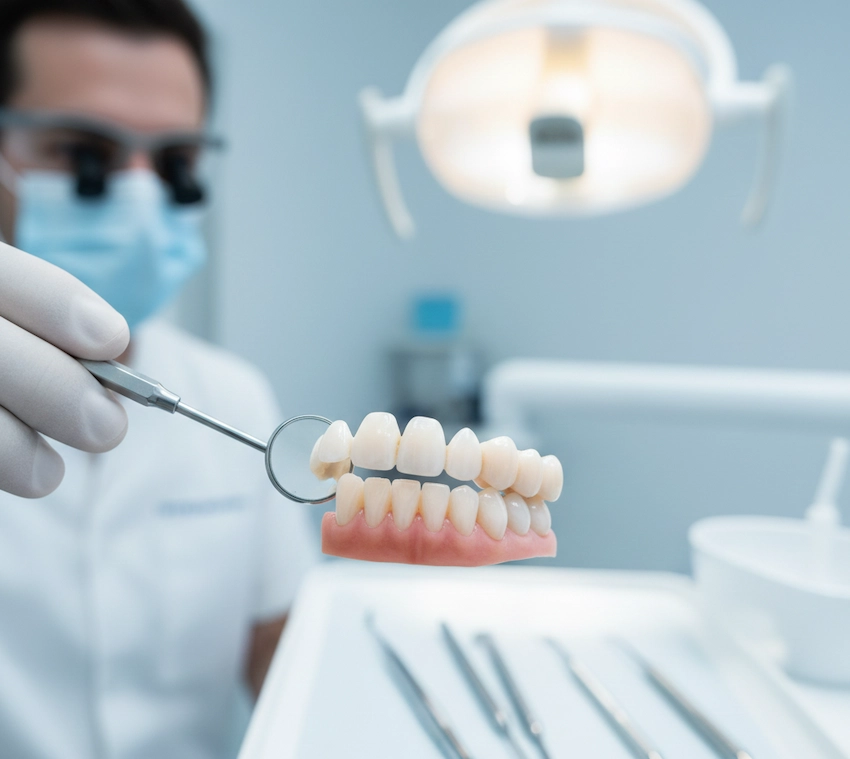
- Dental Bridges
By means of dental bridges, the integration of healthy teeth adjoining the gap is achieved so that one or more dislodged teeth can be substituted. Conventionally, the bridge is fabricated with porcelain, ceramic, or metal. It is then fastened so as to be both utilitarian and visually pleasing. This way of restoration is the best use to cover the absence of one or two teeth when the surrounding teeth are strong enough to carry the bridge.
- Dental Implants
In the first place, dental implants are titanium posts that are placed surgically in the jawbone to serve as artificial tooth roots. The implant is coupled with the bone and thus it is a very firm base for crowns, bridges, or dentures. Implants are the last and absolute tooth replacement option that is still left on earth and they constitute a very durable, patient-friendly long-term solution to the loss of teeth due to decay or trauma.
- Full Arch Prostheses
The full-arch prostheses are the ones that can be used to replace the entire set of teeth in an arch (top or bottom) when a lot of teeth are missing. These prostheses are permanently attached and bring about a total restoration leading to the improved functioning of the mouth as well as the smiling appearance. Any of the dental implants or the remaining teeth can support the full-arch prostheses, thus, these can be considered the definite solution for the patients who have suffered severe tooth loss.
- Fixed Partial Dentures
One of the fixed partial dentures is a bridge that represents a brand-new teeth-set replacement in case scenarios involving one or more tooth loss. The unit is bolted to the neighboring teeth and mostly comprises porcelain or metal. Unlike removable dentures, fixed partial dentures maintain their close position thus, they help return the lost function and aesthetics. This variety is usually referred to as the community of patients who are missing a few teeth but still possess healthy neighboring teeth.
- All-on-4/All-on-6 Implants
An All-on-4 or All-on-6 implant technique is a method that conveys the idea of four or six titanium implants placed into the jawbone to hold a fixed full set of prosthetic teeth of Japanese origin. To put it simply, the people who have a heavy loss of teeth or a condition that makes them unable to undergo a conventional implant surgery are usually the ones that can get the advantage of this method. Besides the minimum number of implants in a full-arch which is one possible outcome of this method, there are also other benefits, such as the elimination of the necessity for bone grafting or other preparatory surgical operations.
Every single fixed dental prosthesis has its own advantages, and the decision is mainly affected by the factors like the number of missing teeth, bone density, and patient’s preferences. Consulting a dental expert, e.g., Dentist Polen Akkılıç and her team at Lema Dental Clinic, is surely the best way to find out which option is the most suitable for an individual.
Comparison of Fixed Prostheses Options
| Prosthesis Type | Key Features | Pros | Cons |
| Dental Bridges | Supported by adjacent teeth | Less invasive, cost-effective | May require healthy adjacent teeth |
| Dental Implants | Titanium post placed in jawbone | Long-lasting, natural appearance | Requires surgery, higher cost |
| Full Arch Prostheses | Replaces entire arch of teeth | Complete restoration, secure fit | Expensive, requires multiple visits |
How Are Fixed Dental Prostheses Made?
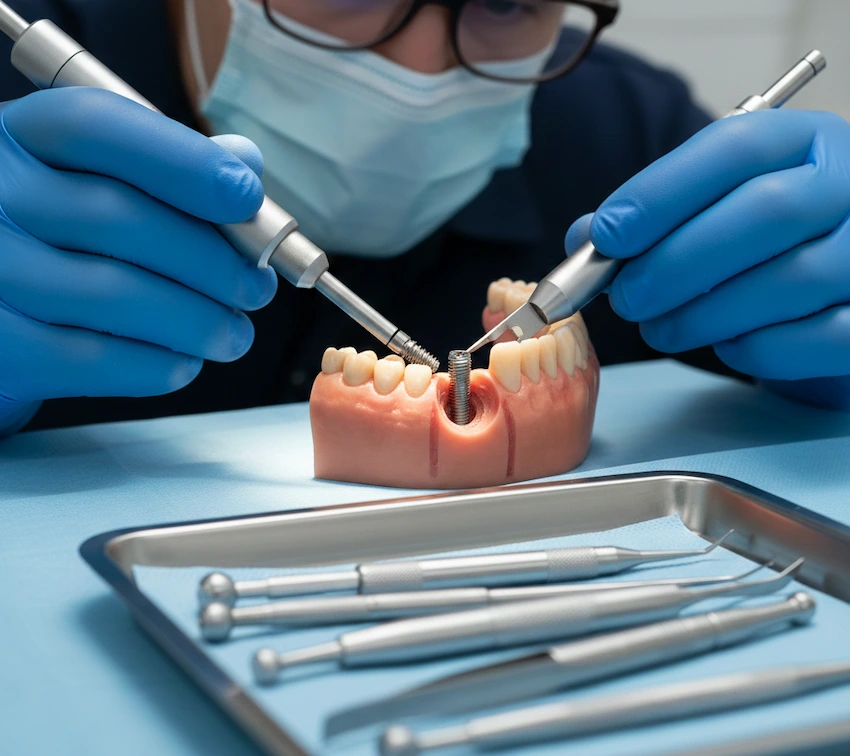
The fabrication of fixed dental prostheses is a multi-step process aimed at precision and patient comfort. Initially, a thorough consultation with a dentist, for instance, Dentist Polen Akkılıç and her team at Lema Dental Clinic, is required to check the overall oral health of the patient. Besides the gums, teeth, and jawbone, the whole oral cavity is inspected. After the initial check-up, a treatment plan is outlined which may necessitate imaging and digital scans to find the most effective way for prosthesis placement.
Once the work-up is done, dental impressions are made and a tailor-made prosthesis is produced for a perfect fit. This procedure is essential in order to make sure that the prosthesis is not only fitting the patient’s mouth but also is compatible with the patient’s natural bite and facial anatomy. The prosthesis, once available, is firmly installed with the help of modern methods, and a few final touches are made to ensure the patient is comfortable and the prosthesis functions well. In fixed prostheses, patients will be able to enjoy the functions of eating, speaking, and smiling without any removable dentures .
Advantages and Disadvantages of Fixed Dental Prostheses
Advantages
- Stability: Fixed dental prostheses are highly stable as a result of their close attachment, thus, providing better stability than removable dentures. As a result, they do not slip or move, therefore patients can feel more comfortable.
- Improved Aesthetics: It is a fixed dental prosthesis that is designed to resemble natural teeth and, therefore, blend with the natural teeth resulting in a more natural and attractive appearance. They do not only make the patient’s smile healthier, but also the patient more confident in social and professional environments.
- Enhanced Function: Since fixed prostheses are firmly secured, they facilitate the return of the functions of eating and speaking that are usually lost due to the absence of teeth. Patients are given the full functionality of their teeth; hence, their standard of living gets elevated.
- Long-Term Solution: Fixed dental prostheses may be with a person for a very long time if they are operated properly, thus, they are essentially a permanent solution for tooth loss. They have a lower probability of being replaced or adjusted than removable dentures.
Disadvantages
- Cost: Fixed dental prostheses in most cases, especially implant, are more costly than removable ones. However, the benefits over time will probably be worth more than the initial price.
- Surgical Prerequisites: If it is a case of implants, a surgery is needed to put the titanium post into the jawbone. Even if it is a usual operation, it is still more aggressive than just getting removable dentures.
- Maintenance: Patients with fixed prostheses may be less demanding in terms of maintenance than those with removable dentures but they still need to maintain good oral hygiene so as not to have complications like gum disease and implant failure.
- Bone Density Requirements: For example, with dental implants, adequate bone density is needed for a successful placement. Some patients will have to undergo a bone grafting procedure before they can get dental implants.
Who Should Get Fixed Dental Prostheses?

Fixed dental prostheses are an excellent option for those who have lost either a single tooth or multiple teeth and are seeking a permanent solution. In particular, these devices provide a significant relief to those who, due to discomfort or difficulty in the function, cannot remove their dentures. Dentist Polen Akkılıç and her team at Lema Dental Clinic, assess the oral health and condition of the patients to make a decision whether they are eligible for fixed prostheses. In essence, people with good oral health, sufficient bone density for implant placement, and the desire to maintain their dental health in the long run, are the perfect candidates.
Fixed dental prostheses are the instruments that individuals suffering from severe dental caries, a traumatized oral cavity, or widespread tooth loss should primarily consider as they accomplish a safe, trustworthy way of both aesthetic and functional rehabilitation. Nevertheless, individuals with certain health problems and low bone density may only be permitted to get dental implants after undergoing a series of other necessary interventions, such as bone grafting. Therefore, the only method to find out the best solutions is to see a professional and experienced dentist for a comprehensive examination and treatment planning.
Frequently Asked Questions About Fixed Dental Prostheses
One of the main differences is that dental bridges are supported by the adjacent healthy teeth, while dental implants are anchored in the jawbone and thus become a very stable base for the artificial teeth.
Generally, fixed dental prostheses are more comfortable because they are firmly secured and therefore do not change positions or move like removable dentures.
Basically, fixed dental prostheses are theoretically able to last anywhere from 10 to 20 years and may even be a lifetime in some cases if they are given proper care.
If gum disease is so severe that it needs treatment, then the treatment would have to be done first before the fixed dental prostheses as the health of the gums is very important for their survival.
In a very few cases hard to pinpoint, these risks, for instance, local infection, implant failure, or nerve damage, are mentioned, however, dental implant surgeries are generally quite safe. The process of a detailed examination by an expert dentist will certainly make these risks less.
- Akkılıç, P., & Yıldız, C. D. (2021). Advancements in dental implants and fixed prostheses: A clinical perspective. Journal of Prosthodontics, 30(5), 221-229.
- Pjetursson, B. E., & Sailer, I. (2020). A systematic review on the survival and complication rates of fixed dental prostheses. Clinical Oral Implants Research, 31(7), 1189-1201.
- Saridakis, D. A., & Mehra, P. (2019). Fixed dental prostheses: Techniques and materials for modern restorations. International Journal of Prosthodontics, 32(3), 283-290.

