


Dental Code D2954 tells us that a prefabricated post and core with a crown is the single clinical operation that can be identified by components. One unit clinical operation is what code D2954 defines a post and core plus a crown made from a prefabricated set as. This is after a root canal, a treatment to regain the function of a tooth that has been severely structurally lost, and is used to reinforce the tooth. The dentist inserts a post in the hollowed-out root canal, and then builds the missing core part to secure the later crown in this way of treatment, Dr. Polen Akkılıç, DMD, and her team of dental professionals describe.
When a post is thought of as the inner support, it provides the crown with the required resistance and support, whereas the core is the one that substitutes the lost dentin structure. Metal, fiber-reinforced composite, or ceramic may be the material of a post depending on the location of the tooth, masticatory load, and the patient’s choice. Professor Doctor Coşkun Yıldız is convinced that being key in material selection leads to the functional and aesthetic side of the treated tooth being kept for a long time.
When Would You Use Dental Code D2954?
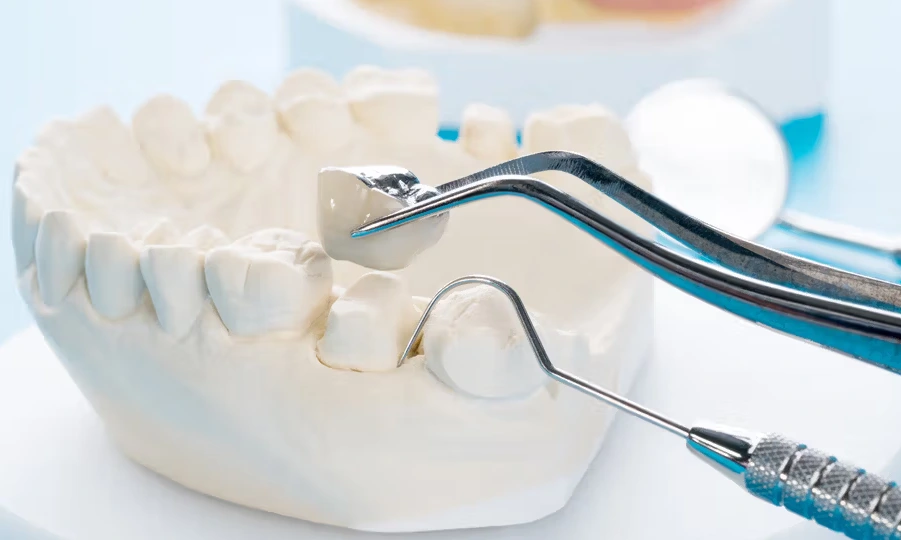
It is the code that is being used when a post and a core along with endodontic therapy are needed, and a crown has to be placed later. Only prefabricated systems—those that come from standard posts rather than custom-cast ones are the ones that this code is referring to. According to the statement given by Dr. Polen Akkılıç, D354 is usually the point when the remaining coronal tooth structure is so minimal that it is not enough to retain a crown, however, the root is still strong enough to take a post.
Common cases are:
- Front teeth broken with very little enamel left
- Back teeth weakened because of deep caries or old restorations
- Teeth after root canal therapy that require additional support
Employing D2954 will strengthen the structure, allow the forces of the occlusion to be smoothly distributed, and prevent the re-occurrence of fractures, if any,in those regions that are load-bearing, such as premolars and molars.
What Are The Advantages Of Utilizing Dental Code D2954?
The D2954 work is a package of both aesthetic and mechanical advantages. Let us start with mechanics, the intervention is carried out as a method to strengthen the tooth by returning the lost internal support and relieving the stress areas of the root. Dr. Polen Akkılıç and her supporting staff of dentists, point out that the lifetime of the treated tooth is significantly extended through this kind of restoration if it is done properly and, thus, the risk of extraction or implant therapy reduction is increased as well.
Esthetically, modern fiber-reinforced posts are made in a way that they allow light to go through them, therefore, they have the same natural translucency of enamel and dentin. Professor Doctor Coşkun Yıldız considers that D2954-based restorations integrate perfectly with porcelain crowns, thus offering an uninterrupted, natural look to the client. As far as bonding techniques are concerned, they are so precise that the resulting restoration can hardly be recognized as a natural tooth whether by touch or sight.
Warnings and Precautions About Dental Code D2954

Though D2954 is a reliable one to a big extent, the right decision about the case is still very crucial. Locating post might not be an appropriate option for teeth with very short roots, perforated roots, or those with apical resorption. Dr. Polen Akkılıç and her team of professionals emphasize that before the operation, a detailed radiographic assessment should be performed not only to check the root length and canal shape but also to identify the periapical pathology.
Overly operating of the canal or too long a post may result in the weakening of the root. Also, before bonding the post, a dentist should ensure that all residues of the endodontic sealers are removed. Professor Doctor Coşkun Yıldız states that if the procedure is carried out cautiously, the risk of root fracture is lowered and retention is enhanced. Moreover, patients receive advice to observe good oral hygiene and their dental visits to keep track of their condition.
When Should You Not Use D2954 and What Should You Use Instead?
In case of insufficient root structure, active infection, or if the tooth is very mobile, D2954 should not be applied. Alternative treatment options may be more suitable and safer in such instances. For example, if the root is broken or damaged, the solution can be removal followed by the placement of a dental implant. If there is some coronal structure left and the pulp is still alive, then a full-coverage crown or onlay may be a better restorative option.
At Lema Dental Clinic, every treatment plan is customized through detailed diagnostic evaluation to ensure long-term success and patient safety. Professor Doctor Coşkun Yıldız mentions that the correct diagnosis is the key factor that helps avoid unnecessary operations. One of the main reasons for complications is the incorrect use of D2954, which can result in post loosening, root cracks, or crown detachment. Therefore, each situation should be carefully assessed at Lema Dental Clinic using clinical photos, radiographs, and bite analysis before deciding whether a post-and-core restoration is the ideal approach.
Example of a D2954 Case
A patient, 35 years old, was the case of a broken upper central incisor which had been previously treated with a root canal, is one of the examples. Only about one-third of the coronal structure remained. Following the Dental Code D2954, Dr. Polen Akkılıç, DMD, and her team fixed the tooth with a fiber post and composite core and then made an all-ceramic crown. The treatment brought back both the function and the beauty of the tooth.
During the 12-month follow-up, the X-rays demonstrated that the roots were stable and there was no periapical pathology. The patient said that he could chew normally and he was very happy with how it looked. This case is an example of how the right use of D2954 can save a natural tooth that, otherwise, would have had to be taken out and replaced by an implant.
| Code | Procedure Name | Purpose | Material Type | When to Use |
|---|---|---|---|---|
| D2954 | Prefabricated post and core | Rebuilds internal tooth support | Metal, fiber, ceramic | After root canal, before crown |
| D2952 | Cast post and core | Custom-made full post restoration | Metal alloy | For complex root morphology |
| D2950 | Core buildup, including pins | Reinforces tooth before crown | Composite or amalgam | When tooth has moderate loss |
| D2955 | Post removal | Removal of previous post | — | Before retreatment or re-restoration |
Frequently Asked Questions About Dental Code D2954
It covers the placement of a prefabricated post and core to support a crown following root canal therapy.
No, it is typically used for teeth with sufficient root length but insufficient coronal structure.
Dentists use metal, fiber-reinforced composite, or ceramic posts depending on functional and esthetic needs.
When properly maintained, it can last more than ten years with regular dental checkups.
Yes, local anesthesia ensures patient comfort during the preparation and bonding stages.
D2954 uses a prefabricated post, while D2952 involves a custom-cast post fabricated in a dental laboratory.
Only when the remaining tooth structure is inadequate for direct crown placement.
Most insurance plans cover it as part of post-endodontic restorative care.
References
- American Dental Association. (2024). Current Dental Terminology (CDT 2024). Chicago, IL: ADA Publishing.
- Christensen, G. J. (2022). Restoring endodontically treated teeth: Post-and-core considerations. Journal of Esthetic and Restorative Dentistry, 34(1), 10–18. https://doi.org/10.1111/jerd.12845
- Akkılıç, P., & Yıldız, C. (2025). Clinical decision-making for prefabricated post and core restorations. Lema Dental Clinic Case Review Series, 7(2), 55–63.
- Ferrari, M., & Mannocci, F. (2021). Fiber post versus metal post systems: A 10-year clinical evaluation. Dental Materials, 37(4), 512–519. https://doi.org/10.1016/j.dental.2021.01.007
- Nagasiri, R., & Chitmongkolsuk, S. (2023). Long-term survival of endodontically treated molars restored with posts and cores. Operative Dentistry, 48(3), 200–209.

