


Dental abscesses are gum or root infections treated with drainage or root canal.
Pain is a language. It is the way of your body screaming that the line has been crossed. When that pain comes from deep inside the jaw or throbs with a fever, it is rarely just a “sensitive tooth.” More often it is an abscess—an infected pocket that behaves like a pressure cooker inside your mouth.
At Lema Dental Clinic in Turkey, we encounter patients who come to us with various degrees of distress. Some have a dull pain they have neglected for weeks; others are unbearably painful and cannot sleep or eat. The truth is, an abscess cannot heal by itself. It needs intervention, accuracy, and a steady, skilled hand.
“Knowing what is going on under your gums” means finding out the root cause of your pain. Once you have that, you can easily get rid of the pain. Internal problems like gum disease inflammation,
What Is a Dental Abscess?
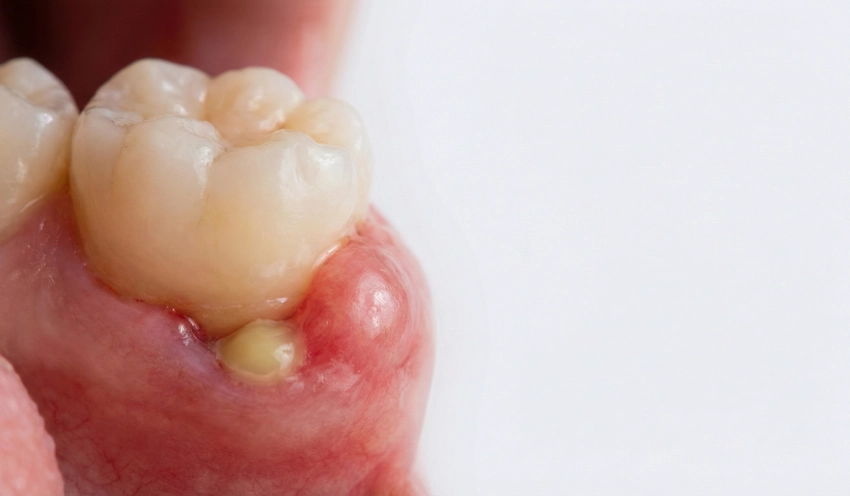
Imagine your tooth is a house. The enamel is the roof, the dentin is the walls. There is the “living room”—the pulp chamber—where nerves and blood vessels are located. When germs get in through the roof or walls (due to decay or a crack), they open their dirty invasion into the living space.
As a result, your immune system tries to fight the bacteria. The battlefield detritus—white blood cells, dead particles, and bacteria—accumulates pus. Since the tooth is hard, this liquid has nowhere to go. The pressure increases. The pressure is the pain you feel when it hurts.
The Three Main Types: Know Your Enemy
Different abscesses differ from each other. From our experience at Lema Dental Clinic, accurately finding the type of abscess is the first step in deciding whether a tooth is saved or if surgery should be considered.
1. Gingival Abscess (The Surface Warning)
This type is the simplest form. It affects only gum tissue (gingiva), and the tooth and periodontal ligament remain unaffected. Usually, it results from a foreign body such as a popcorn kernel or a poppy seed getting forcibly lodged between the gum and tooth, which leads to the localized infection.
2. Periapical Abscess (The Deep Danger)
Most of the abscesses we have to deal with are this kind. It involves the soft tissue at the core of the tooth and extends down past the apex (tip) of the tooth’s root. Usually, it is a cavity or a broken tooth that causes it. If you visualize a dying tree from the inside so that finally the rotten wood hits the ground, that is a periapical abscess.
3. Periodontal Abscess (The Foundation Fracture)
Gum infection and bone support of the tooth are the main areas of origin for this abscess. The infection is most frequently found in gum disease patients. A gap between the tooth and the gum creates an area where bacteria thrive and multiply.
Doctor’s Note: Periapical and periodontal abscesses may also be combined. Dentist Polen Akkılıç and her team are known to use advanced 3D imaging to differentiate such overlapping issues to make sure their treatment plan really hits the target.
Symptoms: When to Book Your Flight to Turkey
How do you know it’s an abscess and not just sensitivity? Most often the signs are so clear that there is no mistake.
- Intense, unremitting toothache: A pain that seems to “bounce” from the tooth to the jawbone, neck, or ear
- Assessing heat or cold: Pain becomes unbearable when exposed to hot coffee or cold water.
- Fever: The infection has gone systemic.
- Swelling: Looks like your cheek or face is puffed up.
- Gum “pimple”: A bump on the gums (fistula) that bursts, draining an unpleasantly tasting fluid.
Do not rejoice if the pain suddenly goes away. It may mean only that the nerve is dead and the infection is still alive and spreading silently into the jawbone.
Treatment: How We Resolve the Infection
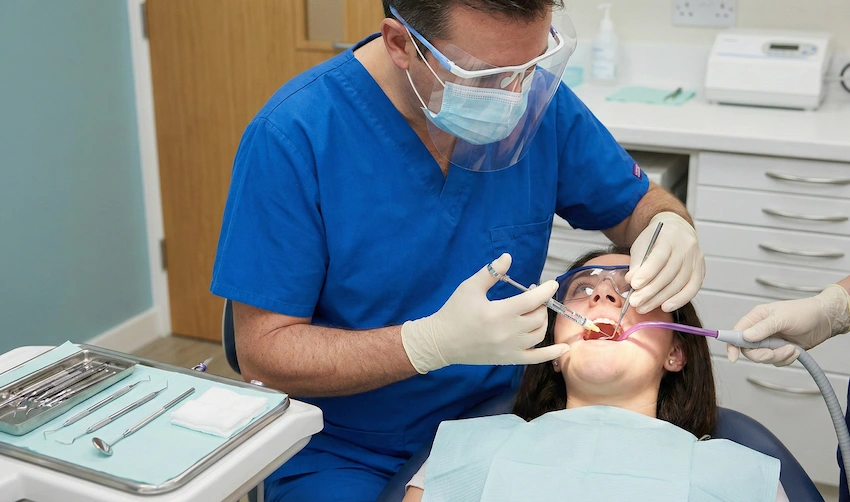
The objective remains constant: remove the infection and keep the tooth if possible.
Step 1: The Drainage
The first thing to do is to get rid of the pain and pressure. In some cases, it might be required to make a very small incision in the abscess to allow the pus to flow out. The ripping pain disappears almost immediately.
Step 2: The Cleanup (Root Canal or Deep Cleaning)
A root canal is the usual course of treatment for a periapical abscess. The dentist removes the infected pulp and fills the chamber. For periodontal abscesses, Dentist Polen Akkılıç may do a deep cleaning (scaling and root planing) to eliminate the gum pockets.
Step 3: Surgical Intervention
Sometimes the harm is great beyond repair. If the tooth is hopeless, the dentist has to pull it out. Professor Doctor Coşkun Yıldız comes in at this stage. With his oral and maxillofacial surgery background, he is the one to entrust with complicated tooth extractions and bone grafting surgeries. Loss of tooth notwithstanding, the plan for restoration goes ahead without delay—usually, dental implants are the method of choice so that you won’t be walking out of Turkey with a space in your smile.
| Abscess Type | Location | Primary Cause | Typical Treatment |
| Gingival | Gums (Surface) | Trapped food or foreign object | Removal of object, drainage, saline rinse |
| Periapical | Root Tip | Untreated decay or cracked tooth | Root canal therapy (RCT), crown |
| Periodontal | Gum Pocket | Advanced gum disease | Deep cleaning, drainage, antibiotics |
| Combined | Root & Gum | Severe decay + gum disease | Complex surgery, often extraction |
FAQ: The Doctor Is In
A warm salt water rinse might temporarily lessen the irritation and draw a little fluid from the surface, but just doing this won’t get rid of the infection as the bacteria are hidden deep within the tissues or bones. You require professional drainage and, in some cases, antibiotics.
It is a huge misconception that we keep hearing and fighting against. Abscess causes pain and the treatment takes away the pain and brings comfort. Lema Dental Clinic is making use of local anesthesia (and sedation, if the patient wants) to make the patient experience absolutely no pain during the operation. Most people say that they feel a huge relief right after the pressure is taken away.
The difference in pressure between the cabin and the environment on the ground can really increase the tooth pain to an unbearable level. However, quite a few of our patients come for an emergency treatment trip. To arrive at our clinic in Istanbul painlessly, the most optimal way would be to see a local dentist first for antibiotics and painkillers.
The basic drainage is a matter of several minutes only. It may take one or two sessions to complete a root canal. You can plan your stay with us for a full smile makeover along with this treatment in such a way that you will still have time to enjoy Istanbul.
Don’t be so unreasonable, please. An untreated abscess is likely to form a cyst in the jawbone and even sepsis (a life-threatening infection of the bloodstream). By neglecting it, the infection might also spread to the soft tissue of the neck and brain. This is a dental emergency .
- Bender, I. B. (2000). Periapical pathology: Etiology and diagnosis. Dental Clinics of North America, 44(4), 679-696.
- Gomes, B. P., et al. (2013). Microbiological findings of periapical abscesses and their association with clinical features. International Endodontic Journal, 46(8), 711-720.
- Matthews, D. C., et al. (2003). Acute periodontal abscesses. Journal of the Canadian Dental Association, 69(10), 660-664.
- Robertson, D., & Smith, A. J. (2009). The microbiology of the acute dental abscess. Journal of Medical Microbiology, 58(2), 155-162.
- Sanders, J. L., & Houck, R. C. (2023). Dental Abscess. StatPearls Publishing.

