


Too much denture adhesive can cause irritation, poor fit, and health risks.
Every week in our practice, we come across patients who are struggling silently. They are the ones who sit in the dentist’s chair. They feel quite naturally frustrated. Their whole morning really depends on the tube of dental glue.
Frequently, this question pops up: how much adhesive should I apply to keep my teeth fixed?
Usually, the truth is, patients most of them by far end up using way too much product. If your teeth are so dependent on the use of pastes and powders only to be able to stay in your mouth, that is, in fact, a major warning signal, to the point that there are further, deeper structural issues that go unnoticed. This is precisely the reason why we have decided to shed light on adhesive rules that are clinically backed, and beyond a doubt, we will also disclose the health risks that overuse of the same entails; not only that, we will even reveal the modern-day ways that are totally glue-free.
Standard of “Pea-Sized” Amount: You Shouldn’t Use any More than Necessary
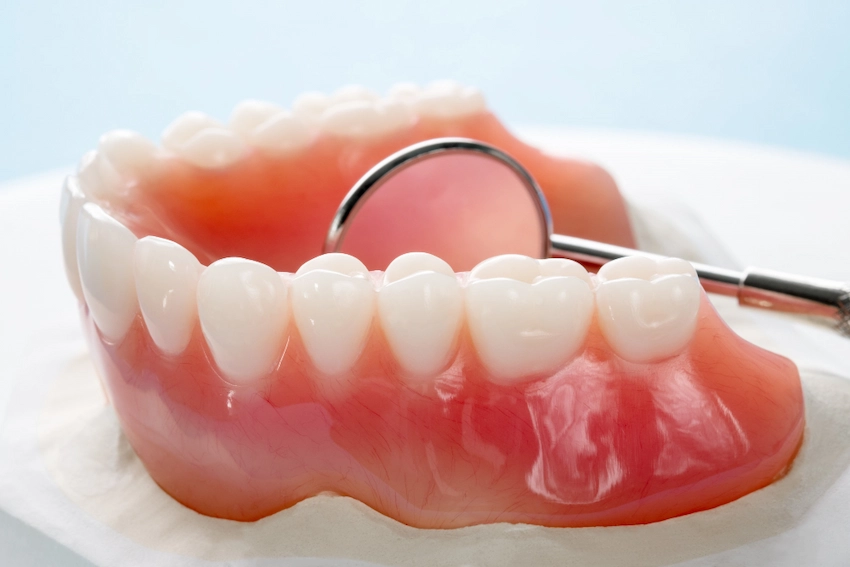
The proper way to apply glue in an indirect way is, again, precision. Non-excessive matter usage shall also be handled,d as well as respective volume, so as not to be switched on each other. So, think not of denture adhesive as a robust glue of the strong kind, but only as a microsealant at the level of individual cells. You’re just aiming to seal the tiny gap between the acrylic base and your soft gum tissue. This keeps food particles out.
To get this seal, three to four pea-sized droplets of glue will suffice.
- For Upper Dentures: First, put one small drop where the roof of the mouth is. Then put three more drops along the ridge.
- For Lower Dentures: First, put three small drops that are equally spaced along the horseshoe shape.
Glue that emits from edges upon biting is evidence that you have applied too much. A thicker line of paste does not yield a stronger hold. On the contrary, it affects your bite alignment. It blocks acrylic from resting against gums. It is like trying to lay a brick on a flooded layer of wet cement. It simply slides around.
Why More Isn’t Better: The Medical Risks
However, let’s just examine more minutely what can result if you resort to the use of too much glue. It’s not just a mess and inconvenience but also a serious health threat.
Health Hazards from Zinc
Most denture adhesives have zinc in their composition. This element helps to make them the most effective. Only a little zinc is a normal part of your diet. Poorly placed daily applications of denture glue can cause exposure to hazardous levels of zinc.
The first symptom of zinc toxicity can be unexplained numbness. You may even have a tingling sensation in your hands and feet, and in extreme cases, you can even get nerve damage due to excessive zinc exposure. If you find that you need to be applying glue to your dentures not once or twice but several times a day to eat, then you are, in effect, doing serious harm to your health.
Fast Bone Deterioration
On a fairly straightforward level, bone in the jaw behaves very much like muscle. And, like muscle, it needs regular exercise if it is to remain strong and well developed. Naturally, even tooth roots will give the necessary ‘workout’ to your jaw bone when you chew. If you lose teeth, then that vital stimulation is discontinued. As a result, the jaw bone gets smaller and smaller with time, and even minerals may get lost.
When the bone shrinks to the point where your denture no longer fits, the more you will use the adhesive to compensate for this expanding gap. This is the cycle, which can be vicious. Indeed, the glue-filled denture exerts heavy, uneven pressure, which, in turn, accelerates the destruction of your jawbone.
The Professional Take on Heavy Adhesive Usage in Turkey
Actually, based on our clinical experience at the Lema Dental Clinic in Turkey, a very strong adhesive is a definite sign to us that your underlying structure or foundation is falling apart.
Professor Doctor Coşkun Yıldız always points out a simple matter of fact. The problem of trying to hold down a denture, which is loose and moves around, with the use of a paste or glue is that it is equivalent to putting a band-aid on a broken foundation. The support structure is simply not there. When patients come to our dental clinic in Istanbul internally complaining about the loose dentures, we don’t just want to give attention to the adjustment of the plastic. The principal thing would be to reconstruct the biological foundation.
Dentist Polen Akkılıç and her team are not only concerned about advanced solutions. We are supporting our patients to change out of removable plastics. Instead, we are directing them towards permanent, implant-supported teeth.
An Overview of the Differences: Glue vs. Implants
The following is an approximate description of the situation when we put the spotlight on the old-fashioned set of dentures and the state-of-the-art implants:
| Feature | Traditional Dentures (with Glue) | Implant-Supported Fixed Bridges |
| Daily Routine | Daily, get your hands dirty applying and scrubbing the denture. | Brushing and flossing naturally, like real teeth. |
| Bite Force | Chew with only the power equal to 20-30% of your natural capacity. | Return to 95% of the natural chewing power of your teeth. |
| Bone Health | Cause your jawbone to deteriorate due to attrition. | Help preserve the jawbone by acting as artificial roots. |
| Dietary Limits | Hard, sticky, or crunchy foods will be close to impossible to eat. | Free of restrictions. You can have an apple or steak without concerns. |
| Comfort | Plastic is bulky and covers the mouth roof, dulling taste. | Smooth Zirconium shape. The mouth roof is totally free. |
What to Do Instead of Using Glue
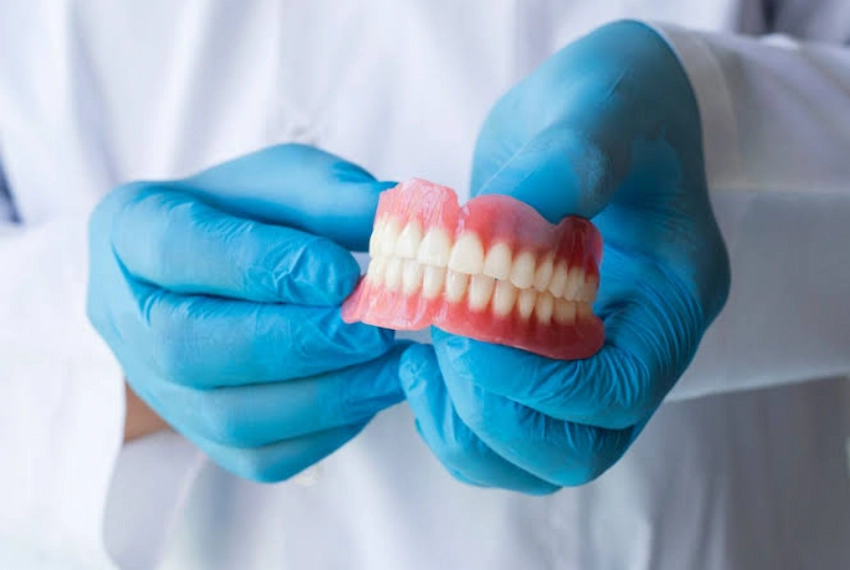
So, the question remains: for what reason do you want to keep dealing with the problem of a system that is failing? There is still modern dentistry offering the complete and permanent treatment.
With the help of the latest techniques, including Zygomatic implants or All-on-6 systems, teeth made of Zirconium can be fastened directly into the bone of the patient. You come with a plastic piece that needs constant care in the form of maintenance. However, the dream is about to be turned into reality with a permanently fixed, beautiful smile. No more paste. No more soaking of the teeth in a glass. You will never again have to worry about your teeth slipping mid-conversation.
Frequently Asked Questions
“Doctor, I cracked my denture. Can I use extra adhesive to glue the plastic back together?”
Definitely not. Adhesive is strictly meant for soft gum tissue that is soft. Acrylic won’t be bonded by it. What’s more, a broken denture may cause cuts in your gums and also harm your jaw joints. Take it off right away and get in touch with our clinic.
“How do I get rid of the sticky residue on my gums safely at night?”
I have been there with that stickiness, and I understand how irritating it is. Do not, however, aggressively brush your gums with a hard toothbrush. Instead, use a soft washcloth soaked in warm water. Gently massage your gums in circles. This loosens the glue safely and also stimulates blood flow.
“So I use a zinc-free adhesive. Does that mean I can actually use any amount that I want?”
No. Although you have eliminated the risk of zinc poisoning, the use of an excessive amount of the paste is still a very bad sign. It means that your denture is not doing its job well in terms of fitting. You will still get mouth sores, and your jawbone will continue to deteriorate at an accelerated pace when you wear it. Besides that, a professional reline or getting new teeth are among the steps that you should consider.
Relining my dentures, will that get me out of the glue dependence?
A hard reline will fit the plastic to the current shapes of your gums. For a few months, it will fit much better. But the jawbone will keep shrinking. And the denture will become loose again eventually. So, it is just a temporary fix, not a permanent cure.
My local dentist told me that implants are not possible as my bone is too thin. Am I bound to use glue forever?
On the contrary! Dental tech has been evolving at a fast pace. It is quite normal for us at Lema Dental Clinic to get cases of patients with almost no bone left here and there. Techniques like Zygomatic implants are the ones we use for anchoring the teeth securely to the dense cheekbone. This means that a bone graft is often not even necessary.
Academic References:
- Carlsson, G. E. (2014). Implant and root supported overdentures – a literature review and some data on bone loss in edentulous jaws. Journal of Advanced Prosthodontics, 6(4), 245-252.
- DeVatt, L. A., & Bagramian, R. A. (2010). Zinc toxicity and denture adhesives: A review of the literature. Journal of Prosthetic Dentistry, 104(3), 200-204.
- Felton, D., Cooper, L., Duqum, I., Minsley, G., Guckes, A., Haug, S., … & Sweitzer, C. (2011). Evidence-based guidelines for the care and maintenance of complete dentures: A publication of the American College of Prosthodontists. Journal of Prosthodontics, 20(s1), S1-S12.
- Grasso, J. E. (2004). Denture adhesives: changing attitudes. Journal of the American Dental Association, 135(1), 81-86.
- Malo, P., de Araújo Nobre, M., Lopes, A., Macroux, M., & Francischone, C. E. (2011). “All-on-4” immediate-function concept for completely edentulous maxillae: a clinical report on the medium (3 years) and long-term (5 years) outcomes. Clinical Implant Dentistry and Related Research, 13(s1), e109-e117.

